

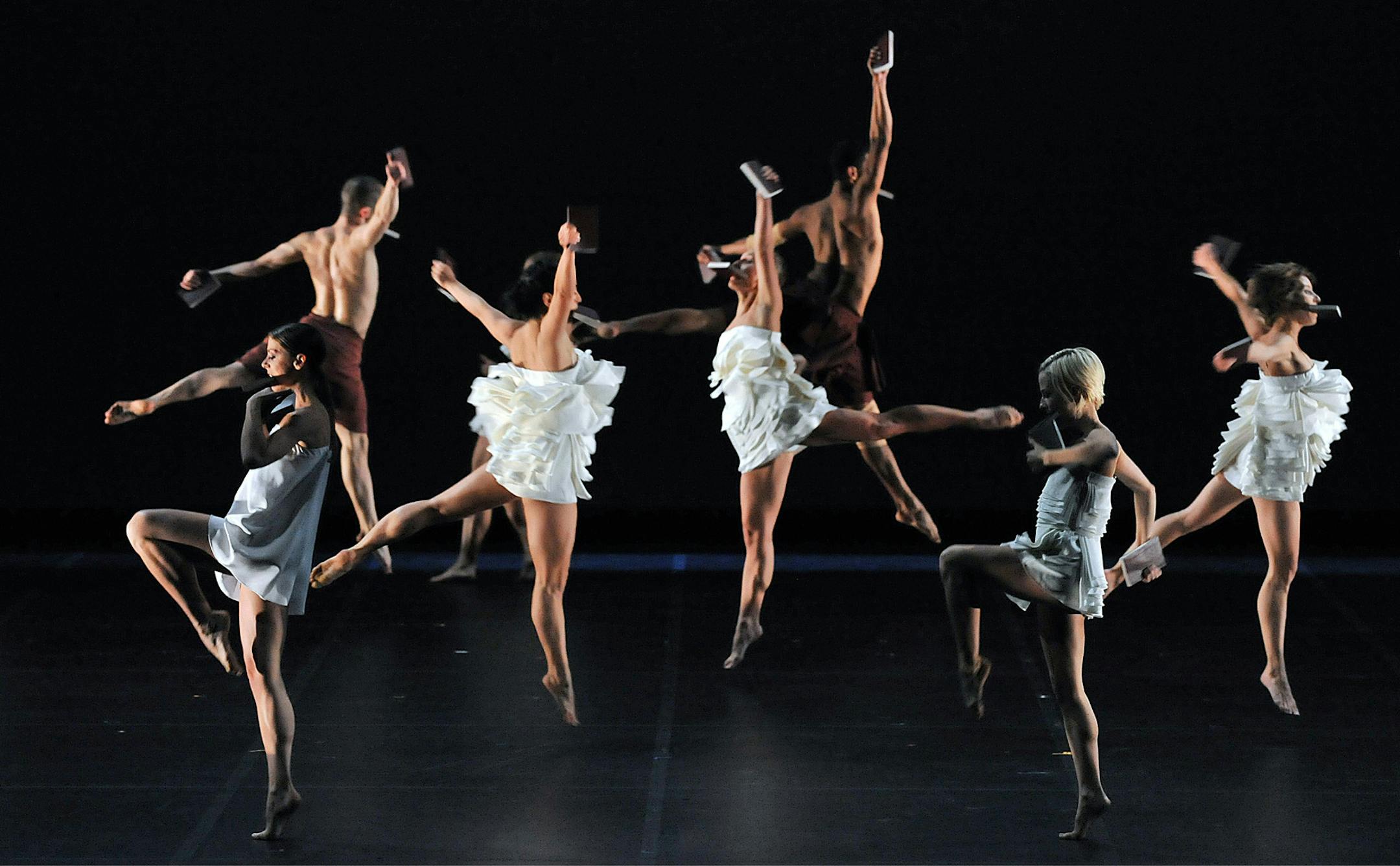
How to make a dance work about Armageddon? If you're Angelin Preljocaj, the first thing you do is leave out the fire and brimstone.
So while the choreographer draws inspiration from the Apocalypse of St. John (the Book of Revelation in the Bible's New Testament) he does not depict a cataclysmic end time or the wrath of an angry deity. Instead, his evening-length work, titled "And then, one thousand years of peace," considers the role humankind plays in its own demise. It will be performed this week by Ballet Preljocaj in a presentation by Northrop Dance at the Orpheum Theatre in downtown Minneapolis.
"For me, what's important is to ponder the present time and the society we live in," wrote Preljocaj in an e-mail. "The world [is moving backward] with intolerances, blockages, tensions that scare me." Recent domestic and global conflicts — whether based in politics, religion or culture — support this perspective.
The dance artist (who was born in Paris five days after his parents fled Communist Albania) chose to address his anxiety through movement. "The body can express many things that can't be put into words," he said. "In a sense, the body is a reflection of the soul. If I wanted to express myself in words, I would have written a book. But what I want to speak about is difficult for words, and as I am a choreographer, I created a ballet about it."
Beginning with the Bolshoi
"And then …" was created in 2010 through a collaboration between the nearly 30-year-old Ballet Preljocaj (based in Aix-en-Provence, France) and Russia's famed Bolshoi Ballet in Moscow. Preljocaj was drawn immediately to the Bolshoi dancers' superb technique and sense of history as well as the opportunity for his dancers to work on a project with another company.
"It was a new challenge," wrote Preljocaj. "These dancers are so particular. As well as having a perfect mastery of the [ballet] codes, they have a streak of madness, a sort of animal instinct. I thought of [Rudolf] Nureyev. The idea of a joint creation seemed obvious, even urgent." Dancers from the two companies have performed the work together in the years since, but only Ballet Preljocaj members will dance in Wednesday's show.
Inciting the senses
Local audiences who saw Ballet Preljocaj's "Snow White (Blanche Neige)" in April 2012 will recall that the company embraces a complete theatrical experience, one that incites the senses through an array of physical, aural and visual cues. For example, Preljocaj had the seven "dwarfs" rappelling, flipping and hurtling down the backstage wall. Fashion provocateur Jean-Paul Gaultier designed the costumes.
For "And then …" the choreographer asked techno music producer and DJ Laurent Garnier to create the pulse-quickening music and visual artist Subodh Gupta to generate the scenic elements. The props are particularly important, wrote Preljocaj, because they supply various meanings. "Chains are a reflection of the growing lack of communication between people in our societies," he said. "Books can refer to the biblical texts and the current rise of religions."


