

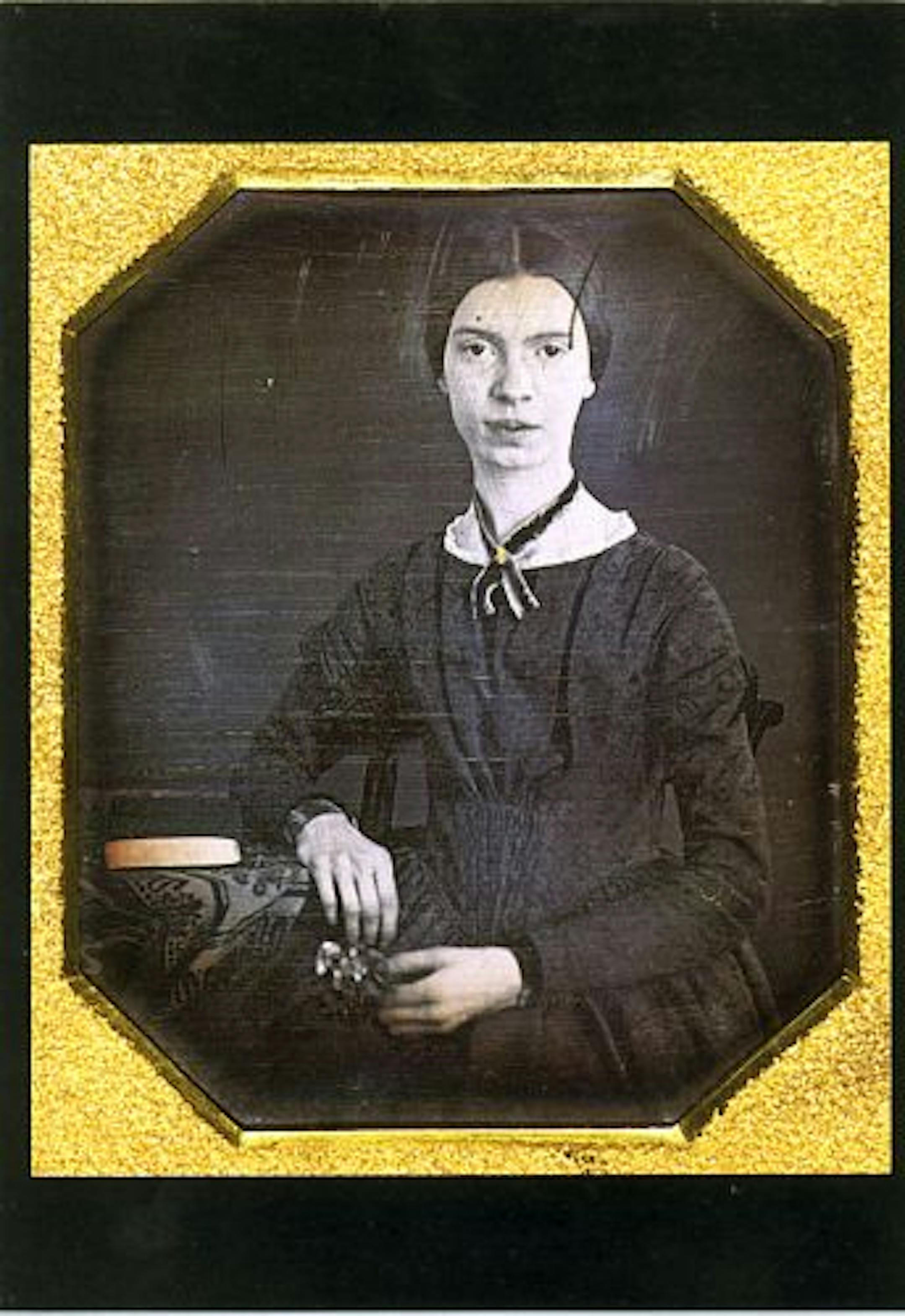
Emily Dickinson, legend has it, was a brilliant eccentric. Retiring to her father's house in Amherst, Mass., when she was in her 20s, Dickinson dressed in white, declined to receive most guests, and rarely left her room. She stored seventeen hundred and eighty-nine poems in a locked chest of drawers, giving little thought to publication.
Well, it ain't necessarily so. According to Lyndall Gordon, a senior research fellow at St. Hilda's College in Oxford, England, Dickinson's life and legacy were obscured for almost a century by "dust-heaps of slander and sentimental conjecture" originating in a family feud involving her brother's wife, his mistress and their children. The poet herself, Gordon argues, was "not, after all, invariably withdrawn," but a formidable, forceful and physical being, "merry to the point of hilarity" and determined to control "her dramas."
Because Dickinson was so artfully indirect, "leaving the red 'Fire rocks' below," Lyndall seems willing to risk the wrath of those who, like John Updike, dismiss biographies as "novels with indexes," with informed speculation about the poet's seclusion. While her guesses are several inches short of a slam dunk, "Lives Like Loaded Guns: Emily Dickinson and Her Family's Feuds" will keep Dickinson devotees busy for decades.
Gordon believes that Dickinson stayed home because she had epilepsy. Throughout her life, Gordon writes, ailments were "unnamed, shielded by cover stories." The medicines ordered for her were used to treat epilepsy -- and the stigma attached to the disease might explain why prescriptions were filled in Boston, even though a drugstore functioned in Amherst. And, Gordon points out, Dickinson's poetry ("I felt a Cleaving in my Mind - /As if my Brain had split-" -) "is replete with information about dysfunction and recovery."
Epileptics were discouraged from marrying in the 19th century, but that doesn't prevent Gordon's Dickinson from seeing "potentialities" in men she knew. "The supposed recluse, the image of white-frocked chastity," didn't object, Gordon suggests, when Otis Lord, a judge on the Massachusetts Supreme Court, swept her into his arms. That Dickinson didn't marry wasn't a tragedy, but a choice, decisive for her future as a poet: "no husband would have tolerated her timetable as her father did, and soon there would have been babies to fill the hours."
And so, Emily Dickinson remained a spinster, dependent in the end on two women to save and share poems jotted illegibly on stationery, brown paper bags, soiled subscription blanks and shopping lists. Two women, Lyndall Gordon reminds us, who hated one another but, unlike virtually all of their contemporaries, "fully recognized her greatness."
Glenn C. Altschuler is the Thomas and Dorothy Litwin Professor of American Studies at Cornell University.


