

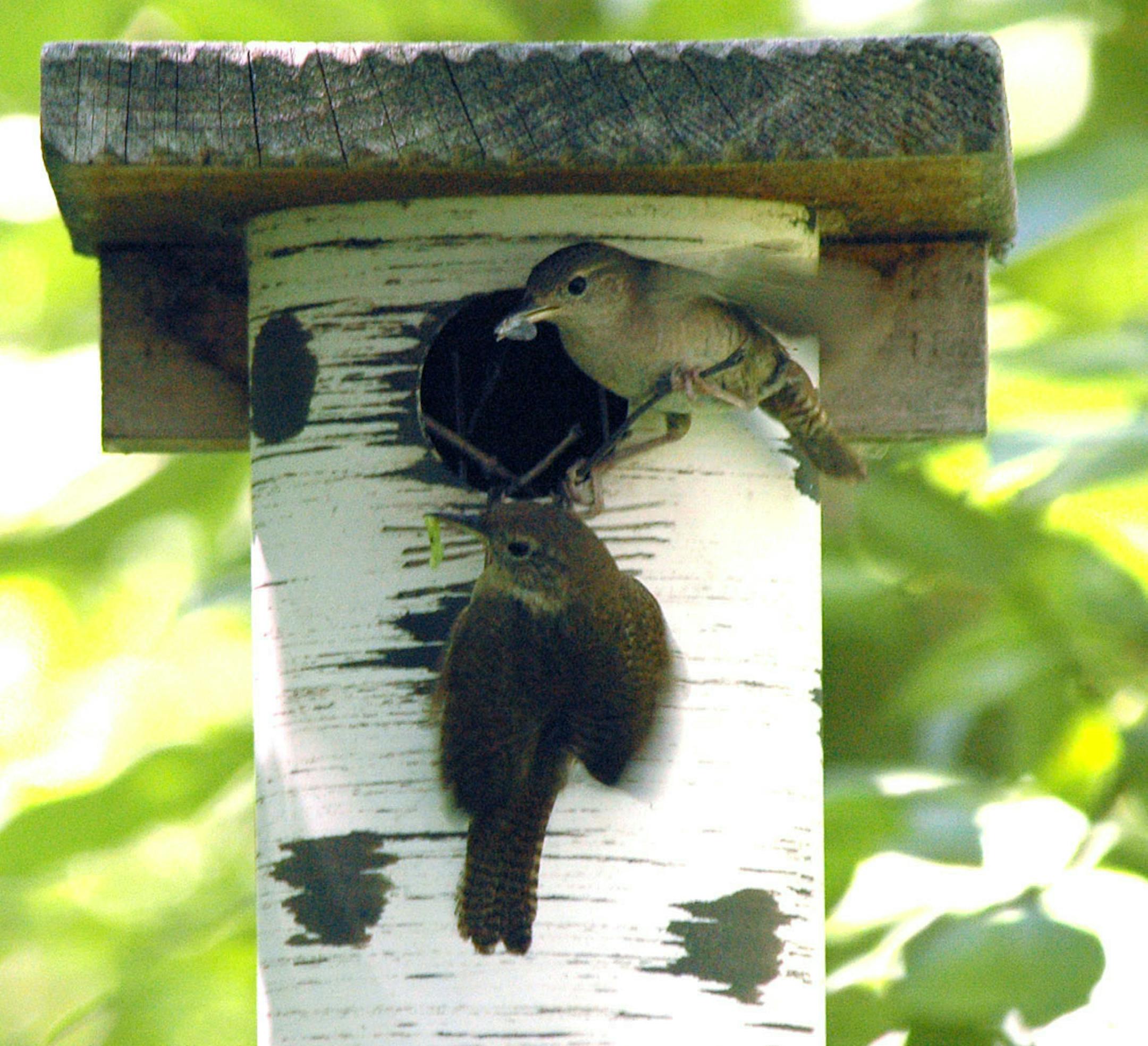
House wrens and spiders have a working relationship.
The wrens employ baby spiders as pest-control crews. The spiders eat mites, which is a good thing, because as many as 50,000 mites can be found in a single wren nest. Remember that number.
This unusual relationship came to mind recently when I was cleaning the wren nest boxes in our yard, after the breeding season was over.
We place one artificial cavity in each corner of our yard. Male wrens tend to choose a territory that offers multiple nesting cavities, natural or store-bought. They build partial nests in at least two of the cavities, usually more. Our male built in all four of our boxes.
A female wren is attracted to an area by a male's singing. But the female apparently pays more attention to the nests than to the male. She wants at least two nesting cavities from which to choose.
If she is happy with the real estate, she stays. And he, apparently, accepts any female who likes his taste in dwellings. If it's good enough for her, she's good enough for him.
"Apparently" is a good word to use when discussing the biology of many bird species. House wrens are among the most thoroughly studied of North American birds, in part because nest boxes make them readily available for research. Yet so much about them is unknown or uncertain.
The spider thing, though, has laboratory credentials. It's been established that male wrens purposely add a small number of spider egg sacs into the nests they build. And studies have proven that when the spiders hatch, they eat the mites.


