

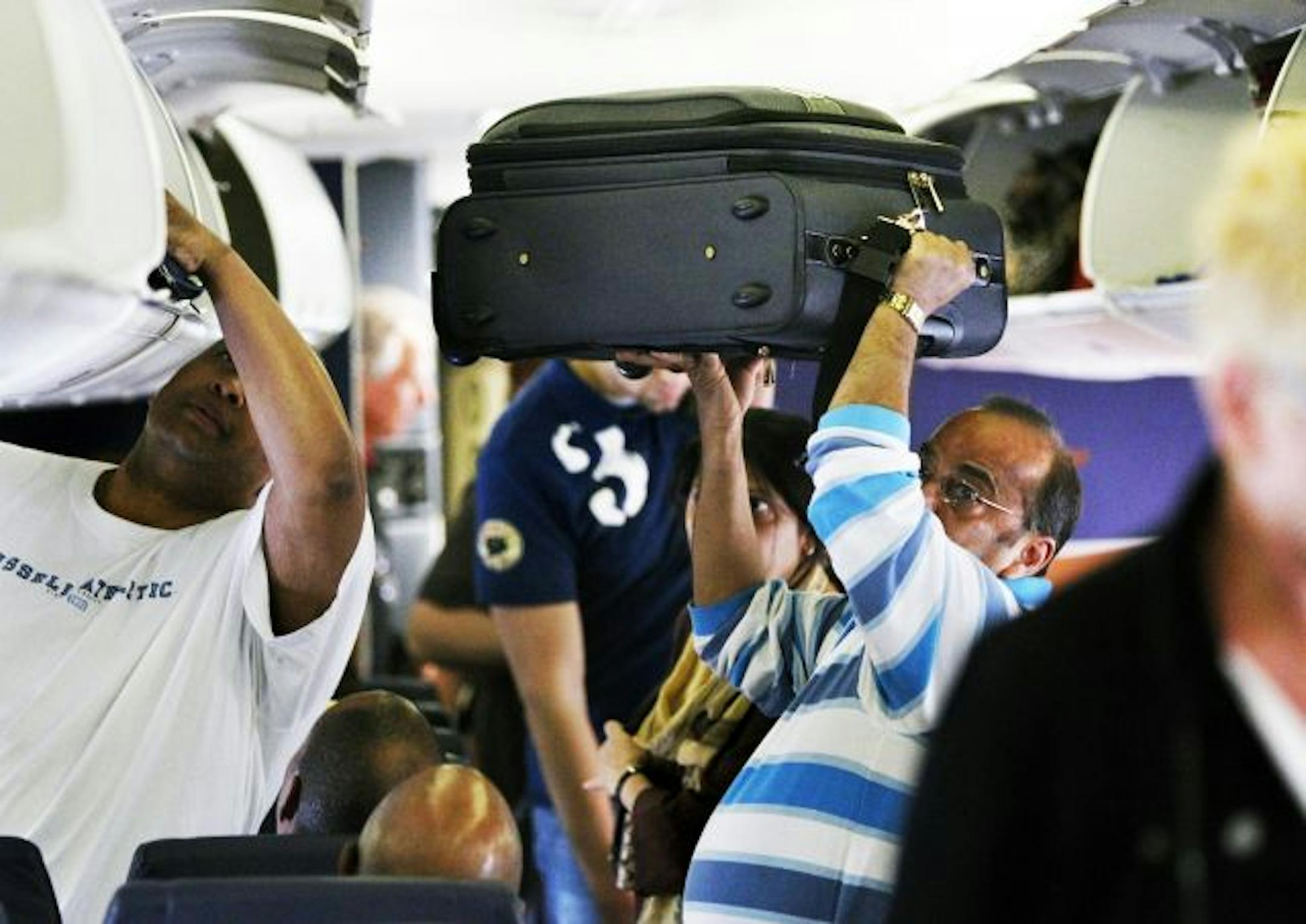
Not long ago, the challenge of carrying bags onto airplanes pertained to size. Would you be able to stuff that teeming roll-aboard into the overhead bin? It took a deft touch and several grunts, but at least the bag was within arm's reach.
Now the challenge is getting a bag on board. Since airlines began charging for checked baggage, more carry-ons have been frozen out. Being forced to check bags at the gate has become common. During preboarding announcements, airlines have taken to telling fliers that the last people on board essentially have no chance of their bags accompanying them in the cabin. Will this battle for overhead space resolve itself anytime soon? Well, sort of.
Gary Chris, a spokesman for Heath Tecna Inc., a Bellingham, Wash., company that designs and builds aircraft interiors, said his company has had steady orders during the last 18 months to expand overhead bins on existing aircraft (replacing the bins outright is too labor- and cost-intensive for many airlines; an expansion takes a mere 12 hours).
The benefit of expanded overhead space is twofold: Passengers are happier, and airlines are delayed less by checking bags at the gate.
Manufacturers Boeing and Airbus plan to add planes to their fleets with deeper overhead interiors, but those are "three or four years" away, Chris said. He described the future of airplane interiors as "more spacious, with maximum storage space." Future bins are likely to be built more deeply into an airplane's ceiling and sides and will swing down into the cabin when open. When closed, they'll be almost recessed, he said.
And yes, much of it can be traced to airlines' decisions to charge for checked baggage, he said.
In the short term, John Pincavage, an airline industry consultant, said that the battle for overhead space will continue to be a win-lose proposition, with plenty of travelers losing. He guessed that rather than charge for carry-on bags as Spirit Airlines started doing last year (as much as $45 per bag), airlines will charge in even more backhanded ways.
For instance, boarding earlier -- a guarantee of access to overhead bins -- will become more common as an extra charge. Eventually, however, he figures that charging for carry-ons will become more common. "It's all about incremental revenue," he said. "It will be a question of which fee you want to pay."


