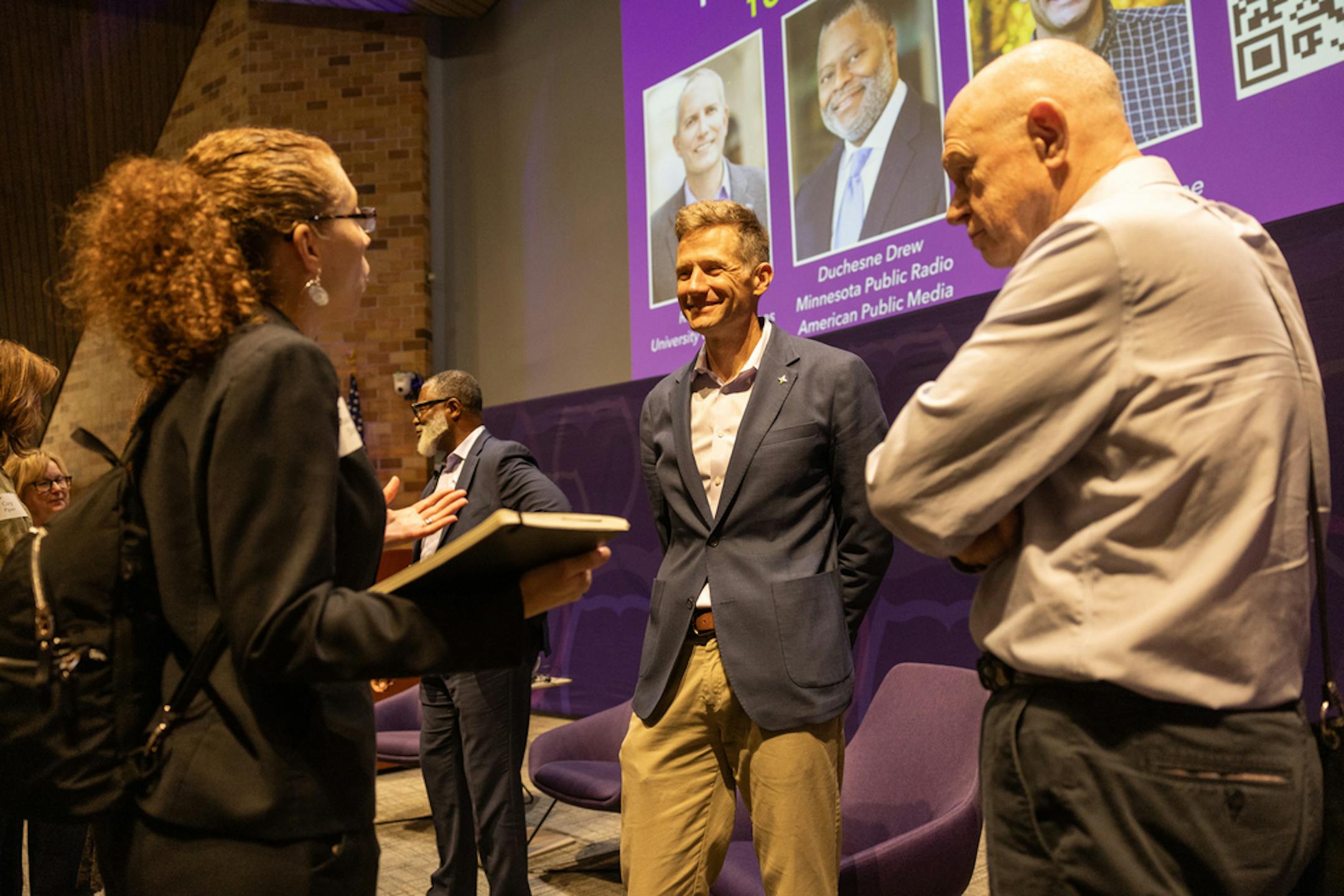
When the University of St. Thomas announced its recent Finding Forward event featuring Steve Grove, president and CEO of the Minnesota Star Tribune, and Duchesne Drew, president of Minnesota Public Radio, the friction and division surrounding the news media soon became evident.
“We got emails saying, how can this be ‘Finding Forward’ on the future of news media when you have two organizations that see everything through a liberal lens?” said Rob Vischer, president of the University of St. Thomas and the event’s moderator.
Allegations of bias, agenda-pushing, and media influence are not new, but they are intensified in today’s environment. These topics and more were on the table at Finding Forward, a speaker series at the University of St Thomas that aims to tackle controversial and divisive themes through discourse in a way that, as Visher said, “sheds more light than heat.”
Both Grove and Drew acknowledged that highly partisan views of news outlets, changes to the economics of journalism, shrinking newsrooms, a decline in media literacy, and the rise of news bubbles have forever changed the relationship between American society and the news media. Yet both hope the media can become a bridge rather than a source of division.
 2:43
2:43Rebuilding Trust by Reconnecting with Local Communities
It starts with trust, which for the media has eroded in recent decades. The news media bears some responsibility, Grove said.
In one powerful example, he shared that on a visit to the Leech Lake Indian Reservation, community leaders told him they no longer trusted the Star Tribune after a story ran many years ago.
“It was an investigative story about a murder on that reservation that I’m sure was impeccably reported in terms of just the facts,” he said. “But that’s the only story the Star Tribune wrote in 20 years about the Leech Lake Reservation. If that’s the only story you write, that’s the only perception people have of that place. And so of course, you got that community wrong.”