

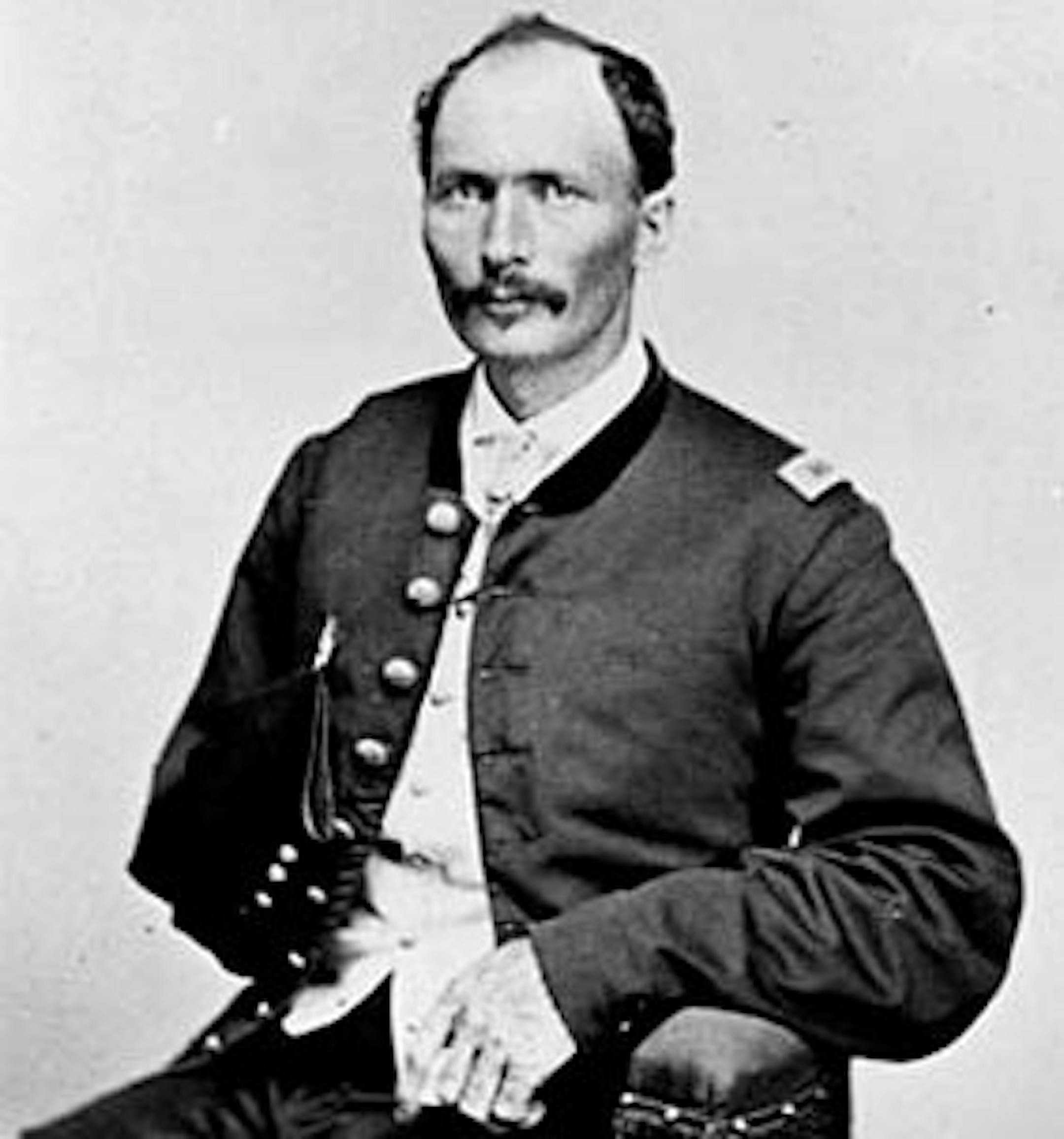
After the Civil War erupted in 1861, a 26-year-old brick maker named Axel Hayford Reed left his home in Glencoe, Minn., to join Company K of the 2nd Minnesota Infantry Regiment.
Two years into the war, Reed found himself under military arrest in Tennessee for writing a letter to the Nashville Union newspaper, complaining that soldiers' rations had been cut and distributed instead to "rebel citizens and deserters." The anonymous letter was traced back to him, prompting his superiors to jail him for breaching discipline.
"I spent last night in the guard-house, a prisoner for the first time in my life," he wrote in his diary in July 1863. A few days later, he added: "It is humiliating to be under arrest, but as long as I am not conscious of having committed any wrong, I do not feel in the least humiliated."
Within two months, Reed would go from hoosegow to heroics. On Sept. 19, 1863, while still under arrest, he bolted unarmed from his place in the rear, grabbed a wounded soldier's musket and fought with "distinguished gallantry" for two days at the Battle of Chickamauga in Georgia.
That was enough to drop the discipline charge and send Reed back into the fray. Two months later, on Missionary Ridge near Chattanooga, Tenn., Reed — by then commanding Company K — fired at a fleeing Confederate soldier mounting his horse.
Before he was able to load again, a minie ball "struck my right arm, shattering the bone for eight inches above the elbow," Reed wrote in a 1915 book he compiled about his family going back to the 1600s (you can read a digital version of the book at tinyurl.com/AxelReed).
Reed stanched the bleeding by tying a strap torn from his haversack above the wound. While Union soldiers celebrated their victory, he caught a ride on a mule-driven wagon to the Army hospital in Chattanooga 3 miles away, where the arm was amputated on Nov. 25, 1863.
After recovering from the wound, Reed declined to take a disability discharge and instead joined Gen. William Sherman's "March to the Sea," fighting through the war's end. The War Department cited his acts of bravery in 1898 when at the age of 63 he was awarded the Congressional Medal of Honor — the highest award granted by the United States for military valor.


