
Aw, rats! U of M study reveals that rats feel regret, too

We've all have regrets. Now, a surprising new study from the University of Minnesota shows that humans aren't the only ones to feel this way. Rats do, too.

June 14, 2014 at 10:36PM
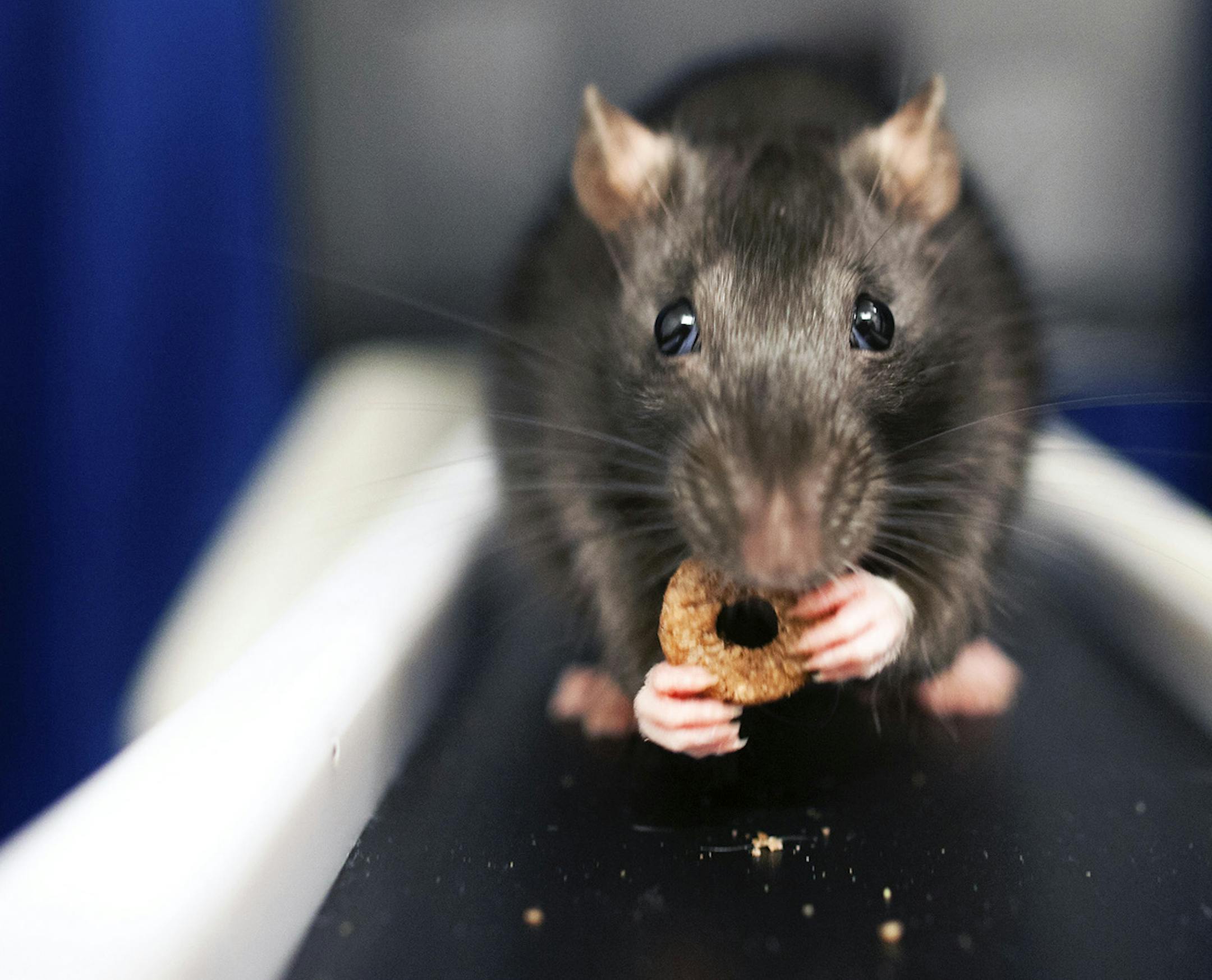
Thelma, a lab rat, pursues cereal on a sequential learning track used to measure activity in the cortex and hippocampus at the Kavli Institute for Systems Neuroscience in Trondheim, Norway, March 27, 2013. Dr. May-Britt Moser and Dr. Edvard Moser, a husband-wife team of neuroscientists at the institute, are exploring the way the brain records and remembers movement in space, which they speculate may be the basis of all memory. (Brian Cliff Olguin/The New York Times) ORG XMIT: XNYT49
Thelma, a lab rat, pursues cereal on a sequential learning track used to measure activity in the cortex and hippocampus at the Kavli Institute for Systems Neuroscience in Trondheim, Norway, March 27, 2013. Dr. May-Britt Moser and Dr. Edvard Moser, a husband-wife team of neuroscientists at the institute, are exploring the way the brain records and remembers movement in space, which they speculate may be the basis of all memory. (Brian Cliff Olguin/The New York Times) ORG XMIT: XNYT49 (The Minnesota Star Tribune)

We've all have regrets. Now, a surprising new study from the University of Minnesota shows that humans aren't the only ones to feel this way. Rats do, too.

David Redish, professor of neuroscience at the university and lead author of the study, has long been fascinated with decisionmaking. Specifically, why people make choices they are likely to regret.

So, for the past 14 years, Redish has researched the process that result in decisions — even bad ones.

"In a lot of cases, what you see is people making those decisions and regretting it the next day," Redish said.

When Redish began his research, he never thought he would claim that rats can show regret, a cognitive behavior thought to be unique only to humans.

(Regret is defined as recognizing a mistake has been made, "whereas disappointment is the recognition that the world is not as good as you had hoped," he explained.)

In an attempt to study decisionmaking in common lab rats, Redish and Adam Steiner, a neuroscience graduate student, strapped sensors on rats to track how they responded to different choices of food rewards. In the course of their research, Steiner noticed that when a rodent made a choice it didn't like, it stopped and looked backward, as if feeling some kind of remorse.

After observing that behavior in a number of rats, Redish and Steiner created an experiment, called Restaurant Row, designed to induce regret. Rats in the lab had to choose whether to wait for a food they liked, or move onto another food station, which may or may not have a favorite food.

The rats that did move on and found the next option less appealing showed regretful behavior — stopping and looking back.

The research led to the discovery that rat brains are very much like human brains when it comes to regretting a poor choice. In fact, humans and rats both show regret for a missed opportunity in the same area (the orbitofrontal cortex) of their brains.

Redish said his animal-model research is being translated to help comprehend how regret affects human decisionmaking when that process is broken, such as in addictions.

"There are questions we can now ask that we didn't know were questions," Redish said.

Redish called his discovery "groundbreaking," saying that it will help him expand his research.

"I live for days when somebody comes into my office and says 'Hey, have you seen what my rats are doing? Looks like they are showing regret,' " Redish said. "That's a great day."

Karen Zamora • 612-673-4647

about the writer

about the writer

Karen Zamora

See Moreicon

More from Minnesota Star Tribune

See More
card image
J. SCOTT APPLEWHITE, ASSOCIATED PRESS/The Minnesota Star Tribune

The "winners" have all been Turkeys, no matter the honor's name.

In this photo taken Monday, March 6, 2017, in San Francisco, released confidential files by The University of California of a sexual misconduct case, like this one against UC Santa Cruz Latin Studies professor Hector Perla is shown. Perla was accused of raping a student during a wine-tasting outing in June 2015. Some of the files are so heavily redacted that on many pages no words are visible. Perla is one of 113 UC employees found to have violated the system's sexual misconduct policies in rece