
At HCMC, a surprise drill in ER to deal with real emergencies

February 14, 2014 at 3:00AM
icon1:38
(Matt Gillmer/Matt Gillmer)

The nurse told the Hennepin County Medical Center residents that mass casualties were arriving from a bomb blast at a light-rail station.

The simulated scenario was sprung on the residents Thursday morning as they worked at stabilizing a child-mannequin with an asthma attack.

If they were surprised at the abrupt and dramatic reassignment, the residents didn't show it. They smoothly shifted over to care for patients with life-threatening injuries.

The simulation involved both mannequins and living colleagues from the hospital who stumbled in on their own or were wheeled in needing tourniquets, breathing tubes, head scans and surgery.

"We're really trying to shift learning from didactic to experiential," said John Hick, HCMC's medical director for emergency preparedness. Hick helped organize and evaluate the first-of-its-kind drill for the hospital's emergency medicine residents.

The goal was to simulate an incident like the bombing at the 2013 Boston Marathon, after which dozens of patients with battlefield-type wounds flooded into hospitals needing immediate treatment to stay alive. "This is the kind of thing that is unfortunately becoming par for metro areas," Hick said of the training.

HCMC is one of three Level 1 trauma centers in the Twin Cities, outfitted to treat the most critically injured patients. It's also a teaching hospital, with a state-of-the-art simulated emergency room in the bowels of the complex.

The teacher-physicians run scenarios from a control room behind one-way mirrors. They can dilate the pupils on the mannequins, make them talk, breath, cry and bleed.
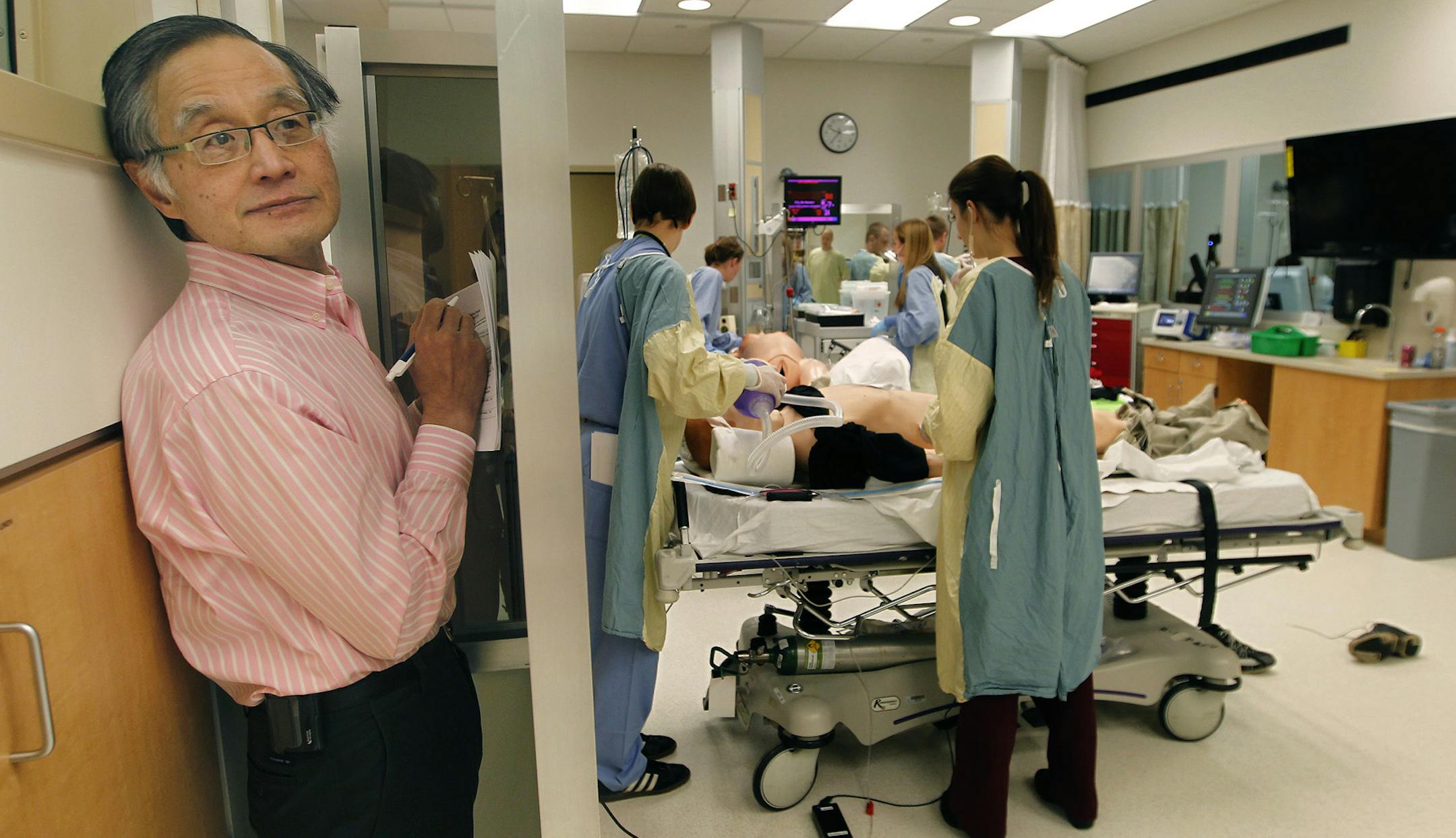
Nurses played scripted roles. "We have no information. All were brought in by car," one nurse told the residents about the first three patients. One woman was pregnant. A small child was whimpering.

"Sir, sir, can you tell me where you hurt?" one resident asked a man on a gurney.

Then, moments later, "we've got another patient here" and in came a mannequin with his lower right leg blown off, burns on an arm and a testicle ripped open. He eventually died, but not from the bleeding. The residents hadn't treated a lung problem quickly enough.

Other patients continued to trickle in dazed, dripping blood and stumbling. One mannequin's wounds looked small from the outside, but he was gushing blood all over the floor.

A teenager with a forearm wound and a tourniquet repeatedly got up and tried to leave. Each time, a resident correctly stopped him.

Throughout the 45-minute drill, no one raised a voice. The residents moved methodically and calmly, their treatment creating a stream of queries and statements.

"No breath sounds even though he's on a ventilator?"

"That's just the bladder, not the spine."

"His pressure's dropping; he's about to pass out. He's got a penetrating abdominal wound."

"We've got two liters of blood going, we need to go to the OR [operating room]."

"Can you get him an IV since you're standing there? Awesome."

"His blood pressure's 80s over 20s and his heart rate is 120."

The residents treated a dozen patients in all.

Early on, third-year resident Matt Rau had stepped into the center of the room to become a triage traffic cop, rather than putting hands on the patients — a needed role. "You can definitely get bogged down in one patient. Because there's a lot of things going on, you need … task delegation," he said.

In a classroom after the drill, Hick praised Rau's actions, but some things didn't go so well.

The residents had let a dead patient take up needed space for 20 minutes during the drill. That patient had died from an untreated lung problem — tension pneumothorax.

Hick highlighted the condition as one of three that must be addressed in an emergency room. The others: opening airways and stopping the bleeding. Even with the fake patients and their friends acting injured, the residents were serious and attentive.

"When I got in there, it felt kind of real," Rau said, admitting that he was nervous even though he appeared implacable. "We've been taught really well," he said.

Hick had one more lesson for the residents. He held up a black backpack and asked, "What about this?"

No one responded. The pack had been dropped in the middle of the room early in the drill. Hick reminded them they were treating bomb victims.

"This might be a bomb," he said, "Or it might be just a backpack."

Rochelle Olson • 612-673-1747 @rochelleolson

Dr. Albert Tsai, left, an emergency physician, took notes as Hennepin County Medical Center residents took on a surprise emergency drill involving bombing victims.
Dr. Albert Tsai, left, an emergency physician, took notes as Hennepin County Medical Center residents took on a surprise emergency drill involving bombing victims. (The Minnesota Star Tribune)
about the writer

about the writer

Rochelle Olson

Reporter

Rochelle Olson is a reporter on the politics and government team.

See Moreicon

More from Minnesota Star Tribune

See More
card image
J. SCOTT APPLEWHITE, ASSOCIATED PRESS/The Minnesota Star Tribune

The "winners" have all been Turkeys, no matter the honor's name.

In this photo taken Monday, March 6, 2017, in San Francisco, released confidential files by The University of California of a sexual misconduct case, like this one against UC Santa Cruz Latin Studies professor Hector Perla is shown. Perla was accused of raping a student during a wine-tasting outing in June 2015. Some of the files are so heavily redacted that on many pages no words are visible. Perla is one of 113 UC employees found to have violated the system's sexual misconduct policies in rece