
Artistry plays a role in crafting of bamboo fishing rods

Lanesboro craftsman has brought back art of making bamboo rods.

July 11, 2017 at 2:53AM
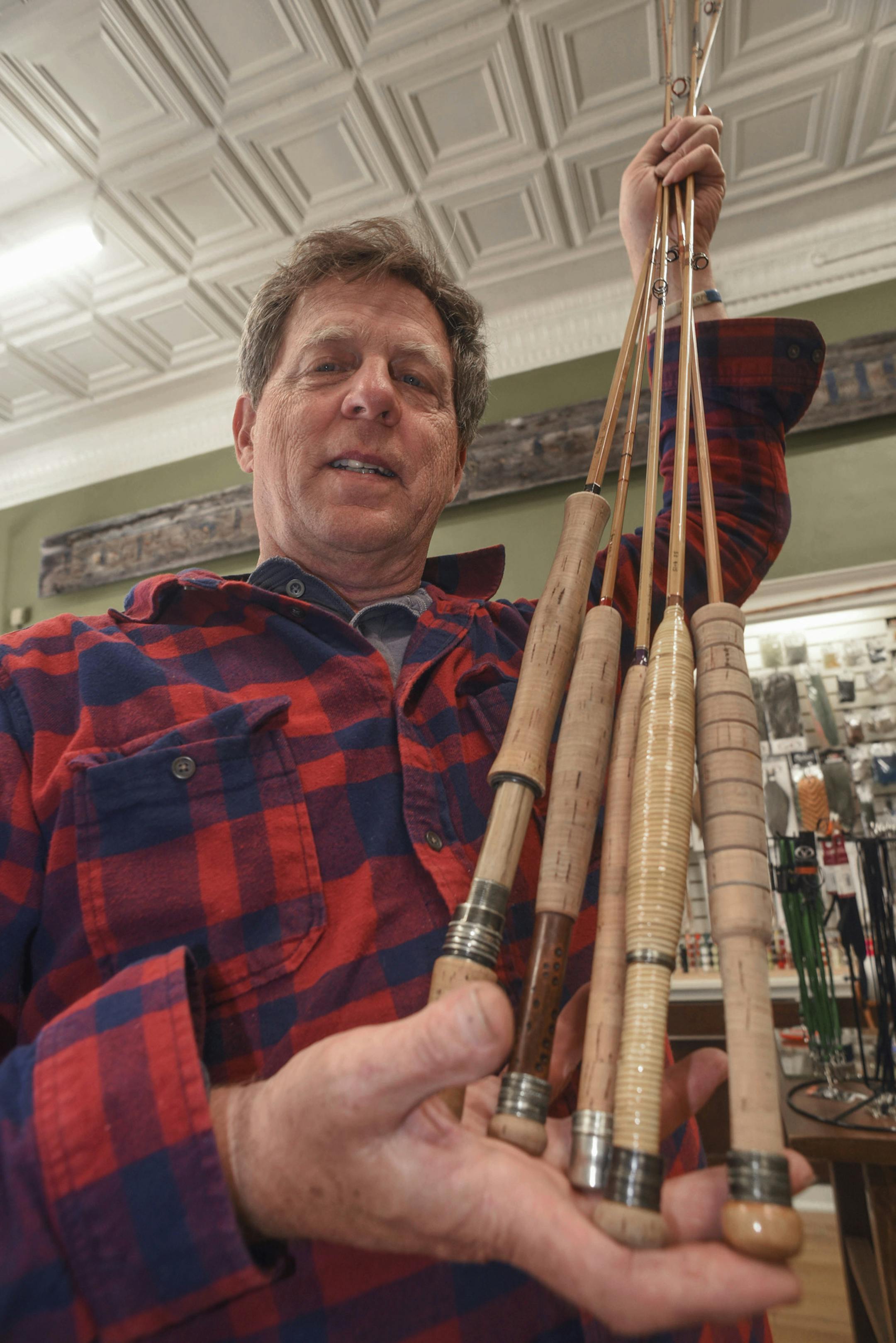
FILE - In this June 25, 2017 photo, Steve Sobieniak displays bamboo fly rods at Root River Rod Co. in Lanesboro, Minn. Steve Sobieniak hopes that decades from now, someone will pick up a fly rod he made, cast it, admire how it wafts out line in gentle curls and appreciate its lithe grace and bamboo beauty. It's a passion he brought to the area when he opened Root River Rod Co. May 1 in downtown Lanesboro. (John Weiss/The Rochester Post-Bulletin via AP)
John Weiss/Rochester Post-Bulletin via AP Steve Sobieniak displayed bamboo fly rods at Root River Rod Co. in Lanesboro. He hopes that decades from now, someone will pick up a fly rod he made, cast it, admire how it wafts out line in gentle curls and appreciate its grace and bamboo beauty. (The Minnesota Star Tribune)

LANESBORO, MINN. – Steve Sobieniak hopes that decades from now, someone will pick up a fly rod he made, cast it, admire how it wafts out line in gentle curls and appreciate its lithe grace and bamboo beauty.

"I hope they say, 'This guy really knew what he was doing,' " he said in a recent interview with the Rochester Post-Bulletin.

He knows what a good fly rod feels like. He's held many split cane bamboo rods made many decades ago, including Fred Thomas, Hardy and Granger rods. "When I pick up an 80-year-old rod, I say, 'Man, this guy really knew what he was doing,' " he said.

It's a passion he brought to the area when he opened Root River Rod Co. May 1 in downtown Lanesboro. It is the second fly fishing shop to open in that area; the first was Mel Hayner's Driftless Fly Fishing Co. in downtown Preston, which opened several years ago. The second shop will help cement the area's push to brand itself as the trout fishing center of Minnesota.

Root River Rods carries most of the flies and other gear needed for fly fishing. But Sobieniak's specialty is making and repairing bamboo rods, and his passion is for those rods.

"I'm not alone," he said. "It's an obsession. A lot of people including myself want to see one of every maker's rods and cast it."

Bamboo was the rod-making material of choice for many decades, from the late 19th century into the middle of the 20th century, he said. It was better than other woods because of how it casts; the best bamboo came from the Tonkin area of China. The line was generally silk, which had to be dried after, or even during, each use.

By the middle of the 20th century, however, fiberglass took over because it's much easier to make and much cheaper. After that, graphite began to dominate. Line changed to braided nylon, or Dacron with a coating.

Bamboo rods were relegated to history and antique stores until Everett Garrison and Hoagy Carmichael came out with "A Master's Guide to Building a Bamboo Fly Rod" in 1976. It prompted a bamboo renaissance. Many of the best old rods sell for several thousand dollars, some in the five-figure range. There are new lines, not of silk, but as small as silk that can be used with the rods.

Sobieniak's rods begin at $1,000 and take at least 50 hours to make. Bamboo rods have something special about them, something that intrigues him. "It has a whole different feel to it, it's slower," he said. "It's a sense of pride. You make something out of a raw material."

He said his father, Matt Sobieniak, got him into fly fishing when he was growing up in upstate New York. His mom, Rosemarie Sobieniak, loved antiques, so he got an interest in history from her. Sobieniak went to college in Colorado, where he added to his passion for fly fishing. He moved to the western suburbs of the Twin Cities where he worked as a finishing carpenter. He continued his love of fly fishing and that, of course, brought him to the southeast with all its streams.

Of all the places he went, he best liked Lanesboro with its steep river bluffs and moving water. "It seemed like Lanesboro was the closest thing to Colorado," he said.

His dad later moved to Oregon where he took up with bamboo rods. Again, his son followed suit but "I'm taking it a little bit further than he did," he said.

When he learned an old shop in downtown Lanesboro was on the market, he decided to make the change to fly fishing shop owner. He's been to such shops across the country, and "I figured I knew what it was going to take to open a fly shop," he said.

One of his loves is repairing old rods, ones that maybe were relegated to the wall or a closet for decades. "It's the whole process of reviving an old rod, making it fish again, give it a second life," he said.

He has made about a dozen new ones, but never the same one twice. That's not in Sobieniak's nature. "I'm a very undisciplined rod maker because I never do the same thing twice," he said. That's too boring.

But when he does make a rod, he learns more about the tapers, the details for the next one. And the next one.

Whatever he does, it won't be perfect. "Nobody can make a perfect rod, though everybody tries," he said.

He doesn't think about that much. "I'm trying to do the best that I can, that's all," he said. "It's something that gets in your blood."

about the writer

about the writer

John Weiss, Rochester Post-Bulletin

More from Minnesota Star Tribune

See More
card image
J. SCOTT APPLEWHITE, ASSOCIATED PRESS/The Minnesota Star Tribune

The "winners" have all been Turkeys, no matter the honor's name.

In this photo taken Monday, March 6, 2017, in San Francisco, released confidential files by The University of California of a sexual misconduct case, like this one against UC Santa Cruz Latin Studies professor Hector Perla is shown. Perla was accused of raping a student during a wine-tasting outing in June 2015. Some of the files are so heavily redacted that on many pages no words are visible. Perla is one of 113 UC employees found to have violated the system's sexual misconduct policies in rece