

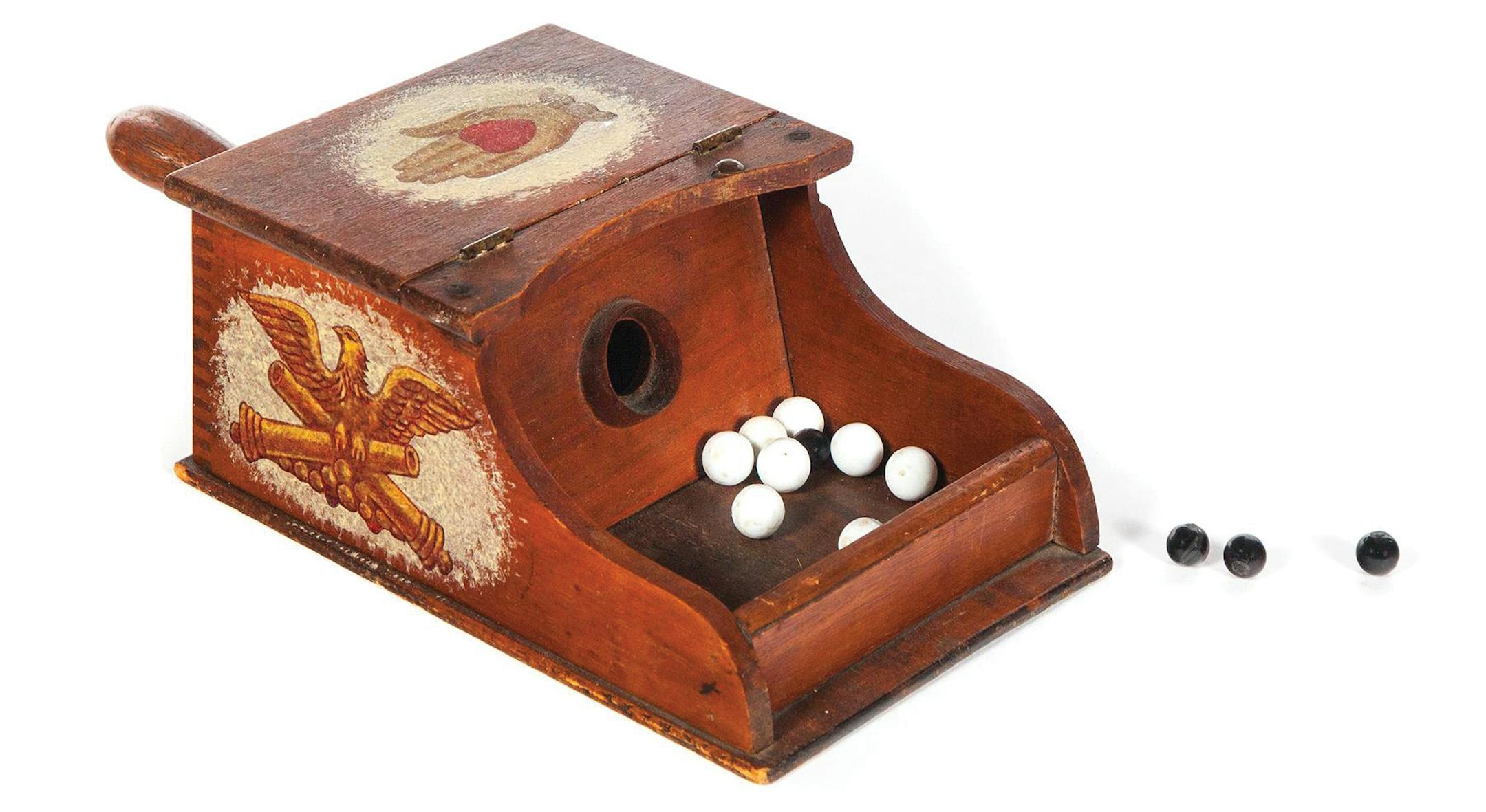
As early as the 17th century in America, members of fraternal clubs often voted at their meetings without paper ballots. Many decisions had to be almost unanimous; just one "no" vote could defeat a project. So, they used a blackball box instead of paper ballots.
Each person was given a random number of black and white marbles. To vote no, a black marble was dropped in the box. The box had a board that covered the voter's hand and marble so that no one could see the vote. Each marble made a noise when it was dropped, so that only one marble could be used. When the box was opened, it was easy for everyone to see the number of black marbles and if the project, motion or request for membership had passed or failed.
It was impossible to tell who had used a black marble. The term "blackballed" is still in use, and the box was saved as part of history.
An old blackball box used by the Odd Fellows fraternal order was sold at a Garth's auction recently for $500.
Knickerbocker china
Q: I found a plate marked "Knickerbocker Vitrified China No. 28" in the woods outside of Trenton, N.J. The plate is white with a brown tulip in the center, a blue ring and clover border. Can you tell me how old it is?
A: Knickerbocker is a pattern made by Noritake from 1985 to 1987. Noritake porcelain was made in Japan by Nippon Toki Kaisha beginning in 1904. The company is still in business. Knickerbocker plates sell online for less than $10.
Antique light bulb
Q: I have a light bulb that I have identified as an 1885 Heisler-Bernstein incandescent lamp. Does it have any value? And if so, where would I find a buyer for such a bulb?
A: Antique and vintage light bulbs are classified as "early technology," an area of collecting that includes electrical apparatus, astronomical devices and medical instruments. Artificial lighting is significant, since its beginning in the 1880s marked the lengthening of the workday and other changes in everyday life.


