
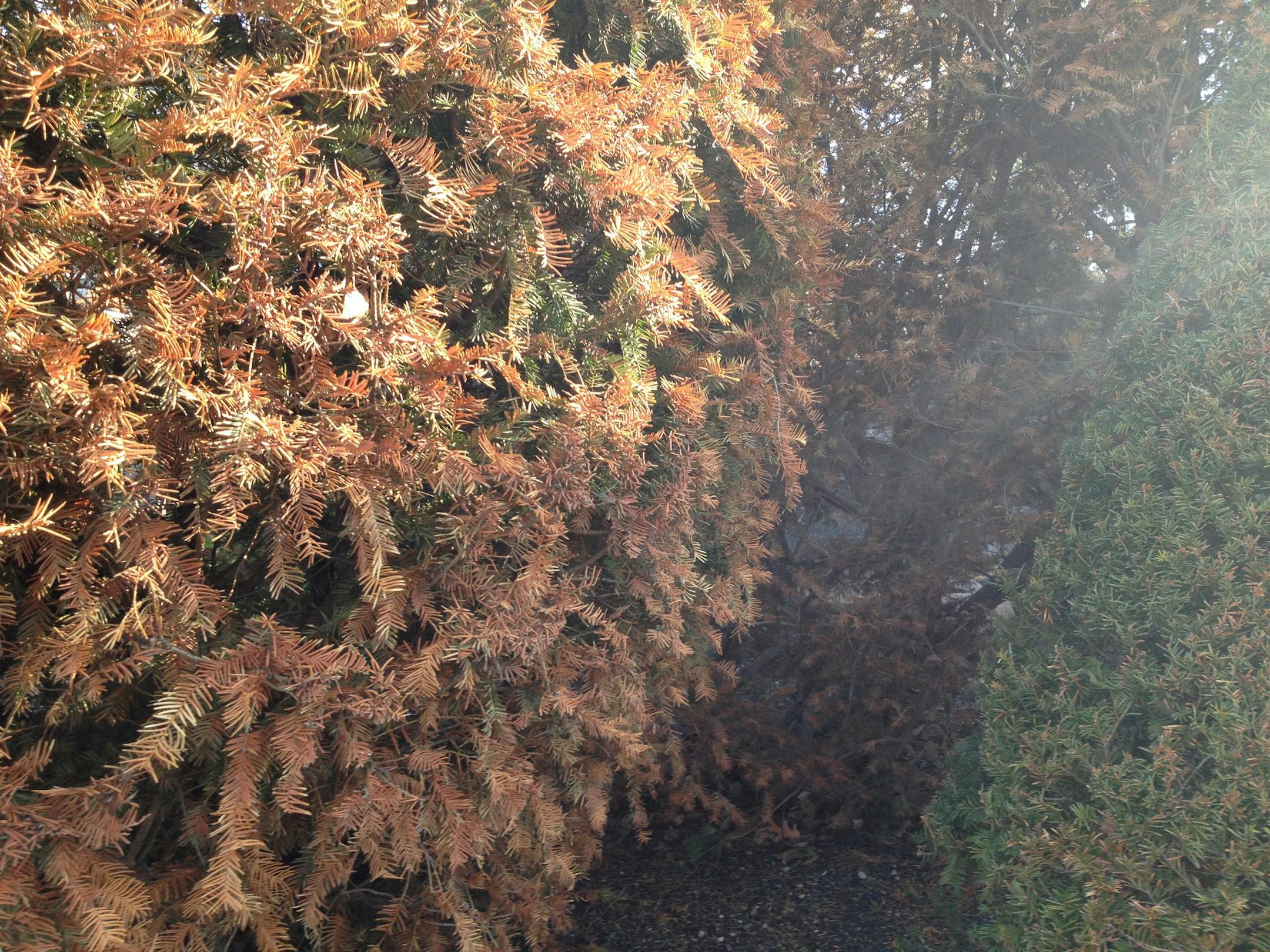
Evergreens in the Twin Cities took a hit from winter

April 29, 2014 at 7:29PM
Brown yews
Brown yews (The Minnesota Star Tribune)

Are some of your evergreen trees and shrubs looking like shredded wheat: brown and crispy?

Chalk it up to our harsh winter, which was especially hard on conifers, causing widespread browning and bleaching of needles.

"We're seeing quite a bit of damage out and about," said Jeffrey Johnson, woody plant specialist for the Minnesota Landscape Arboretum. "Pines, in particular, took it hard, and also some of the spruce."

The condition is called winter burn, and it occurs because of water loss.

Winter winds cause moisture to evaporate at a time when the tree can't take up water to replace it because the ground is frozen. Evergreen foliage buried under snow is usually protected from damage, according to the University of Minnesota Extension Service, while plant parts above the snow line are more vulnerable.

"It's really spotty; we don't see a great pattern," Johnson said. "We're also seeing a lot of damage along highways," caused by spray from road salt. "There was a lot of snow this year, and the salt tends to mist up and drift," he said. "But some trees that aren't near highways don't look real good, either."

This year's snow tended to be on the "dry and fluffy" side, rather than wet, which also contributed to dry conditions for evergreens, Johnson said.

Needles that are brown and crispy now will not re-hydrate and turn soft and green, but new growth may still fill in, as long as the tree is not completely dead, according to tree experts, who advise patience and caution before pruning or removing brown trees.

"If you take a smaller branch, and it's still bending, leave it alone; let spring do its thing," said Josh Plunkett, nursery inspector with the Minnesota Department of Agriculture and co-author of "The Complete Idiot's Guide to Trees and Shrubs." If the branch is so dry and crispy that it breaks right off, it's probably dead, Plunkett said. If you're not sure, you can contact the University of Minnesota Extension Service or a certified arborist. (The International Society of Arboriculture website offers searches by location, www.isa-arbor.com/findanarborist/findanarborist.aspx.)

With most brown evergreens, it's probably a good idea to wait a few more weeks before pruning or removing.

"You really need to be patient," Johnson said. "Once you remove it, you can't put it back."

Deciduous trees that are hardy for this climate should be fine, according to Johnson and Plunkett, although if you experimented with Zone 5 or other marginal trees or shrubs, you can expect to see some dieback.

If you want to help your brown trees, make sure they're adequately watered, but not over-watered, and give them a layer of mulch — not too thick and not up against the trunk.

But resist the urge to fertilize, Johnson said. "Fertilizer is iffy. If plants are stressed, fertilizer can do some damage by inducing overgrowth."

Kim Palmer • 612-673-4784

about the writer

about the writer

Kim Palmer

Reporter, Editor

Kim Palmer is editor/reporter for the Homes section of the Star Tribune. Previous coverage areas include city government, real estate and arts and entertainment 

See Moreicon

More from Minnesota Star Tribune

See More
card image
J. SCOTT APPLEWHITE, ASSOCIATED PRESS/The Minnesota Star Tribune

The "winners" have all been Turkeys, no matter the honor's name.

In this photo taken Monday, March 6, 2017, in San Francisco, released confidential files by The University of California of a sexual misconduct case, like this one against UC Santa Cruz Latin Studies professor Hector Perla is shown. Perla was accused of raping a student during a wine-tasting outing in June 2015. Some of the files are so heavily redacted that on many pages no words are visible. Perla is one of 113 UC employees found to have violated the system's sexual misconduct policies in rece