

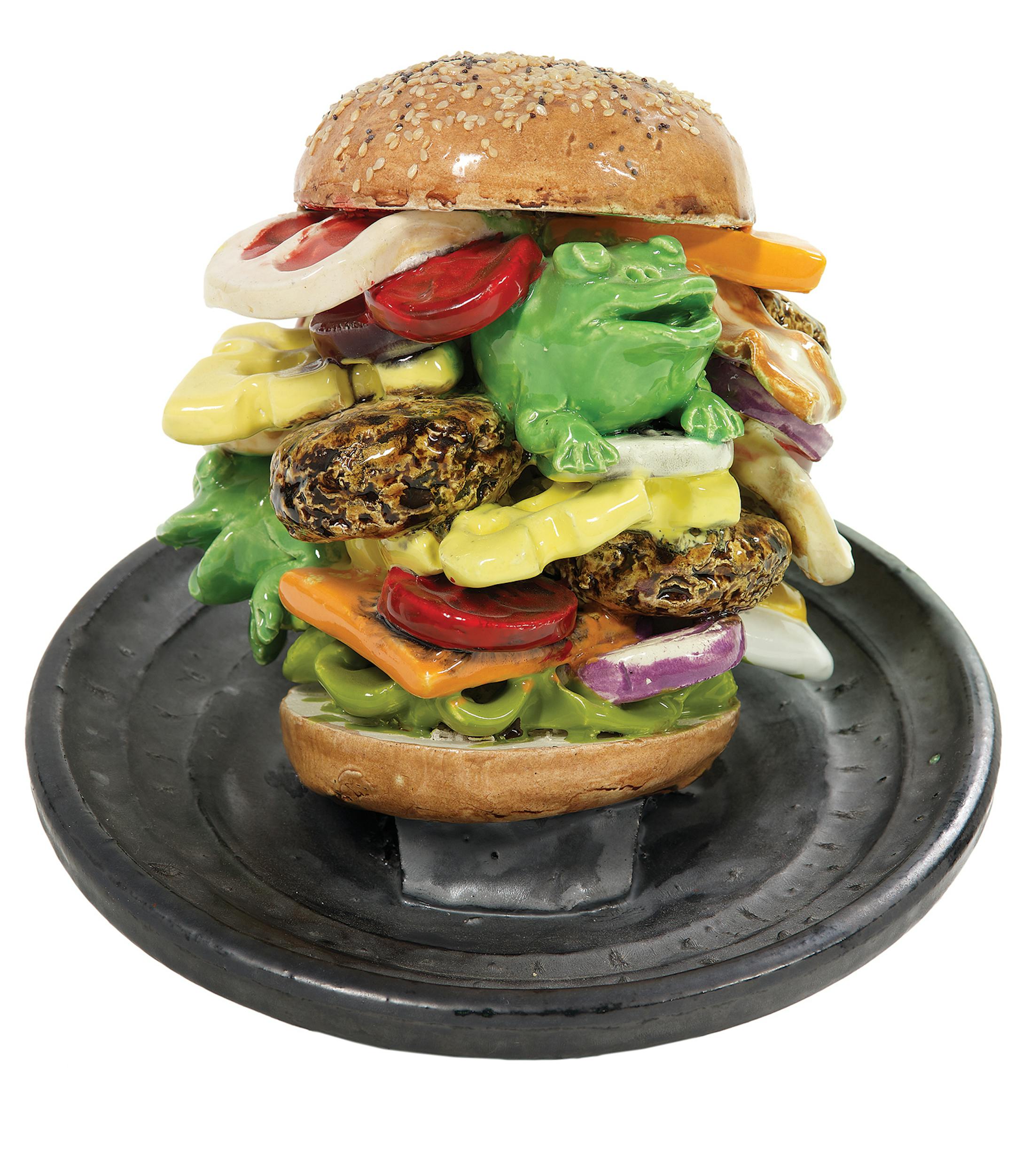
David Gilhooly (1943-2013) was a successful contemporary artist who often included big or small realistic or comic frogs in his sculptures. He is known as the founder and father of the Bay Area Funk Art group in the 1960s.
Although he had dozens of exhibitions and made art from papier-mâché, plastic, clay and trash, he is best known for the green frogs. His most controversial sculpture is a crucified frog, now in a museum collection.
Almost all his sculptures were fantasies, meant to be funny or have a satirical message. He sculpted frogs in salads, wedding cakes, pizzas, frying pans and with hats. Look carefully at this Gilhooly sculpture. It sold for $2,125, although it is only 8 inches high. Nice-looking realistic sandwich with tomato, cheese, lettuce, pickle and onion on a sesame seed bun and don't forget the bright green frog.
Barbie doll prices
Q: I have several Barbie dolls and four boxes of Barbie doll clothes I'd like to sell. What are they worth and where is the best place to sell them?
A: Over a billion Barbie dolls have been made, and millions are still produced each year. Prices range from under $10 to thousands of dollars. The first Barbie doll was produced by Mattel Creations in 1959 and sold for $3. She wore a black and white striped bathing suit, high heel shoes, earrings and sunglasses. The first Barbie had holes in her feet and copper tubes in her legs, and came with a stand. Barbie No. 1 sells for several thousand dollars today.
Vintage Barbie dolls sell at auctions, antiques shops, doll shows and online. As with most collectibles, rarity and condition affect price. Dolls in original clothing still in the original packaging are worth more than similar items that have been played with. Find lists of Barbie dolls and accessories with prices online and at Kovels.com/prices.
Beacon Hill dishes
Q: I found some dishes marked "Beacon Hill, by British Anchor, Staffordshire, England, Ironstone" in the basement of my house. I'd love to know if they are worth something.
A: Beacon Hill is the name of a pattern made by British Anchor Pottery, an earthenware manufacturer in Longton, Stoke-on-Trent, Staffordshire. The company was in business from 1884 to 1970, when it was sold to another Staffordshire company. This mark, with pattern name included, was used beginning in 1945. A different mark with a date code added was used beginning in 1954. Dinnerware is hard to sell. Even complete sets for eight sell for less than $200.


