

Photography is not Juliet Madsen's art form, yet her story-in-pictures may matter the most of all the hundreds of images taken by the eight winners of McKnight Photography Fellowships that are now on view at Franklin Art Works and Midway Contemporary Art in Minneapolis through July 24.
Madsen isn't a fellowship winner; she's a disabled U.S. vet with whom photographer Monica Haller collaborated. Haller is using her $25,000 grant from the Twin Cities-based McKnight Foundation to help veterans tell their stories by making books filled with their snapshots, letters home, diary jottings, memories and whatever else comes to hand. Working with a computer program she's developed, Haller helps the vets edit and arrange their stories into booklets of 50 to 300 pages that can be passed around to family members and friends, and collected into a record of our time of endless war.
Fourteen of Haller's vet books are piled on a table at Franklin Art Works, Madsen's story among them. A lithe, pretty blonde in fatigues, she looks happy on the book's cover, the kind of reassuring face you'd want to hover over you after your leg or some other body part was blown off in Desert Storm, or Desert Shield or Operation Iraqi Freedom. She served in all those conflicts during 17 years as an Army paramedic. Back stateside, her husband -- also a veteran -- was bringing up the kids.
Madsen, who enlisted at 17, was the only female in her squad in the 82nd Airborne out of Fort Bragg, N.C., but that probably wasn't why the deterioration in her own health was ignored until she was involved in an IED explosion and got med-evac'ed back to the States. The sequence and details of her story are confused and impressionistic in the book, as if recalled through the heatstroke she suffered.
Even before the IED incident, she'd tape herself up with an IV under her uniform to get extra vitamins and fluids, but that didn't stop the nausea, headaches and vomiting. By the time she was airlifted to Walter Reed Medical Center in Washington, D.C., she'd had seizures, a heart attack, two brain strokes and her kidneys were shutting down. After a long hospitalization, she's now living with her family in Colorado, where she makes quilts and donates them to raise money for other disabled vets.
"Anything that could have been done correctly was done so wrong," Madsen writes, piecing her story together so her family can see "that I really do realize that I am not who I was."
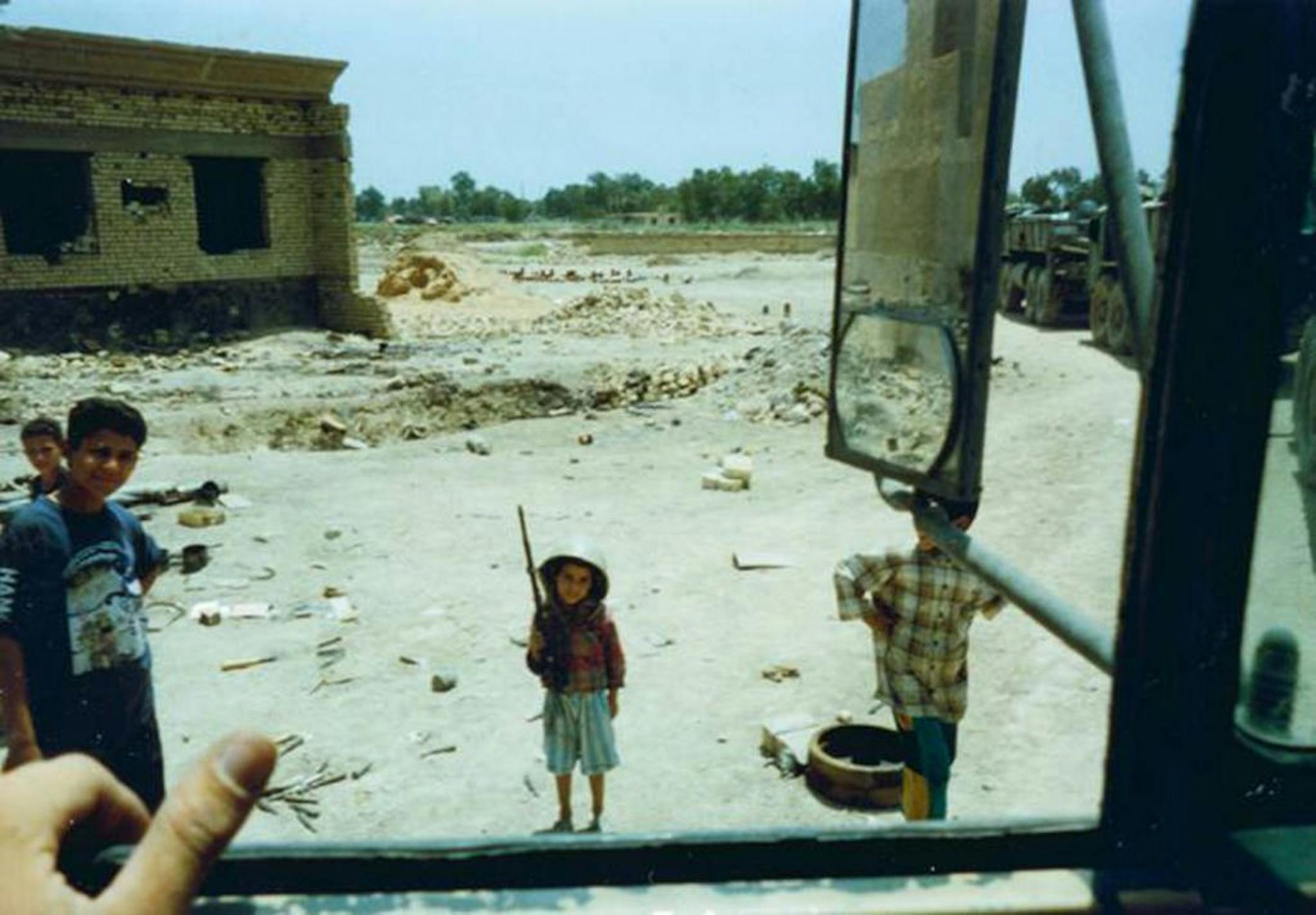
None of the snapshots in the vet books are Pulitzer Prize contenders, but their cumulative impact is significant. The very ordinariness of the images, their blurry snapshot familiarity, brings the wars' chaotic awfulness home more vividly than even some of the best photojournalism. Haller describes her contribution as that of an editor, but her role is clearly more complex than that -- part psychologist, therapist, historian and confidante, as she helps vets try to make sense of their inchoate memories. She is doing important work, one life at a time.
The missile next door


