

Benjamin Franklin and John Cage would love the Bakken Museum's new "Green Energy Art Garden."
As a founding father of American science -- and the inventor of bifocals and the lightning rod -- Franklin would naturally embrace the novelty of a solar-powered rainmaking machine.
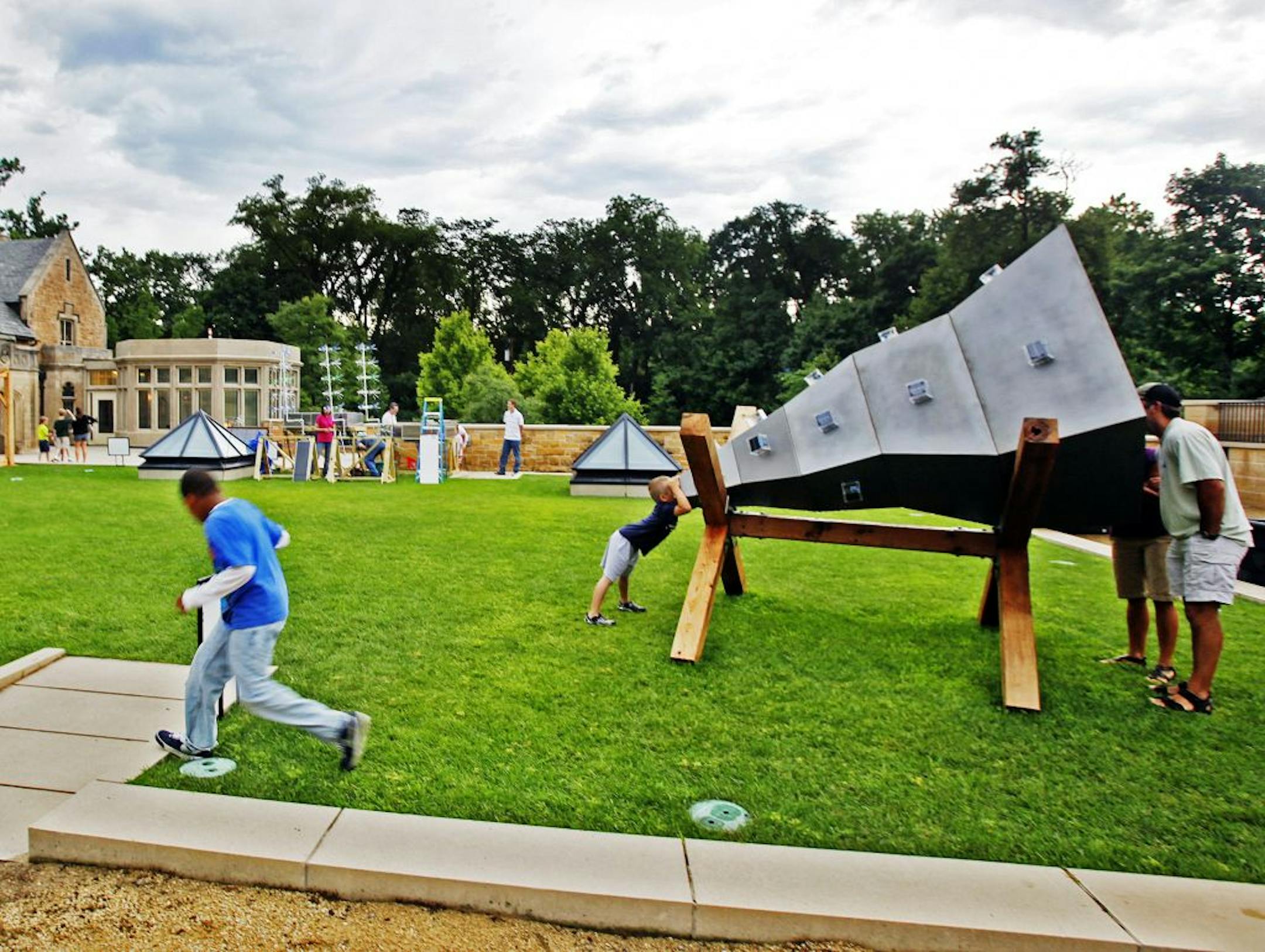
And Cage, famous as the composer of "music" consisting of long stretches of silence interrupted by patches of ambient noise, would obviously approve of a big angular megaphone tricked out with dozens of little solar-powered devices that click and clatter, buzz and whir. He might even write a symphony for it.
Though best known as a museum of electricity and magnetism, the Bakken has been "a crossroads for science, art, medicine and literature" since it opened in 1975, said director David Rhees. Its new rooftop art garden, which will be up through Sept. 3, is designed to demonstrate that creativity is at the core of both art and science.
Renewable energy animates art
A pilot program that the Bakken hopes to expand in future years, the garden has four art projects powered by sun or wind. All are kid-friendly interactive devices that respond to human activity or entice viewers to touch or manipulate controls. Most are fabricated from readily available hardware or landscaping material; one uses recycled plastic bottles to transmit power. Knocked together out of 2-by-4s, rubber tubing, electrical cable, tiny pumps and motors, the projects' apparent simplicity belies the research and planning that went into their fabrication.
The seven artists were chosen from about 20 applicants in a competition organized for the Bakken by Forecast Public Art, a St. Paul consultancy. Before setting to work, they met with consultants from the University of Minnesota's Department of Electrical Engineering, a research and development team from Xcel Energy, solar and green-technology entrepreneurs, as well as Bakken exhibition designers. Funding was provided by an anonymous Bakken supporter.
"The challenge we gave the artists was to illustrate how we can use renewable-energy sources to generate electricity in a sustainable and beautiful way," said Kelly Finnerty, the Bakken's deputy director of programs.


