

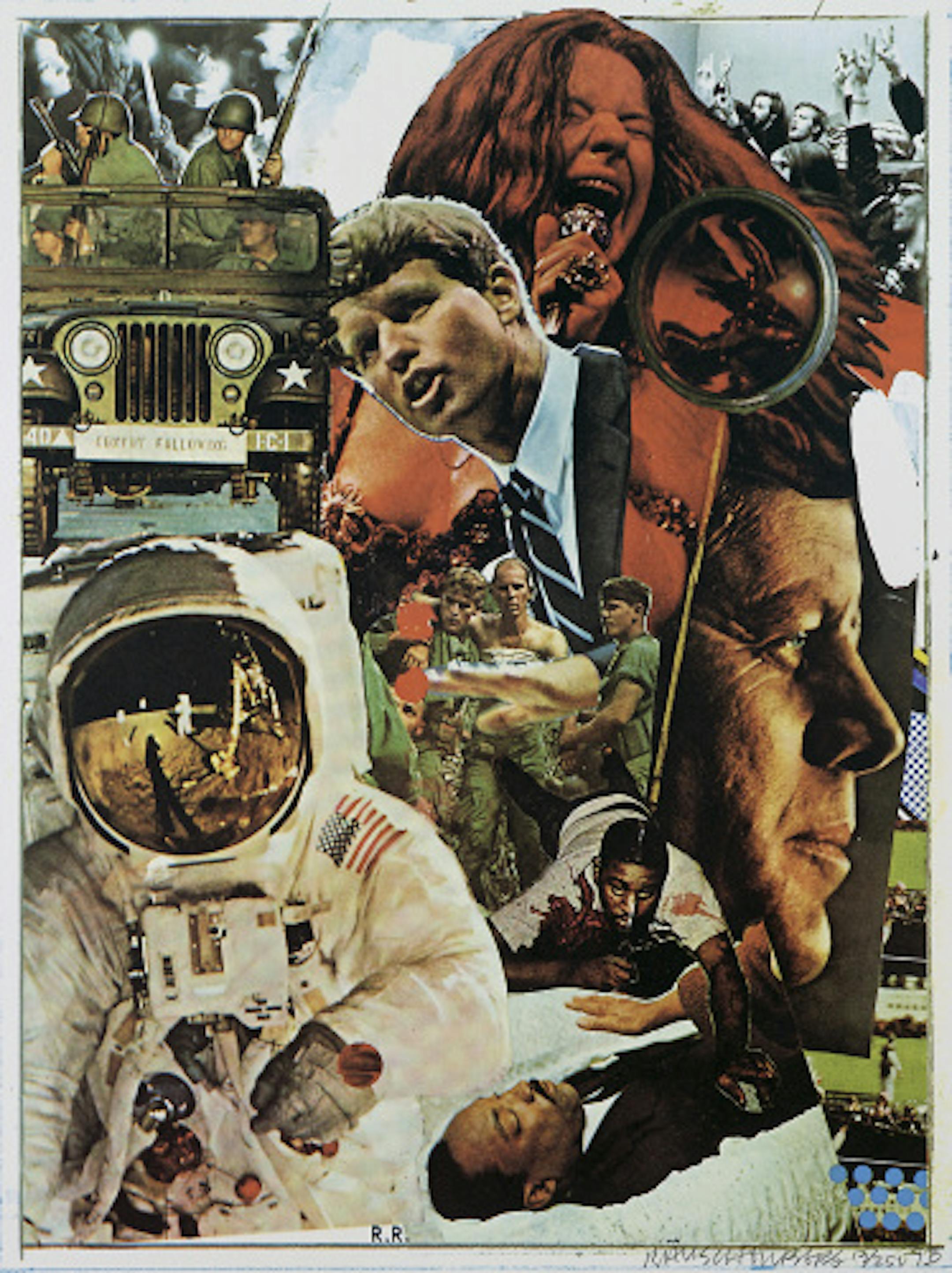
Hold on. The Rauschenberg exhibition at the Minneapolis Institute of Arts is an exhibit of prints? Really?
For an artist who built so much of his renown in wild three-dimensional experimentation, it seems very odd for the MIA to honor him with a show that's so, well, flat. "Robert Rauschenberg: Prints/Editions 1962-78" takes a look at one of the art world's most audacious experimenters, but through the lens of one of its most limiting and traditional media: printmaking. It's a collection of tepid two-dimensional work that dulls the brilliance of an otherwise riveting artist. Given Rauschenberg's recent passing (he died last May at age 82), the exhibition feels almost like a slight -- a banal tribute to an icon deserving of so much more.
Rauschenberg was a one-man Dada resurrection. He mounted blank canvases on gallery walls. He performed choreography wearing roller skates and a parachute. He partially erased a De Kooning painting and claimed it as his own. But it was his "combines," strange hybrids that straddled the line between painting and sculpture, that really made his name. These often involved piles of garbage, splotches of acrylic and, in one infamous example, a stuffed goat with a rubber truck tire ringing its belly. Coated liberally with paint stains and built from the junk of everyday life, the combines were the perfect bridge between Pollock's splatter-fests and Warhol's Brillo pads.
Confining Rauschenberg to a flat panel on a wall is like forcing Björk to make a record with a kazoo. Except that the Björk record might actually be interesting.
"He was a little reluctant to work in what he deemed a 'traditional manner,' meaning stone lithography," admits curator Dennis Michael Jon. "In fact, he was often quoted as saying, 'The second half of the 20th century is no time to start writing on stones.' [But the prints] are a central part of his work. He himself cited them as being influential in developing ideas for his paintings and other works."
Jon may be right. After all, Rauschenberg produced hundreds of these two-dimensional projects throughout his career, working at some of the most prestigious printmaking studios in the country. And some consider the 30-odd prints hanging in the MIA to be among the best American graphic work of the 1960s.
A 'Carnal Clock'
But the question remains: Can a '60s radical hippify a process invented in the 18th century? Rauschenberg certainly tried. He invented techniques to transfer images from magazines and newspapers directly onto the litho stone. As a result, most of his lithographs look more like photo collages than standard prints, a point made woefully clear by the five banal lithographs that begin the show. Process geeks might get a kick out of the techy details, but everyone else will breeze by these in a single pass.


