

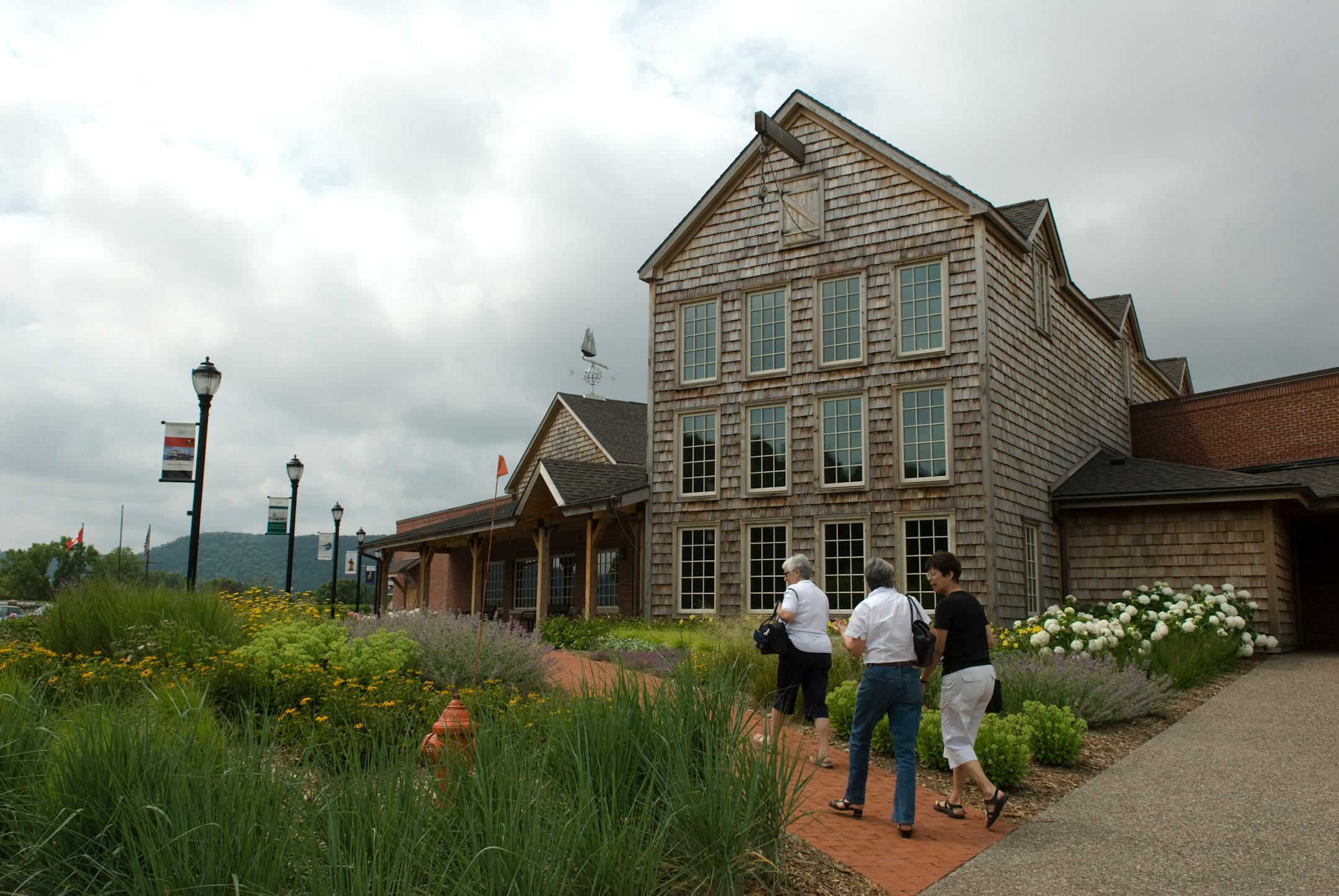
Although it sits along the Mississippi River in Winona, the Minnesota Marine Art Museum has a curiously New England feeling about it.
Designed to suggest a cluster of small-town buildings, the museum's centerpiece is a shingled three-story hall with tall, many-paned windows and a peaked roof. Gently weathered wooden shingles add to the sense that there must be a lighthouse on some rocky promontory nearby. Your ears tune, expecting the crash of waves or a seagull's cry. But on a hot summer day, the breeze brings only the prairie rustle of long grasses and the hum of a bee dipping into the roses, yarrow, daylilies and other perennials flanking the museum's entrance.
The view from the museum's walkway is not a grand vista of the Mississippi valley -- for that you must drive up the bluff overlooking the city -- but of a comparatively narrow river channel, a quiet industrial byway in a working river. Occasionally a barge chugs past pushing a flat-bottomed load of some Midwestern product -- grain, iron ore, taconite? Who knows what's concealed in the bulky boxes moored to an island across the water from the museum?
Inside, glossy wooden floors, honey-toned wood and splashes of sunlight create a cheery, welcoming atmosphere. Three large galleries open off the central hall, which houses a ticket desk, small gift shop and occasional displays. This summer, the hall features a pretty, 8-foot-tall stained glass window new to the museum's collection. Designed by Louis C. Tiffany, the 1896 window depicts a woodsy scene with a distant view of San Francisco Bay as seen from a home in Marin County, north of the city.
Mixed media
For a young institution that's still building its collection, the museum has struck a nice balance of media in its current shows of folk-style carvings by Winona natives Leo and Marilyn Smith, sea-themed paintings by Nova Scotia artist Jack Lorimer Gray and digital reproductions of 19th-century photos of the Mississippi.
For the Smiths, who now live in nearby Fountain City, Wis., the museum's main gallery must be a spectacular advertisement. The museum owns more than 400 of their charming, gaily painted sculptures and sells reproductions of their work in its shop. Nature and human motifs often mix in their work, as in a masklike face, half sun and half moon, painted on the back of a turtle-shaped wall piece. Other carvings represent the buckskin-clad maiden Winona, voyageurs, an albino deer, assorted animals and a raft of small-town characters inspired by people the Smiths know: Elmer the gas station attendant; Emil the farmer; Clara, whose strawberry pies always win blue ribbons at the fair. In one memorable piece, stylized fish, heron and lotus flowers decorate a 5-foot-tall bas relief that symbolically represents the Mississippi. Another, larger triptych depicts the town of Fountain City rising up the bluff above rolling waves.
Born in Halifax, Nova Scotia, Gray (1927-81) was a popular illustrator of ocean scenes -- portraits of sailing ships, fishermen and bays from New York to Maine. His 23 paintings in the museum's current show are on loan from the collection of Bob Kierlin and his wife, Mary Burrichter, key backers of the museum. A former Minnesota state senator, Kierlin made his fortune at Fastenal, a now-international industrial- and construction-supply firm he started in 1967. His chance enthusiasm for a seascape inspired a collecting spree that grew into a 400-piece collection from which they've lent generously to the museum.


