

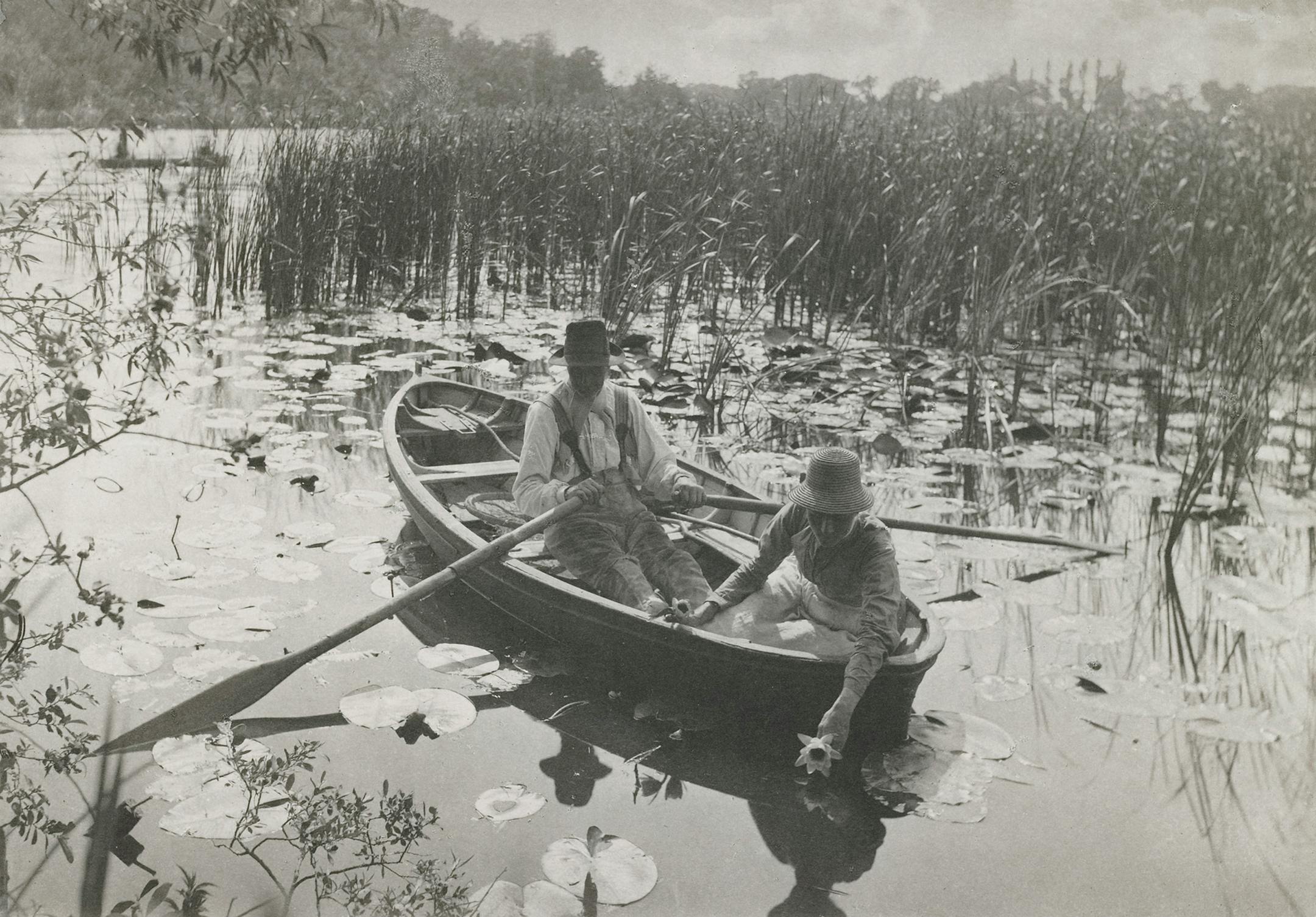
Delineating the exceedingly subtle difference between naturalistic and pictorialist photography is one of those scholarly exercises that only a connoisseur would cluck over. That would be Christian Peterson, the acting curator of photography at the Minneapolis Institute of Arts, who has mounted a nostalgic show that does just that.
"Peter Henry Emerson and American Naturalistic Photography," which opens Saturday, offers about 80 landscapes and genre images by 24 naturalistic artists working between 1890 and 1930. All are Americans except Emerson, an Englishman whose books and portfolios -- often lavishly illustrated with platinum prints or photogravures -- helped define the field for progressive amateurs and professional enthusiasts in the United States.
Emerson, a distant relative of American philosopher Ralph Waldo Emerson, was an early influence on Alfred Stieglitz, who went on to become one of the most important photo promoters and art dealers of the early 20th century (and, not incidentally, to marry Georgia O'Keeffe). The show and its very pretty catalog ($39.95, published by the institute) include a couple of early Stieglitz photos in a sentimental, moralizing, anthropological mode -- one of a barefoot peasant girl resting in a field against a bundle of firewood, the other of a bonneted woman mending nets on a beach.
The other big-name American is Edward S. Curtis, whose 20-volume ethnographic and somewhat romanticized record of American Indian tribes staked his claim to photographic immortality. Several Curtis images are shown, including a quite handsome gravure profile of Bear Bull, a Blackfoot with an impressive topknot of hair.
Peterson contends that Curtis falls into the "naturalist" camp because of the similarities between his work and Emerson's. Like Curtis, who artfully documented the lives of Indians, Emerson brought ethnographic rigor to his studies of the peasants of England's Norfolk Broads, a marshy coastal region where industrialization threatened rural values. Both accompanied their images with extensive writing about the culture and lifestyles of their subjects.
Naturalism vs. pictorialism
A Cuban-born, English-educated doctor, Emerson devoted his career and independent income to the promotion of photography as an art. His 1889 book "Naturalistic Photography for Students of the Art" was enormously influential. Reacting against the prevailing taste for sharp-focused allegories patched together from several negatives, Emerson insisted that photographers should stick to Nature with a capital N.
That meant rural subjects such as landscapes, agrarian lifestyles and rustic domestic scenes. He advocated sharp focus for a photo's main subject and softer focus for background and edges, an approach that he believed imitated human vision, but was controversial among photographers.


