

Watercolor paintings are all about the joy of looking, the pleasure of caressing with the eyes. They're about seeing and intuiting the way light dances off water, sparkles on chrome, bounces through glass, warms a cheek, is absorbed by snow, glows through leaves and vegetal matter. And then it's about translating those observations into sheer washes of paint on paper by an extraordinary alchemy of hand, eye, training and tricks of the trade.
Good art always involves transformation of some sort, but the deceptive simplicity of watercolors makes them especially magical when they're as fine as most are in "Waterborne," a show at the University of Minnesota's Katherine E. Nash Gallery of more than 100 paintings by 27 of the field's top talents from Minnesota, Wisconsin and the Dakotas. Many of the artists are widely acclaimed, notably Cheng-Khee Chee and John Salminen, the Duluth-based painters whose work has been shown worldwide and who attract students from across the country.
Organized by Margaret Bussey, an adjunct faculty member at the university and Anoka-Ramsey Community College, "Waterborne" is a transparent effort to bridge the gulf that often separates the academic art community -- which frequently disdains watercolors -- from the public and practitioners who appreciate them for their technical demands and visual rewards. (Count me among those who take not-very-guilty pleasure in waterborne art.)
For Bussey, watercolors are simply another skill set that art students should have. Because watercolor pigments sink into and stain paper, they can't be erased or altered as pencil sketches and oil paintings can. Instead, colors must be layered from light to dark while white spaces remain untouched. Some watercolorists highlight their work with opaque pigments, but that's a no-no for purists who prefer a "transparent" technique composed of sheer veils of color.
To Bussey's great credit, "Waterborne" showcases various techniques, thus enhancing the show's educational potential and its visual variety. She also avoids the irksome jumble found in many group shows by including multiple pieces by each artist to demonstrate their strengths and intentions.
Highlights include a little tribute at the entrance to the late Malcolm Myers, a much-loved U of M professor whose whimsical watercolors of drifting canoeists, barnyard animals, farm scenes and other ephemera speak to a lighthearted, long-ago moment when it was OK for art to ignore angst and celebrate the quotidian.
Chee's rather abstract landscapes echo cloud and rock motifs common to the Chinese art of his heritage, while his paintings of koi achieve lyrical tranquility with the fishes' mottled red and white scales virtually flickering in their painted ponds. Note especially his "Lake Shore 95, No. 1," a tour de force of wet and dry pigments that coalesce as a craggy North Shore cliff broken by pools of shimmering water.
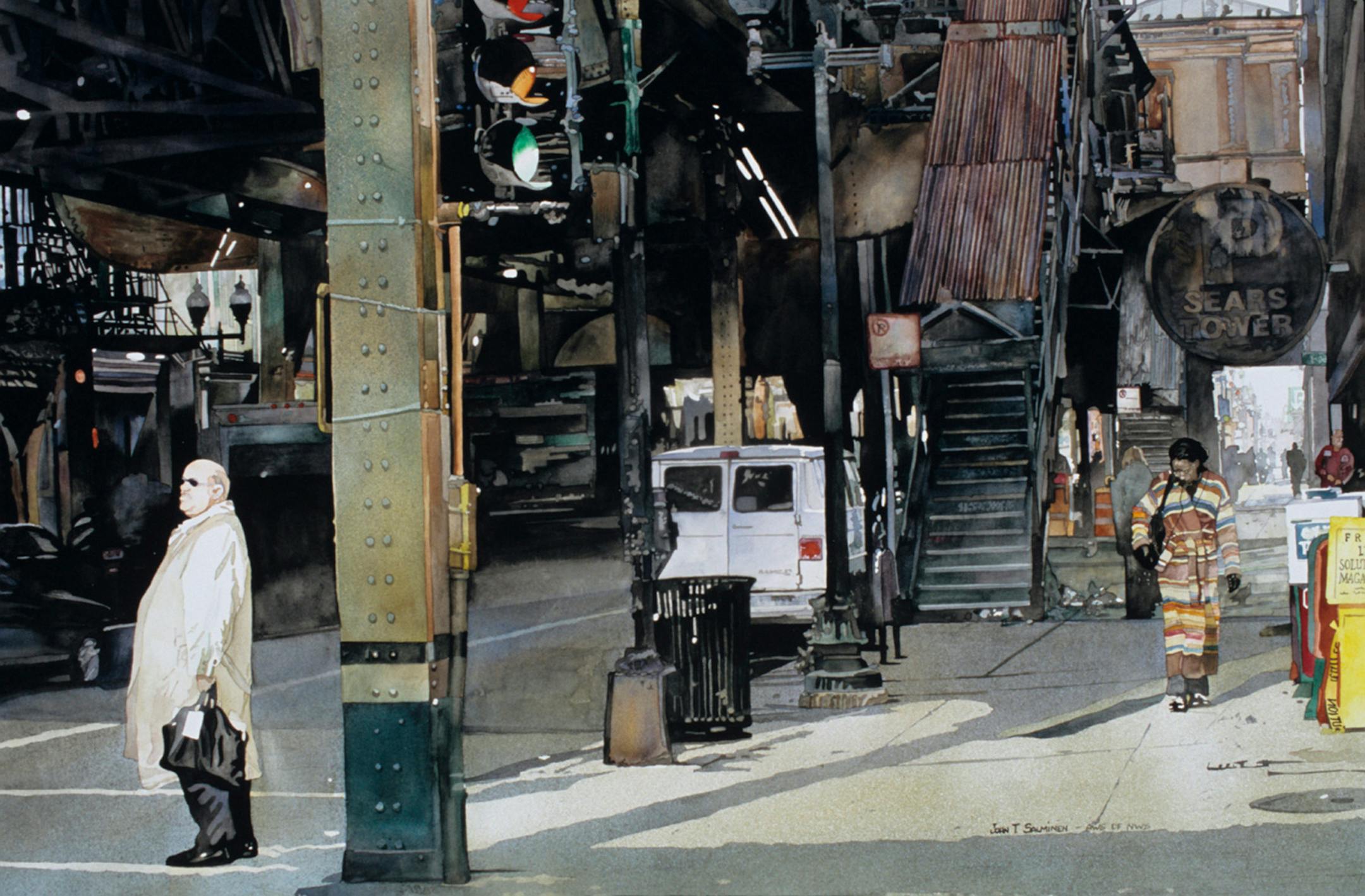
Although Salminen lives in the woods outside Duluth, he specializes in urban nighttime scenes that take him to New York, Los Angeles, Chicago. He starts with photos, but never lets his images be overwhelmed by the finicky detail that so often blights photo-based art. Editing for atmosphere, he suggests the inviting clangor of San Francisco's Chinatown with a frieze of shop signs, windows, curving rooftops and strings of paper lanterns bobbing above the street. Chicago's industrial grit permeates the elevated train tracks that frame a portly businessman and a colorfully garbed woman outside the city's landmark Sears Tower.


