

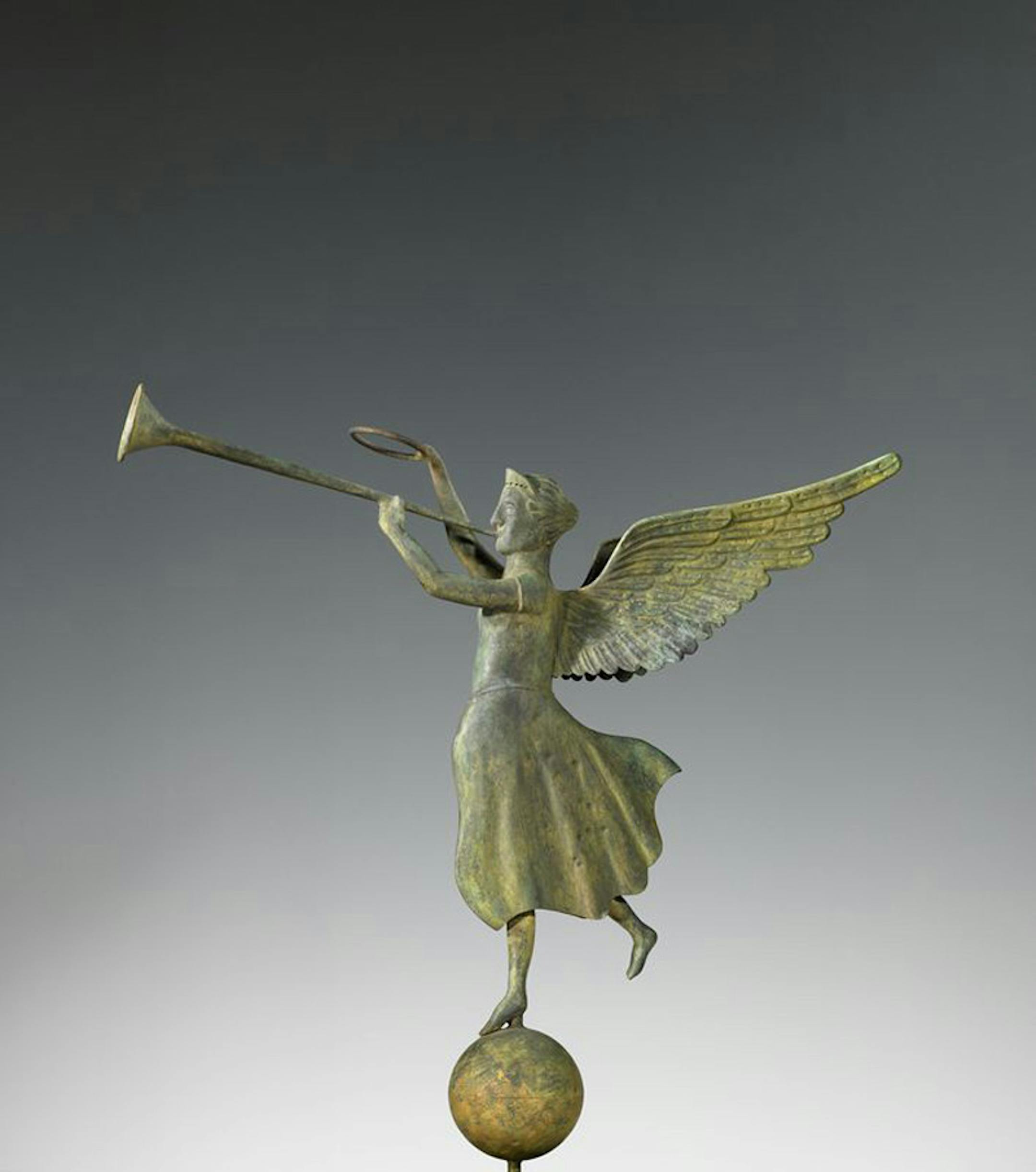
Even if weather vanes weren't such obvious fun, cultural historian Karal Ann Marling could persuade anyone of their charms. Marling has contributed a delightful essay on the subject to the catalog for "Wind and Whimsy: Weathervanes and Whirligigs From Twin Cities Collections," a sweetheart of an exhibition at the Minneapolis Institute of Arts through April 13.
Smartly installed by associate curator Corine Wegener, "Wind" offers more than 40 examples of infectiously appealing folk-art sculpture. A panoply of 19th-century icons parades by: sailing ships, sailors, Indians, an angel, personifications of fame and liberty, a whole barnyard of animals -- roosters, horses, fox, cow, peacock and even a couple of grasshoppers.
Fashioned of sturdy metal -- copper, zinc, iron -- and sometimes painted or covered in gold leaf, the vanes once crowned hotels, churches, barns and other buildings throughout the United States. Designed to spin on a rod, they typically have a broad tail or torso balanced by a small, weighted head that pivots to face into the wind.
With characteristic erudition and aplomb, Marling embarks on a merry romp in search of weather vanes in history, art and literature. She finds everything from an ancient weather-clock built in 48 B.C. in the center of Athens, Greece, to Bob Dylan's 1962 song "Blowin' in the Wind." Washington Irving, she reports, was the "first American writer to take special notice of the weather vane." He even placed a rooster vane atop his home in Tarrytown, N.Y. Chaucer mentions a weathercock in "The Canterbury Tales," and one even appears on Westminster Abbey in the Bayeux Tapestry, a medieval embroidery that records the Norman invasion of England in 1066.
Utilitarian delights
Weather vanes have existed for centuries as utilitarian ornaments of daily life. Farmers, sailors and weather-dependent tradesmen were especially concerned about the shifts in wind currents that herald changes in temperature and precipitation.
Weather vanes also had symbolic associations. The rooster vanes that often crowned European and U.S. churches are associated with St. Peter, Marling says. According to legend, the birds symbolize the disciple who, Christ warned, would -- before the cock crowed in the morning -- thrice deny even knowing Jesus.
Not surprisingly, rooster vanes are the centerpiece of the museum's show, perched on poles in the middle of the gallery. Most are gifts of John and Elizabeth Driscoll, who in 2004 gave the museum choice pieces from a collection assembled over 30 years. They range from a sleekly stylized 1871 French bird with a smooth, moon-shaped tail to a plump, silvery "Hamburg Rooster" (1880) with a jaunty red comb and wattle, and a flat painted "Red Hook" from 1890.


