

Attention, gardeners! If you're struggling to eradicate winter brown spots in an otherwise lush green lawn, Walker Art Center has news.
Through the alchemy of modern technology, artist Tomas Saraceno is growing grass in a Walker gallery. More surprisingly, he's doing it on balloons covered with black felt. If an Argentine-born, Europe-based artist can get green shoots to sprout from fur balls in a Minnesota museum gallery, we native gardeners have no excuse for the shabby state of our lawns.
Except, of course, we don't have Saraceno's mod-cons to work with. His "Lighter Than Air" show, on view through Aug. 30, is a utopian fantasy of high-tech equipment (miniature wind turbines, solar sensors, cameras, motors, pumps, plastic tubing and computer monitors) and mundane garden stuff (sunflower plants, grass, water) deployed to playful and thought-provoking effect.
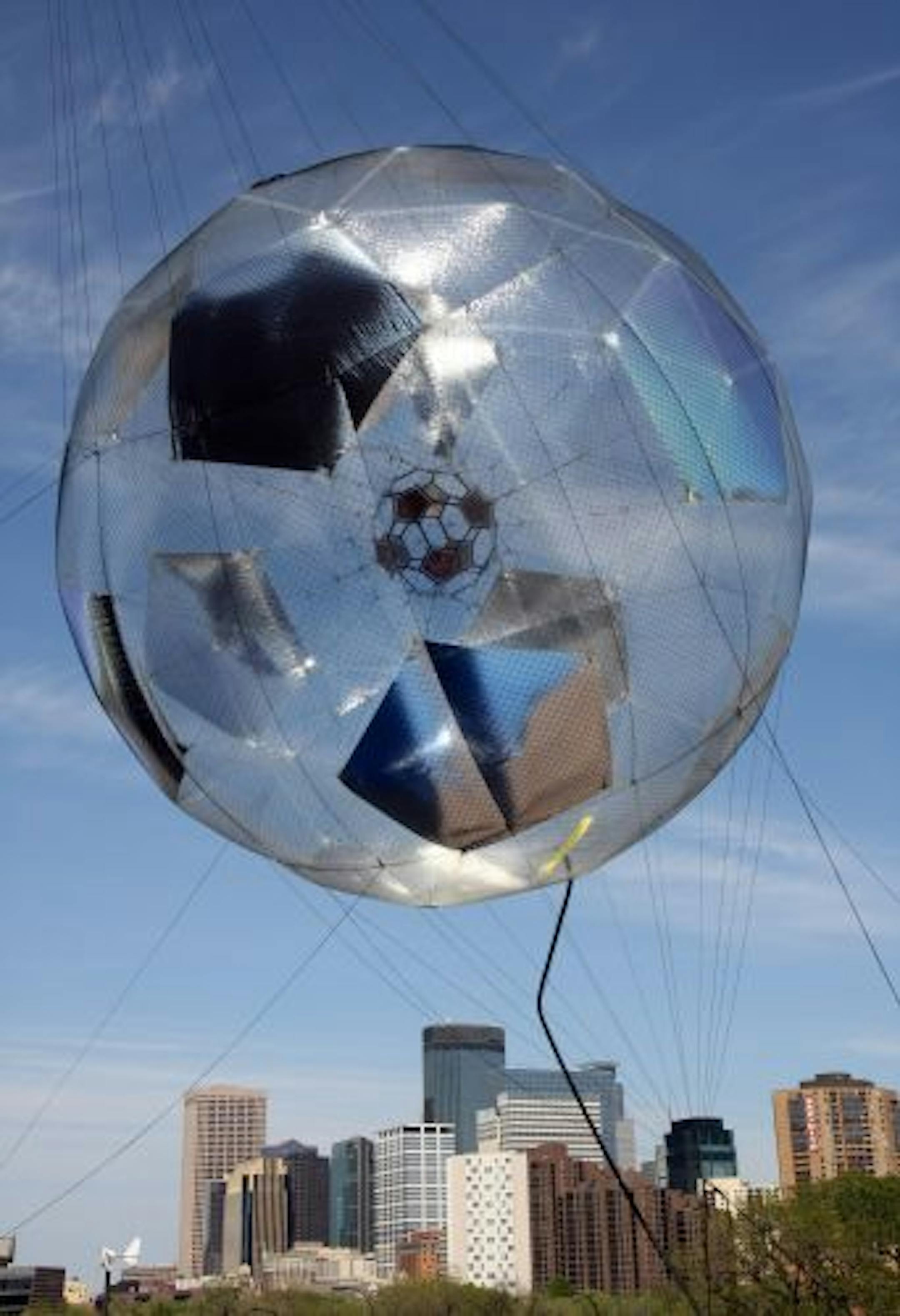
The greenery is just one arresting element in a show that includes immense blastula composed of transparent balloons anchored in black webbing, and a 27-foot-long mural of netting undulating in the sky above an urban landscape. Periodically the Walker will also deploy Saraceno's solar-paneled balloon, "Iridescent Planet," on a rooftop terrace as a beacon and extension of the show.
The secret of Saraceno's success in getting grass to sprout from felt seems to be the same thing recommended at garden centers everywhere: water, water, water. On a recent morning, Walker associate curator Yasmil Raymond was doing the honors with a sprinkler wand. The grassy balls in Saraceno's "32SW Stay Green/Flying Garden/Air-Port-City," have to be sprayed every 30 minutes, Raymond said, which means that gallery gardening is even more demanding than the outdoor variety.
"Stay Green" is a large sphere of grass-and-felt-covered balloons suspended above a plastic-lined basin in which excess water is recycled. Its sprinklers are attached to tubing linked to a water pump that's powered by wind turbines positioned on an adjacent rooftop terrace. All that rigging is an elaborate metaphor for the complexity of nature's own growth systems.
The balloon blastulae next door are conceptual models of Saraceno's proposed "Air-Port-City," which would consist of lighter-than-air habitats bobbing about in the upper atmosphere like clouds, unbound by the geopolitical and cultural limitations of terrestrial life. In his mural the blobs float invitingly above a sprawling city inspired by Liverpool, England, where the image was first shown in a recent biennial. As metaphors of interconnectedness the balloons and webs are seductively appealing, lyrical drawings of pretty forms undulating like jellyfish in a tropical sea.
Not all of Saraceno's efforts to link nature and technology work. He attached a finger-sized camera to a sunflower blossom, expecting that the bloom would turn to follow the sunlight pouring through a gallery window. A wind-powered turbine was then supposed to activate the camera, making pictures of the ever-changing sky. But the blossom never moved, perhaps because it was a hothouse flower unresponsive to real sunlight or because the museum's glass screened out ultraviolet light.


