

Jennifer Danos, Janet Lobberecht, Margaret Pezalla-Granlund, and Megan Rye have created work that slowly blooms in the mind, like an intellectual flower that opens over the course of a spring. And while there is no overt theme to this year's McKnight exhibition at the Minneapolis College of Art and Design, the artists all demonstrate a mercurial shiftiness, a shared pleasure in avoiding singular interpretations, neatly gathered conceptual threads -- or, in some cases, even an identifiable, clear-cut medium.
In short, equivocation reigns.
In the best cases, the inconclusiveness is smart, practiced -- a willingness to acknowledge complexities and allow them to fester. Pezalla-Granlund does this marvelously, building suspicion around the way we rely on images to grasp abstract scientific concepts. Inspired by German geologist Otto Hahn, who mistakenly observed organic material in the microscopic composition of meteors, Pezalla-Granlund makes her own models of meteors -- muddy watercolor portraits; dangling mobiles made of concave paper discs, like imploded grape bunches; images of powdery craters adhered to the gallery floor. Each is a false study aid. None is created to any accurate scale or form. Instead, they are ways of modeling visualization itself, the subtle lie that occurs when imagination stands in for impossible firsthand knowledge.
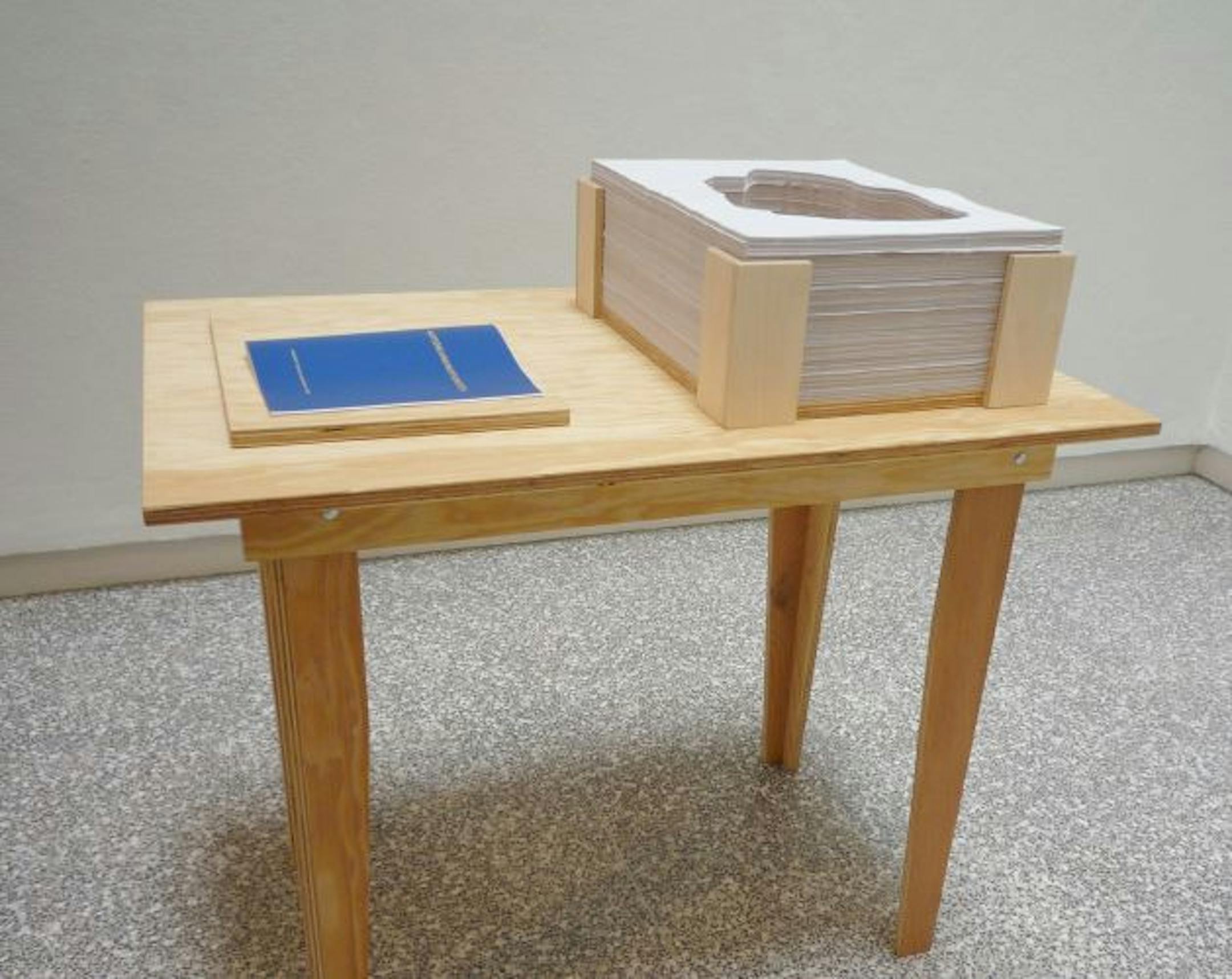
The best piece in the show is Pezalla-Granlund's "Absence," a crater-shaped hole cut into a stack of newsprint. Visitors are asked to remove a sheet, and when they do, the paper collapses into a flaccid, ungainly ring. It's a great moment of surprise and disappointment, the model's lie of information literally falling apart in your hand. Immateriality made touchable.
Paintings from photos
Rye offers more well-crafted ambiguity. Her paintings, based on photographs taken by her brother, a Marine stationed in Fallujah, are fueled by dualities -- unexpected beauty in a grisly war zone, intricate detail matched by intensely lit emptiness, surreal embellishments placed over authentic scenes.
The most intriguing aspect of Rye's work is how it handles the realness of photography. The paintings assert, rightly, that the proximity of a photograph is a lie; to look at them is to understand the huge distance separating us from the conflicts in the Middle East. But in the same moment they absolve this lie. Through the alchemy of painting, Rye re-imbues these photographic sources with the immediacy of being there, bringing us back to a sense of quiet and mystery.
Lobberecht's work marvels at the awkwardness of certain civic speeches and procedures -- oaths, swearings-in, flag plantings, commemoration ceremonies. Like an electrician shutting off power before tinkering with the wires, Lobberecht removes all authority from her formal stagings so that she can study how they work. "The Whole and Nothing But" gets stretched thin over three installations -- a landscaped median and flagpole in the MCAD parking lot, a karaoke screen scrolling text from familiar oaths, and a gallery wall dressed in the style of a passport photo background.


