

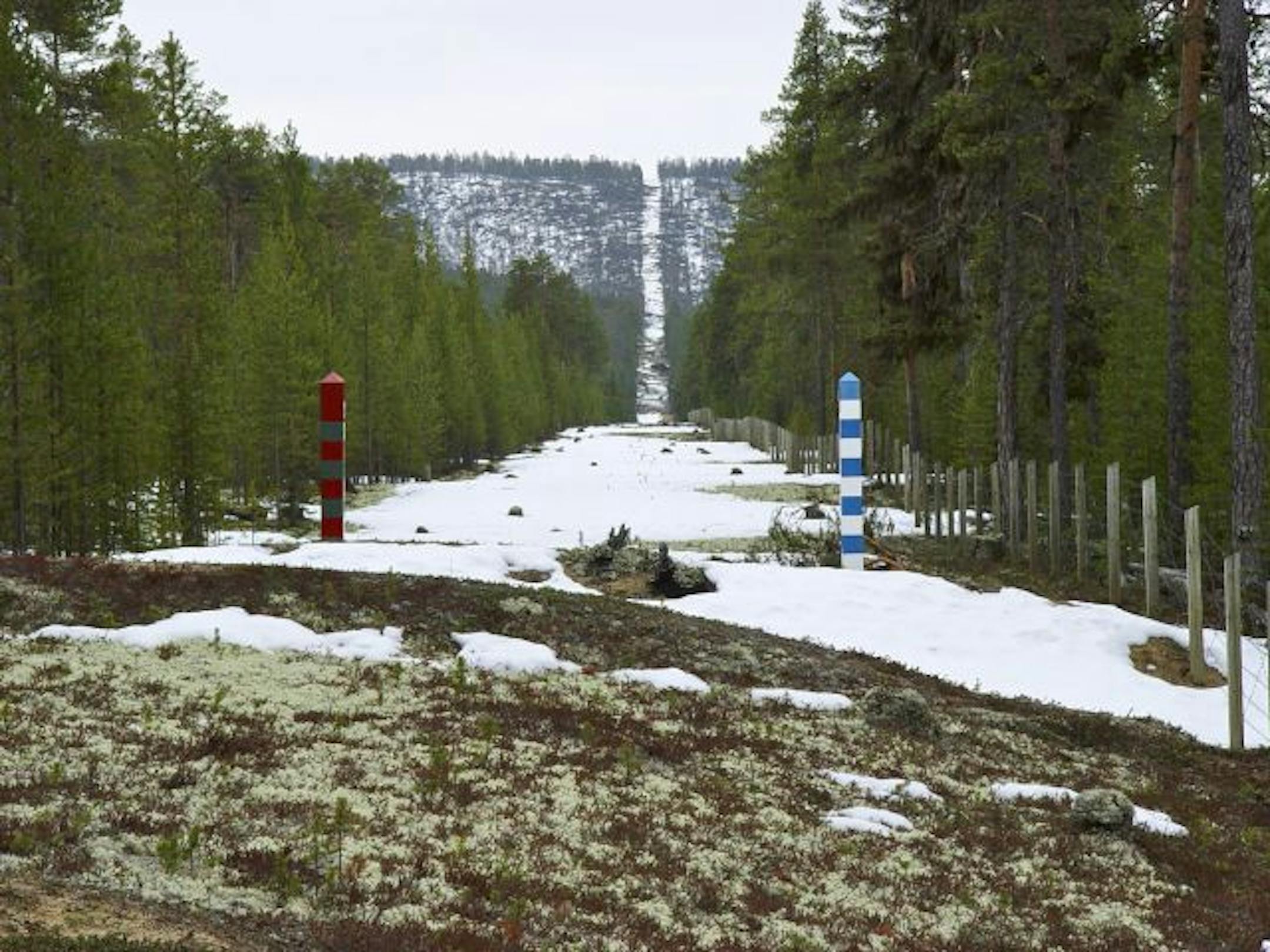
Snaking through the wintry forests and summer meadows of northern Europe is a wide cut in the trees, a grassy path stretching for more than 700 miles. To a casual observer it might appear to be a fire break or an old fashioned power-line corridor. To the Finns and Russians who live on either side, however, the cut denotes the edges of their countries, a no-man's-land patrolled by troops from both nations.
"The border zone is a human construct that in some ways doesn't really exist," said Minna Rainio, a Finnish filmmaker who is a visiting professor of photography at the University of Minnesota. "You can stand three feet on either side of it and nothing really changes. But it is a powerful, arbitrary line in the landscape and people live very different lives on either side of it."
More than a mere national border, the Finnish-Russian line divides East and West, the European Union and Russia, capitalist democracies and post-Soviet oligarchies. No matter that the landscapes are virtually identical, the ideologies bristle with difference.
Fascinated by those psychological undercurrents, Rainio and her British-born husband, Mark Roberts, made "Borderlands," a three-screen video installation that pairs visuals of the serene landscape with voice-overlays in which Finns and Russians talk about the Cold War and the national histories, ideas and fantasies that unite and divide them. Though it appears peaceful enough, that border is still so sensitive that the videographers had to get special permission to work there and were always accompanied by a guard while doing so.
Their video will be shown continuously at the University of Minnesota's Katherine E. Nash Gallery starting today, along with films, videos and photos by seven other European artists with roots around the world. Called "Almos(t)here," the show was organized by Rainio as part of her two-year residency at the university.
"Since the premise of the show is to question these national, fixed boundaries, I thought it appropriate to include artists from different countries," Rainio said recently. "Coincidentally, many of the artists have themselves experienced migration or dislocation. Adel Abidin, for example, was born in Iraq but now lives in Finland and has represented Finland in the Venice Biennale. Pauliina Salminen is Finnish and her husband, Andres Jaschek, is Argentinian but they live in France."
The show's images and installations, which were unavailable for preview, are equally eclectic, Rainio said. Finnish videographer Maria Ylikoski interviewed a Finnish woman who has lived in the United States for 35 years, constructing a bicultural marriage, divorce and identity. In "Unspoken Destinies," Finnish photographer Jaakko Heikkilä produced panoramic images and texts about the Armenian diaspora, including images from communities in Los Angeles and Venice.
"People talk about their experiences and memories," Rainio said. "They might never have been to Armenia but could pray in Armenian or had heard stories about the massacres from their parents or grandparents."


