

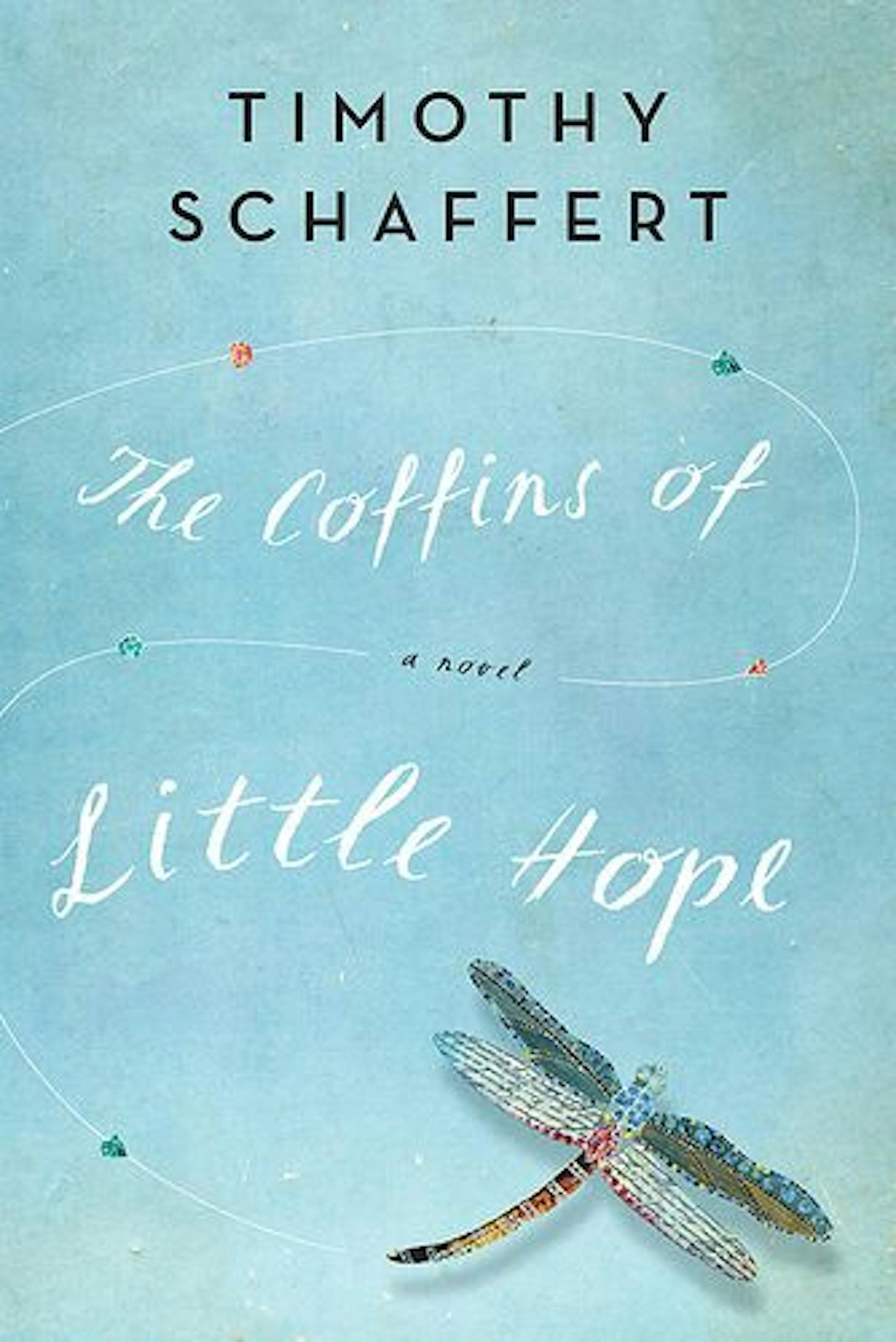
It is usually wise for readers to obey the maxim that "You can't judge a book by its cover." A related maxim might reasonably be "You can't judge a novel by its title," and yet the titles are the very reason it is difficult to resist the novels of Timothy Schaffert. Previous books include "The Phantom Limbs of the Rollow Sisters," "Devils in the Sugar Shop" and "The Singing and Dancing Daughters of God." Now comes another winning title, "The Coffins of Little Hope."
This is a superbly crafted novel set in small-town Nebraska, Schaffert's home state. He grew up on a farm there, lives in the biggest city (Omaha) and teaches writing on the state university's main campus in Lincoln.
Schaffert's protagonist is Esther Myles, an 83-year-old obituary writer for the County Paragraph, a small Nebraska newspaper, who will not give up her 1953 manual typewriter because the quiet clicks coming from a computer keyboard don't "quite fit my sense of what writing sounds like." Her idiosyncrasies are tolerated because her late husband ran the newspaper, and now her grandson is the editor in chief.
Myles does not normally specialize in scoops, but when she hears that an 11-year-old girl named Lenore might have been abducted, she cannot ignore the story, for personal and professional reasons. As Myles investigates, however, the truth becomes more, not less, murky. Was the abduction real, or a hoax perpetrated by Daisy, the alleged mother? Does Lenore even exist in the flesh, or is she a figment of Daisy's imagination?
In a parallel narrative, Schaffert spins a sendup of book publishing. The newspaper employing Myles has been chosen as a contract printer by a New York City publisher for the final book of a bestselling young adult series. The printing is supposed to be confidential, because the publisher wants to avoid leaks before the official release date of the book. The confidentiality disintegrates, though, when somebody reveals portions of the manuscript. The formerly lazy, peaceful Nebraska town is now a center of attention, with amusing and not-so-amusing consequences.
In real life, obituary writers learn a lot about attitudes toward death, but do not normally share those lessons with a wide audience. Schaffert's novel, while not claiming verisimilitude, is filled with Myles' insights, and they track well with those shared by obituary writers I have known in newsrooms across the nation. Myles understands, for example, that when she asks the bereaved what they best remember about the dear departed, the initial answer is usually superficial. If she waits silently, however, deeper truths usually emerge.
Schaffert is an expert at writing deeper truths.
Steve Weinberg is a member of the National Book Critics. He's at www.steveweinbergwriter.com


