After a decade making a name for himself in Brooklyn, sculptor Aaron Spangler returned to Minnesota with his wife and infant son. Settling a few miles from the headwaters of the Mississippi in a spit of a burg called Two Inlets (pop. 237), they aimed to keep things simple. That meant just adding electricity, running water and another room to the log studio he'd hand-built there years earlier.
That was five years ago, and, as it turned out, even Up North, Spangler and his family have never been very far off the grid. Since the move, his big carved-wood sculptures have been shown in New York, Houston, Berlin and Rotterdam and at Walker Art Center in Minneapolis, among other places. Simultaneously, the career of his wife, Amy Thielen, took off with the publication of her award-winning cookbook, "The New Midwestern Table," and the success of her "Heartland Table" television show, now in its second season on the Food Network.
Now Spangler, 43, has a new series of woodcut prints at Highpoint Center for Printmaking in Minneapolis through Nov. 15. With their sophisticated mix of rustic and personal imagery, the prints have been selling briskly to private collectors and museums, including the Walker and the Minneapolis Institute of Arts.
The prints are not as dark, intense or political as his early lead-black sculptures, which bristled with bas-relief images of claustrophobic forests, primitive industrial sites, menacing tools and weapons of war. Chiseled from slabs of basswood procured at a sawmill where Spangler once worked, the brooding sculptures succeeded in "transforming a marginalized craft … into a conduit for the mythology of the Midwest," said Artforum magazine.
Spangler said recently by phone, "In a way, when I was in New York, I was more tied to a rural perspective and rural politics because I was always longing for something that I didn't have there. It's like country western music, which was really created by people who had moved to cities and missed their roots and old life. Coming home definitely freed me from that."
Three years in the making
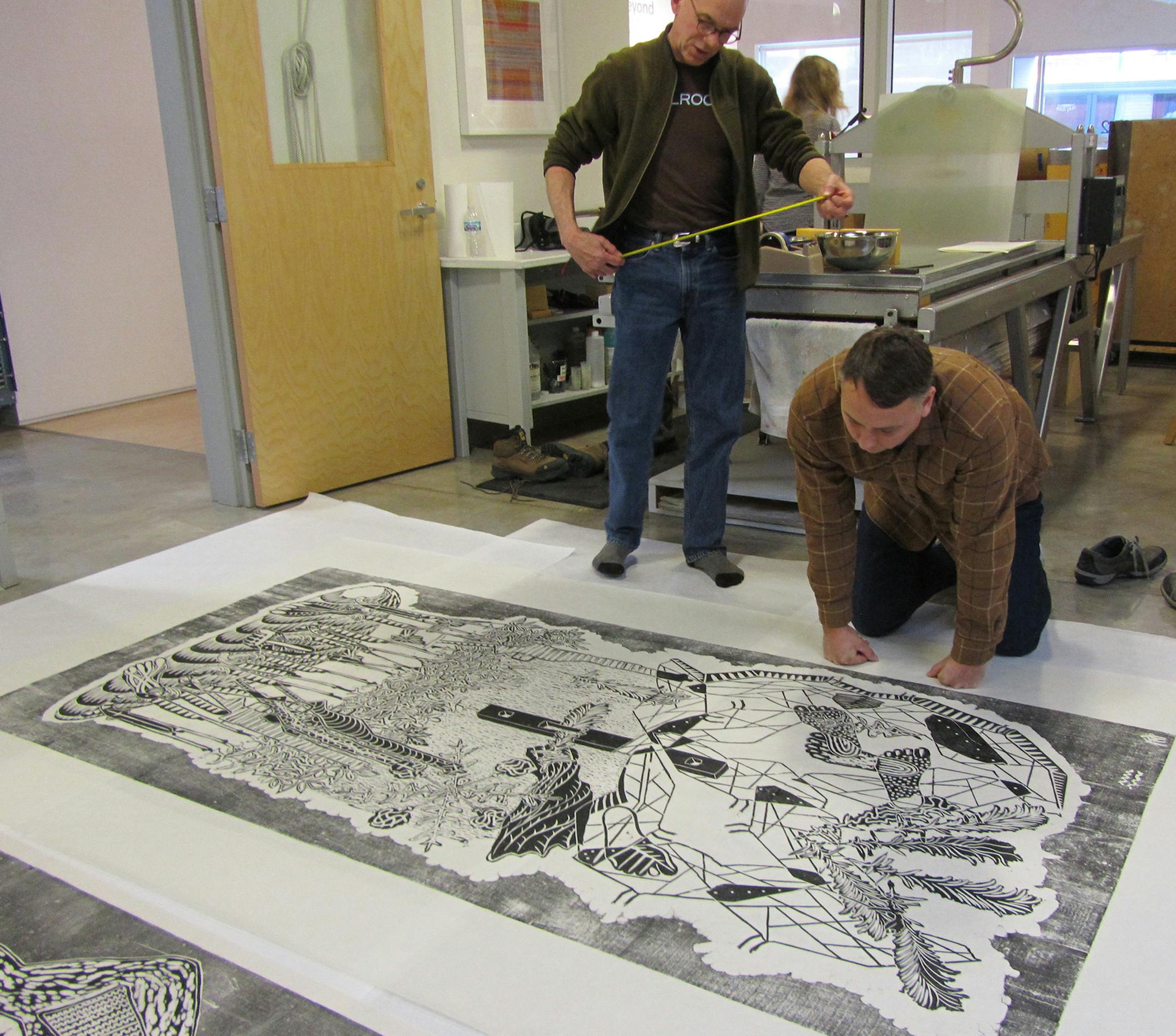
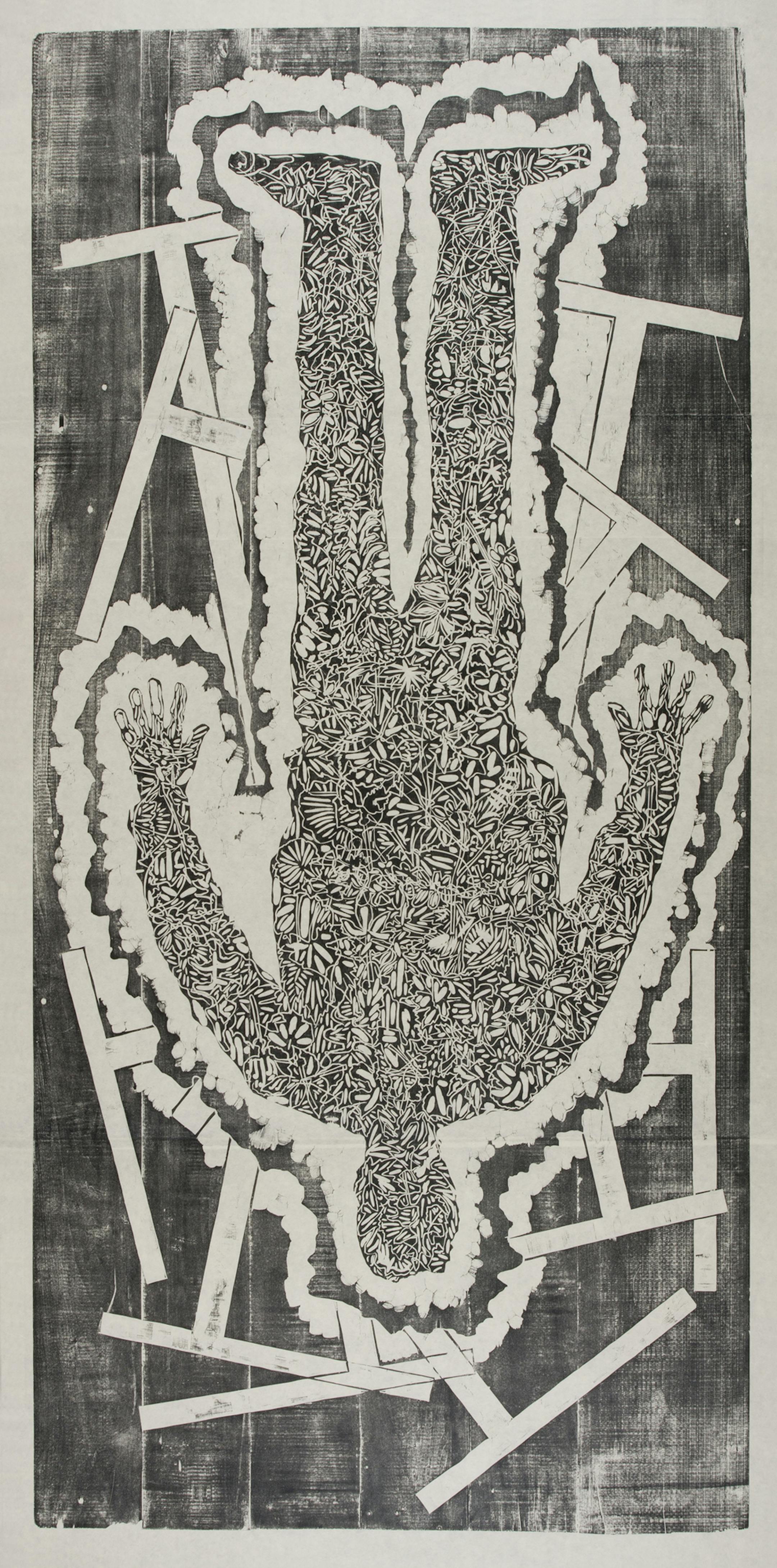
He spent three years, off and on, working on the 10 Highpoint prints. The smallest is about 3 feet square; the three largest are roughly 9 feet tall by 4 feet wide.
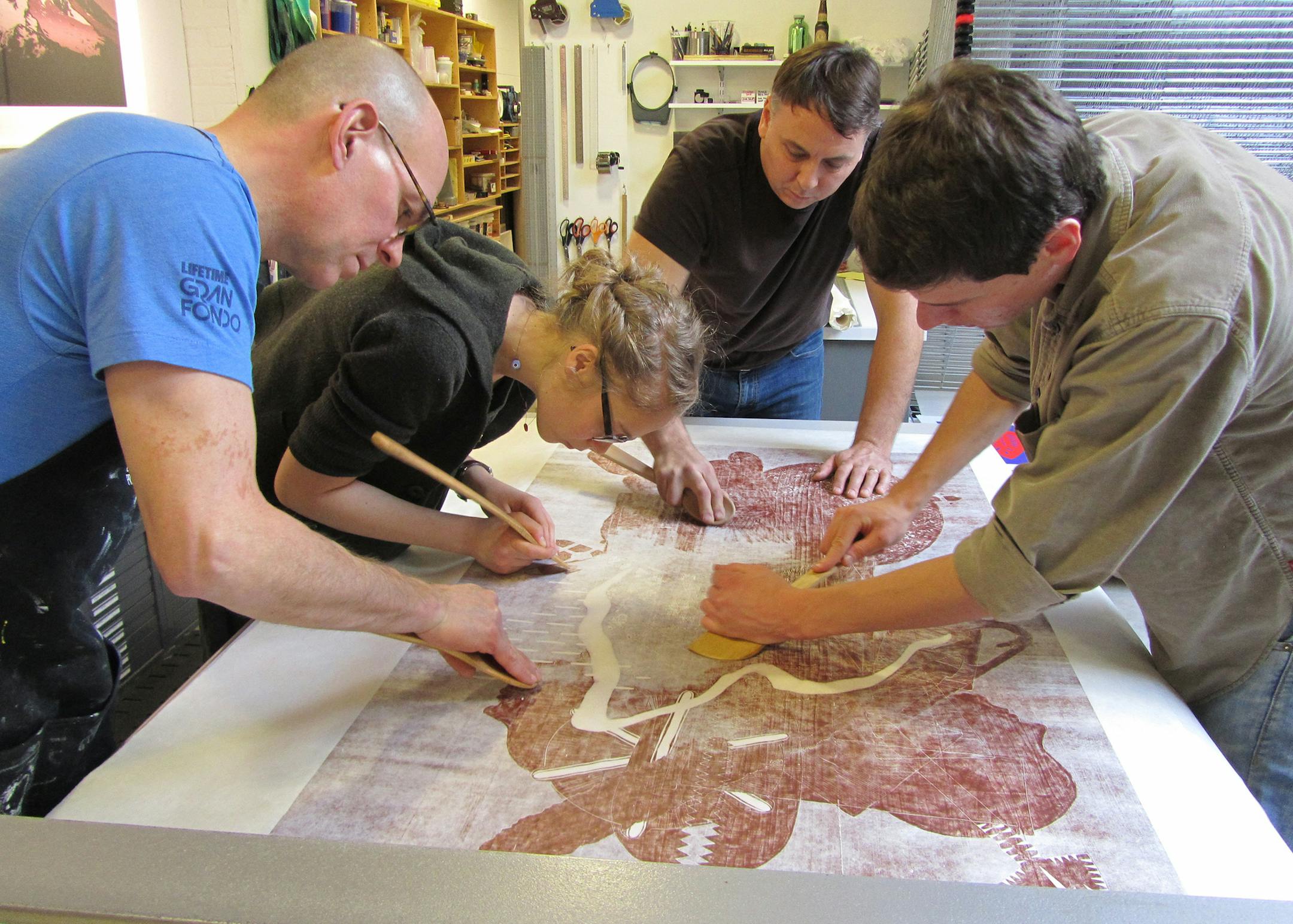
At a glance, they look like big abstract jigsaw puzzles — jumbles of black-and-white stripes, zipper-ribbons, dots, gouges, squiggles, feathery marks — on gray backgrounds that resemble stained floorboards. Upon scrutiny, images appear — of body parts (hands, footprints, heads, outlined torsos); tools (levels, gouges, rakes, chisels, saw blades), and other stuff (chair arms, crosses, kitchen utensils, guns). The images overlap, fragment, fold and break apart. One print is a rusty brown; all the rest are black, white and gray.
Outlines of guns recur, but they are not intended as a statement about weapons, he said.