
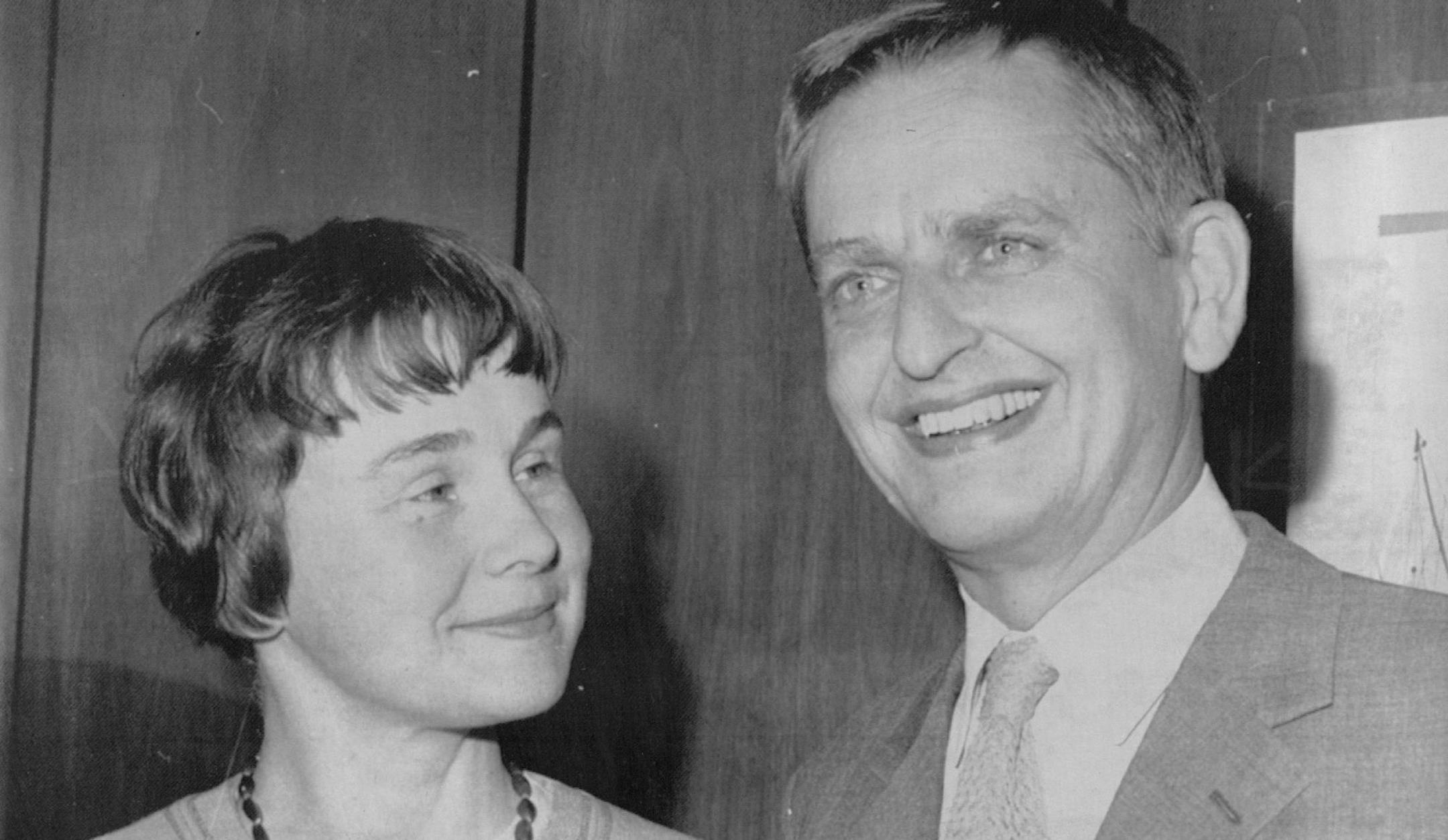
Also noted: Lisbeth Palme, Sweden's first lady who witnessed her husband's assassination

October 20, 2018 at 10:59PM
June 4, 1970 Palme Explains -- Swedish Prime Minister Olof Palme and his wife arrive in New York en route to commencement exercises at Kenyon College, Gambier, Ohio. Palme said that in one of the recent anti-U.S. demonstrations against Ambassador Jerome Holland, American expatriates had played a conspicuous role. Associated Press Photo
Swedish Prime Minister Olof Palme and his wife, Lisbeth, came to the U.S. in June 1970 for graduation ceremonies at Kenyon College in Ohio. Olof Palme was a 1948 Kenyon graduate. (The Minnesota Star Tribune)

Lisbeth Palme, 87, a crucial witness in one of the biggest unsolved crimes in modern European history, the 1986 murder of her husband, Prime Minister Olof Palme of Sweden, has died.

Prime Minister Stefan Lofven noted her death Thursday in a Facebook post, calling Palme, a child psychologist, "a committed champion of the child's right," a reference to her work on children's issues for the United Nations and others. The date and location of her death were not immediately reported.

Palme had just left a movie theater in Stockholm with her husband on the night of Feb. 28, 1986, when someone stepped out of the shadows and fired several shots. Olof Palme, who was not accompanied by security guards, collapsed on the sidewalk. Once the police arrived, it took them awhile to realize who he was, although Lisbeth Palme is said to have shouted: "Don't you see who it is? They've shot my Olof!"

Lisbeth Palme was grazed by a bullet but not seriously hurt. Her husband, though, died shortly after. And the country, which was unaccustomed to gun violence, was in shock — so much so that the trauma has still not completely worn off, especially with the crime unsolved.

"Our idea of Sweden back then was of a bucolic, tranquil haven, where leaders lived like the ordinary people," Jonas Hinnfors, professor of politics at the University of Göteborg, said in 2016 for a New York Times article on the 30th anniversary of the shooting. "Yet suddenly, there lies the prime minister in his own blood, and the legal system fails to find the killer. Our self-image was shattered."

The police investigation was widely criticized for sloppiness. The shell casings, for instance, were found not by investigators but by passers-by. In 1988, a career criminal with a substance-abuse problem, Christer Pettersson, was convicted, in part on the strength of Lisbeth Palme's identification of him as the killer. But the next year a higher court set him free, citing a shortage of evidence and questions about the credibility of her identification.

In the years since, there has been no end of speculation about who carried out the killing and why. The guessing game has examined the political positions and international involvements of Olof Palme, a member of the Social Democratic Party who had been a force in Sweden for years. The killing, depending on the theory, involved Kurdish rebels, an international arms deal, the CIA or Croatian terrorists.

Anna Lisbeth Christina Beck-Friis was born on March 14, 1931, in Stockholm. She and Olof Palme married in 1956.

As a child psychologist she was a senior staff member of Sweden's social welfare department. She continued in the public arena after her husband's death: In November 1986, she was named chairwoman of the Swedish committee for UNICEF, the U.N. Children's Fund. She was UNICEF's worldwide chairwoman in 1991 and 1992.

She was also one of seven members of an international panel that in 2000 issued a report criticizing the U.S. and other governments, as well as religious groups, for not doing enough to stop the 1994 genocide in Rwanda.

Takehisa Kosugi, 80, an avant-garde composer who was an accomplished violinist but who was just as likely to play bicycle spokes or inflatable balls in his innovative explorations of the sonic landscape, died on Oct. 12 in Ashiya City, Japan.

The Merce Cunningham Trust said the cause was esophageal cancer. Kosugi composed for and performed with the Merce Cunningham Dance Company for decades and was its music director from 1995 to 2012.

In a long career on the cutting edge, Kosugi's interests were in creating events rather than traditional musical works; in examining all parts of the acoustical spectrum, and in challenging audience expectations.

Takehisa Kosugi was born on March 14, 1938, in Tokyo. He studied music at the Tokyo University of the Arts, graduating in 1962. While still a student he was among the founders of Group Ongaku, an improvisational music ensemble that explored the idea that physical actions could constitute music.

"There is a radical integrity to everything he did that stayed razor sharp," said Jay Sanders, who curated "Takehisa Kosugi: Music Expanded," a 2015 retrospective at the Whitney Museum of American Art in New York.

Kosugi became identified with Fluxus, a movement that defined art in terms of experiences, as well as traditional forms like paintings or musical compositions.

Kosugi also created performance-based works in this period, and in 1967 — assisted by two other artists then building their avant-garde reputations, Nam June Paik and Charlotte Moorman — he offered some in a program called "Music Expanded" at Town Hall in Manhattan.

Barbara Moore, a Fluxus historian, described these early works as "more what is now called performance art — in his case with strong visual components implying a musical connection rather than making it explicit."

Kosugi's later performances, Moore said were more conventional, with him and others playing instruments or creating electronically amplified sounds from various sources.

Cornelius Gallagher, 97, a New Jersey Democrat who used his clout in Congress to protest the erosion of privacy for Americans, ruefully calling the United States a "nation of snoopers," before losing his seat amid redistricting and allegations of tax fraud and other scandals, died Wednesday at his home in Monroe Township, N.J. Gallagher served in the House from 1959 to 1973.

The cause was brain cancer.

An Army veteran of World War II and the Korean War, he received two awards of the Bronze Star Medal and three Purple Hearts. In Congress, he accumulated a solidly liberal voting record. He was an early supporter of Sen. John F. Kennedy, D-Mass., in his bid for the presidency in 1960 and was mentioned as a possible vice presidential running mate for President Lyndon B. Johnson in 1964.

Gallagher "represented the best of New Jersey Democratic politics" in the late 1960s and early 1970s, helping to make "the New Jersey delegation one of the most formidable in the House," said Ross Baker, a professor of political science at Rutgers University.

Some members of the delegation "went on to greater things; others to ignominy. Sadly, Neil Gallagher was one of the latter," Baker continued. "At his noblest, Gallagher was a champion of the rights of American citizens to privacy. He served his country gallantly in World War II but succumbed to the corrosiveness of New Jersey's environment of official corruption."

U.S. citizens, Gallagher contended, were being slowly stripped of their civil liberties by invasive federal agencies, "big computers" that collected personal data and businesses that used such tools as cameras and two-way mirrors to guard against shoplifting and bank robbery.

On the Committee on Government Operations, he chaired a subcommittee on the invasion of privacy. He introduced legislation to severely curtail government use of polygraph tests, which he considered unreliable.

Gallagher's political career turned rocky in 1968, when an article in Life magazine depicted him as a "tool and collaborator of a Cosa Nostra ganglord."

He fiercely denied the allegations and was reelected easily that year and again in 1970. But his final term in Congress proved more tumultuous.

In April 1972, Gallagher was indicted on charges of attempting to evade $102,000 in income taxes, perjury stemming from grand jury testimony and a conspiracy with local New Jersey officials to obscure kickbacks. He insisted on his innocence and said that the charges should alarm "anyone who disagrees with the new Caesars in America."

Later that year, after redistricting combined his district with another, Gallagher lost his seat to U.S. Rep. Dominick Daniels in the primary, who went on to win election.

In late 1972, after an initial not-guilty plea, Gallagher pleaded guilty to tax evasion. He served 17 months in prison.

Cornelius Edward Gallagher was born in Bayonne, N.J., on March 2, 1921.

news services


FILE — The avant-garde composer Takehisa Kosugi performs at the Whitney Museum of American Art in New York, Sept. 12, 2015. Kosugi, the longtime music director of the Merce Cunningham Dance Company, often explored found sounds through compositions that set out challenged audience expectations. He died on Oct. 12, 2018, at age 80. (Hiroyuki Ito/The New York Times)
The avant-garde composer Takehisa Kosugi was the longtime music director of the Merce Cunningham Dance Company. He died Wednesday at 80. (The Minnesota Star Tribune)
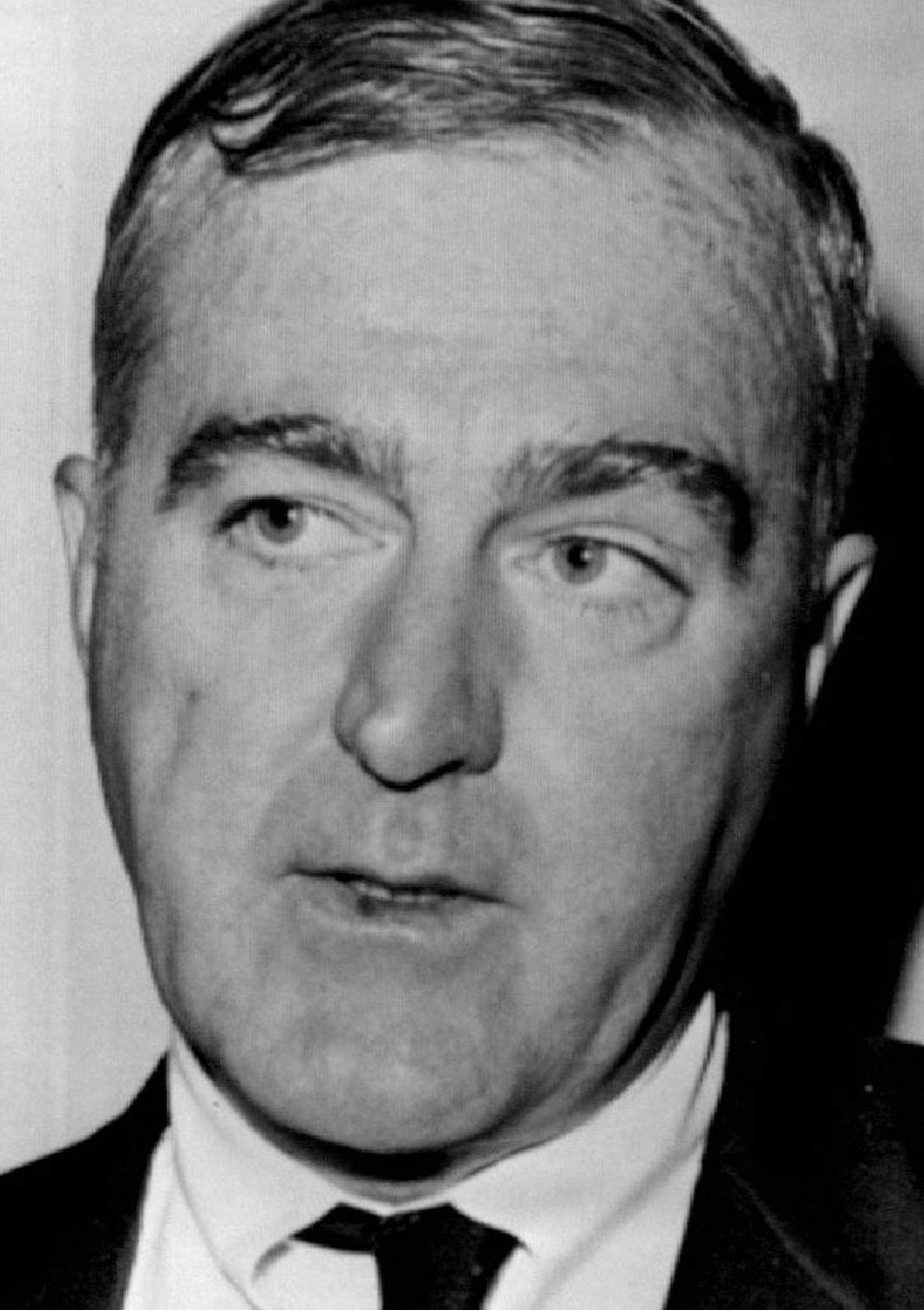
January 11, 1966 REVEALS PLACE MOVE TIMING -- Rep. Cornelius Gallagher, D-N.J., a member of the House Foreign Affairs Committee, talks with newsmen today after hearing Undersecretary of State George Ball's closed briefing on Viet Nam peace moves. He said America's direct communication with Hanoi came soon after the Christmas eve suspension of bombing raids on North Viet Nam. January 13, 1966 February 26, 1970 AP Wirephoto; Minneapolis Star Tribune
Gallagher (The Minnesota Star Tribune)
about the writer

about the writer

More from Minnesota Star Tribune

See More
card image
J. SCOTT APPLEWHITE, ASSOCIATED PRESS/The Minnesota Star Tribune

The "winners" have all been Turkeys, no matter the honor's name.

In this photo taken Monday, March 6, 2017, in San Francisco, released confidential files by The University of California of a sexual misconduct case, like this one against UC Santa Cruz Latin Studies professor Hector Perla is shown. Perla was accused of raping a student during a wine-tasting outing in June 2015. Some of the files are so heavily redacted that on many pages no words are visible. Perla is one of 113 UC employees found to have violated the system's sexual misconduct policies in rece