
Also noted: Aileen Mehle, gossip columnist known as 'Suzy'

November 12, 2016 at 3:15AM
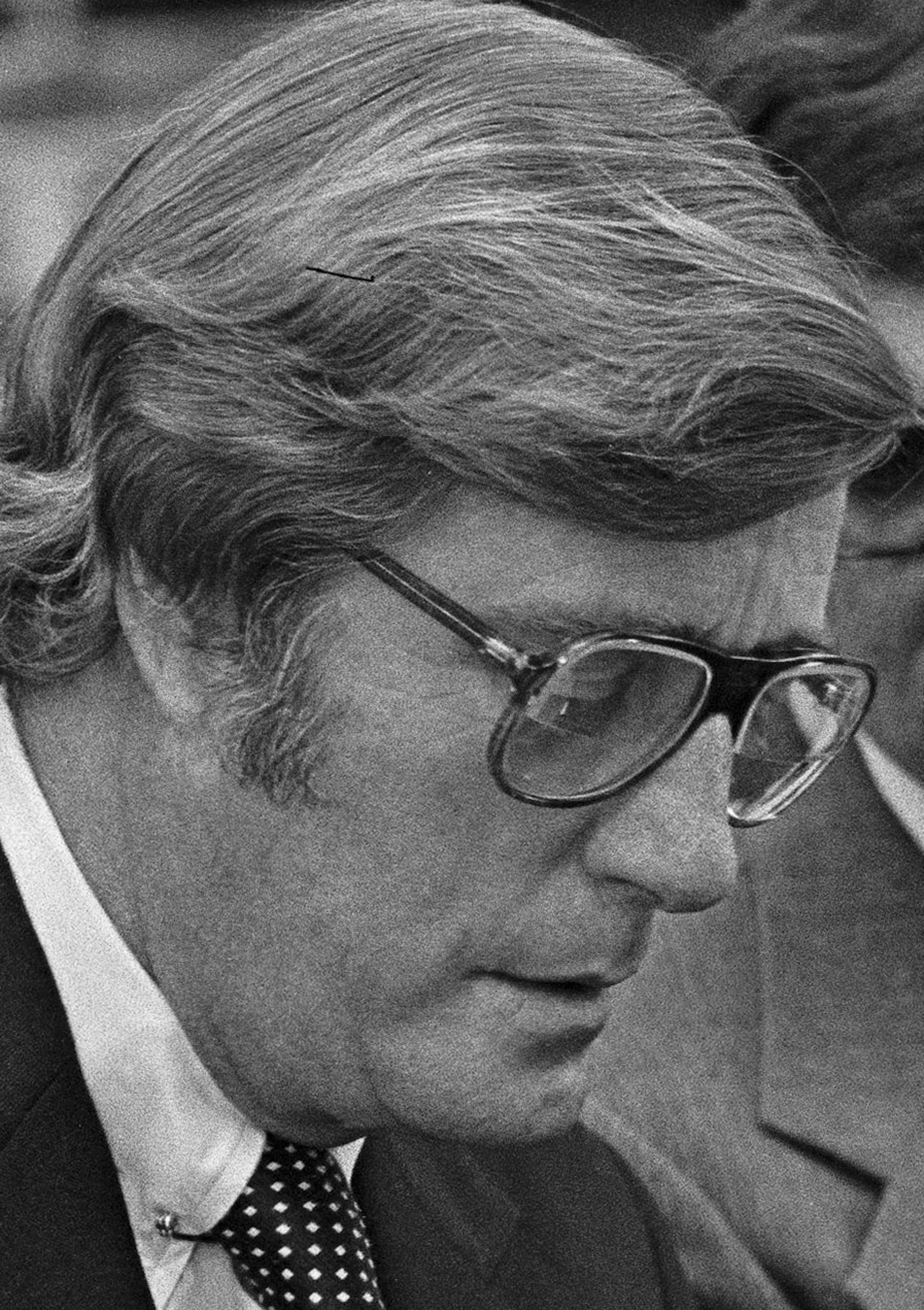
FILE — E. Barrett Prettyman Jr., left, confers with his assistant Allen Snyder during a House Committee on Ethics meeting in Washington, Feb. 20, 1980. Prettyman Jr., a prominent Washington lawyer who played crucial backstage roles in the Supreme Court’s unanimous school desegregation decision, the first expulsion by Congress of one of its members in more than a century, and the release of prisoners captured in the abortive Bay of Pigs invasion of Cuba, died on Nov. 4, 2016, in Was
Prettyman (The Minnesota Star Tribune)

Aileen Mehle, 98, who titillated readers with her rapier wit for five decades as "Suzy," the glamorous nationally syndicated grande dame of tabloid society gossip columnists, died Friday at her home in Manhattan.

"Glamour was her occupation; she wrote about it and lived it," Blaine Trump, Donald Trump's former sister-in-law, said in an interview. "She was the social historian of her era."

Mehle (pronounced MAY-lee) admitted to indulging in trivia and superficiality, but was unapologetic about her professed mission: to add some spice to the quotidian lives of her millions of readers.

Those millions read her column in scores of newspapers across the country and knew her face from her regular appearances as a panelist on the CBS game show "What's My Line" in the 1960s.

Mehle was recruited in the early 1950s by the New York Daily Mirror, a raffish Hearst tabloid, and worked, in succession, for the New York Journal-American, the New York Daily News, the New York Post and Women's Wear Daily. Though readers knew her across the nation as a syndicated columnist, New York was her base.

Phyllis Cerf, the children's book publisher, said in 1970 that Mehle had performed in the guise of a "Mother Goose for adults," eavesdropping and rubbernecking to report on the very people with whom she partied.

"The people I cover have no more secrets than any others," Mehle said. "Just more money." Life magazine labeled her America's "No. 1 Society Snooper."

Clarence M. Ditlow III, 72, widely regarded as the United States' foremost advocate for automotive safety, who championed seat belts, air bags, electronics to avert crashes and campaigns to force the recall of millions of dangerously flawed motor vehicles, died Thursday night in Washington, D.C., of cancer.

As head of the Center for Auto Safety, based in Washington, for 40 years, Ditlow exposed hundreds of automotive defects. He was instrumental in forcing manufacturers to recall the Ford Pintos with infamous exploding gas tanks, Toyotas that suddenly accelerated out of control and GM pickups with sidesaddle gas tanks that blew up in collisions, killing more than 1,000.

With a budget less than half the cost of one General Motors Super Bowl commercial, Ditlow took on auto industry giants in lawsuits that tightened standards for ignition systems, air bags and fuel ­efficiency; lobbied government agencies to ban driving while texting or using cellphones; and achieved "lemon laws" in all 50 states that made it easier for buyers to return defective vehicles.

"He was the nightmare of the misbehaving auto industry and the dream of safety-conscious motorists," Ralph Nader, the consumer advocate and Ditlow's mentor, said. "He was also honest, ethical and self-effacing."

An engineer and lawyer, Ditlow collaborated with Nader on "The Lemon Book" (1980), on "The Lemon Book: Auto Rights" (1990) and on many safety articles. He also wrote about the tendency of some vehicles to roll over, to jump from park into reverse gear and to power off with a loss of all controls and air bags while being driven.

"When regulators sleep and auto companies place profits over safety, safety defects pile up," Ditlow and Nader wrote in an Op-Ed article in the New York Times in 2014.

Yaffa Eliach, 81, a survivor and historian of the Holocaust who memorialized its victims not by recording their deaths but by remembering their lives in a massive photography collection that became a centerpiece of the U.S. Holocaust Memorial Museum, died Tuesday at her home in New York City.

She had dementia, said her husband, David Eliach.

Among the 1,500 images displayed in the Holocaust Museum's three-story Tower of Faces is one that depicts a bright-eyed girl in a gingham dress and surrounded by chickens, her face locked in a permanent expression of curious delight. The girl was Eliach and the photo was taken on the day in June 1941 when Germans occupied her Lithuanian hometown, Eishyshok, southwest of Vilna.

Three months later, Nazi mobile killing units would execute nearly its entire Jewish population of 3,500 in two days. Eliach, who was hiding with a Polish housekeeper, was one of 29 to survive.

Along with her parents, who also had evaded capture, she would later hide for a period in the attic of a carriage house. There, her infant brother was suffocated in an effort to muffle his cries when Germans entered the building. They found refuge in a pit beneath a pigsty, where Eliach used the earthen wall as a chalkboard, learning the Hebrew alphabet.

After her liberation in 1944, she immigrated to Israel and ultimately settled in the United States.

As a professor at Brooklyn College, Eliach helped build the field of Holocaust studies in U.S. universities. But she forged perhaps her most lasting legacy through a 17-year odyssey that took her across the diaspora to collect photographs and other documentation of every Jew who lived in Eishyshok in the 20th century. She considered Eishyshok the "paradigm of Eastern European shtetl life" that was extinguished by the Nazis.

Because so few residents of Eishyshok survived, the search for their traces was an arduous undertaking. Eliach helped one man exhume photos that he had buried in a tin in Israel. She located other photos in a former synagogue in Detroit.

Eliach reported that she located photographs of 98 percent of the Jews of Eishyshok. The collection became a principal exhibition at the Holocaust Museum in Washington after it opened in 1994.

E. Barrett Prettyman Jr., 91, a lawyer who had an advisory role in the Supreme Court's landmark 1954 decision Brown v. Board of Education, which outlawed segregated schools, and who decades later investigated congressional corruption in the Abscam case, died Nov. 4 at a Washington, D.C., hospital. The cause was a respiratory ailment.

Prettyman was a law clerk to three Supreme Court justices in the 1950s, an assistant to Attorney General Robert Kennedy and, in later years, a mentor to current U.S. Chief Justice John Roberts Jr.

In 1962, Prettyman negotiated with Cuban leader Fidel Castro for the release of prisoners taken in the ill-fated Bay of Pigs operation, and his clients later included General Motors, acclaimed writers such as Truman Capote and former Beatle John Lennon.

Prettyman's contribution to Brown v. Board was unknown until author Richard Kluger described it in his 1976 book, "Simple Justice."

Prettyman was a clerk to Justice Robert Jackson, who had drafted a separate opinion in support of the court's unanimous decision regarding segregated schools. After reading Jackson's concurring opinion, Prettyman realized it could be seen as, at best, a lukewarm endorsement.

He composed a sharply worded memorandum in which he urged Jackson not to publish his separate opinion.

"I told him quite candidly," he said in a 1996 interview, "that I didn't think much of the opinion, that it sounded more like a dissent than a concurring opinion."

He argued that Jackson's separate opinion would only undercut the force of the court's unified ruling. Jackson ultimately agreed, and the opinion was never published.

news services

FILE - In this March 2, 2010 file photo, Center for Auto Safety Executive Director Clarence Ditlow, testifies on Capitol Hill in Washington. Ditlow, whose work forced the auto industry to make improvements including installing air bags, has died. The center announced Ditlow’s death at the George Washington University Hospital in a post on its website. He was 72. (AP Photo/Manuel Balce Ceneta, File)
Ditlow, (The Minnesota Star Tribune)
about the writer

about the writer

More from Minnesota Star Tribune

See More
card image
J. SCOTT APPLEWHITE, ASSOCIATED PRESS/The Minnesota Star Tribune

The "winners" have all been Turkeys, no matter the honor's name.

In this photo taken Monday, March 6, 2017, in San Francisco, released confidential files by The University of California of a sexual misconduct case, like this one against UC Santa Cruz Latin Studies professor Hector Perla is shown. Perla was accused of raping a student during a wine-tasting outing in June 2015. Some of the files are so heavily redacted that on many pages no words are visible. Perla is one of 113 UC employees found to have violated the system's sexual misconduct policies in rece