

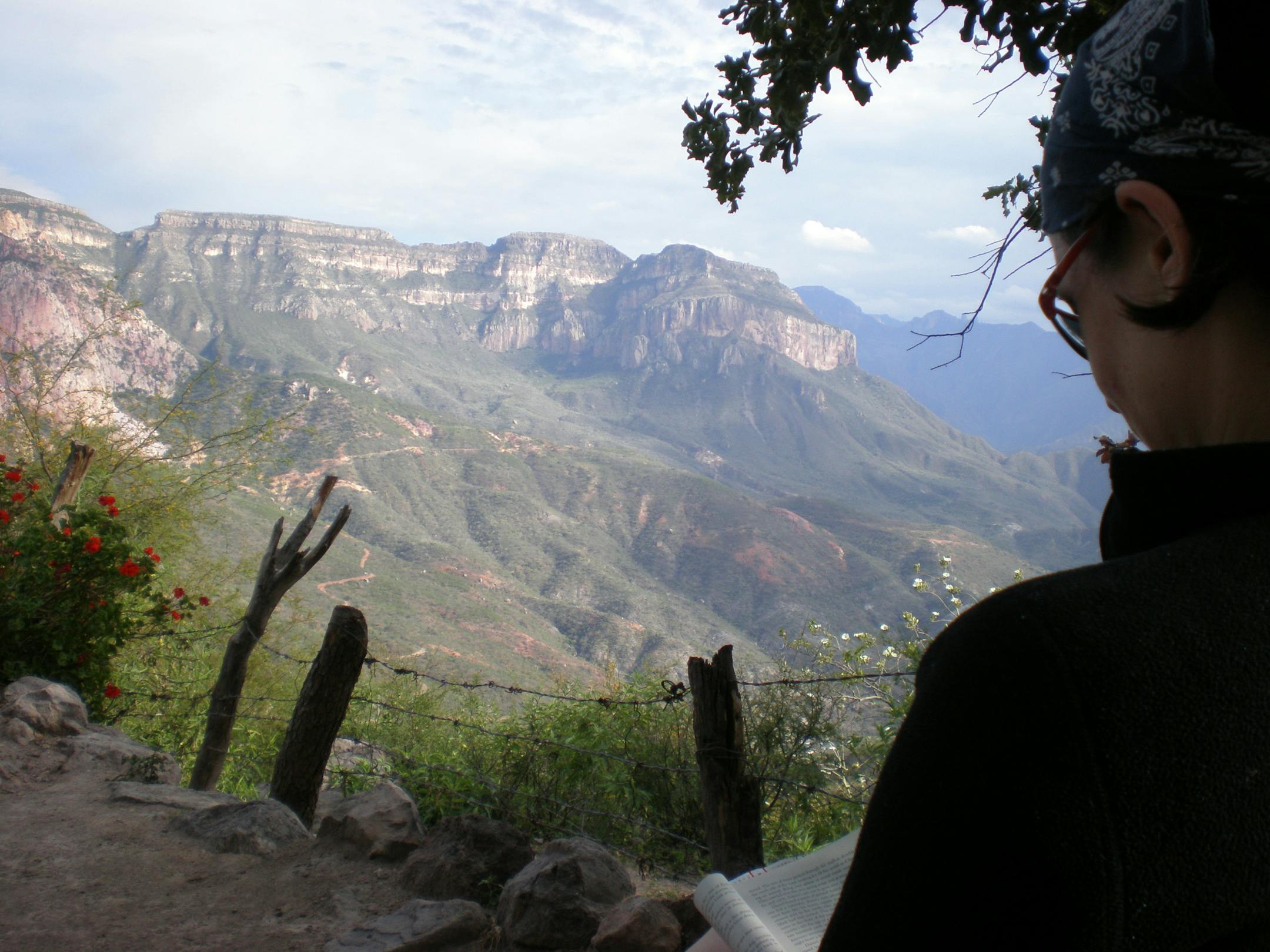
The scene was worthy of a classic western in which the hero and his companions look out to the horizon, showing the rough road ahead and the rugged beauty of the landscape. Appropriately, I had the reverbed-out theme from "The Good, the Bad and the Ugly" running through my head. My wife, Suzanne, and I were looking over Urique Canyon, with striated red cliffs rising above the rim to the north, and to the west a darker, greener landscape that resembled a crumpled piece of paper, half-smoothed-out again. Through a light fog, we saw the silvery Urique River snaking in the distance. A stray donkey eyed us, apparently more spooked by strangers than the 800-foot drop.
We were in the midst of a four-day hike in Copper Canyon, also known as Barrancas del Cobre, a sprawling series of canyons within the Sierra Madre in the northern Mexican state of Chihuahua. The vistas there rival those of the Grand Canyon in rough-hewn splendor, but the fuzzy geographic definition of what actually constitutes the canyon makes it difficult to evaluate locals' claim that it is deeper and larger than that northern wonder. That ambiguity aside, the area offers spectacular views -- whether from the popular Copper Canyon Railway, which runs from the city of Chihuahua to the town of Los Mochis on the Sea of Cortez, or from the dusty trail.
We had chosen Copper Canyon as the first destination in a February honeymoon that eventually took us to the Sea of Cortez and then across to the Baja Peninsula. For a sometimes indecisive type like me, the combination was perfect: a few days of vigorous hiking followed by a seaside rest; a camping trip, but one made cushy by guides who cooked for us and a pack mule that hauled our gear.
Before we hit the trail, our travel plan was more "Planes, Trains & Automobiles" than "The Good, the Bad and the Ugly." In quick succession we flew to the city of Chihuahua, rode the Copper Canyon Railway to the frontier town of Creel, and then hung onto our hats as our outfitter drove us 80 switch-backed miles down into the canyons, to the small town of Batopilas.
A glittering past
Once a silver boomtown, Batopilas retains an Old West feel, with cobblestone streets, turn-of-the-century buildings, mining-era aque-ducts and a population of 1,300, about a quarter of its peak in the late 19th century.
In the last silver era, long before the railway to the coast was finished, mule trains carried people into and silver bullion out of the canyon's remote reaches. These were elaborate logistical affairs requiring stocked way stations, and the route was often chosen at the last minute to confuse banditos. Our four-day trek took us up and out of the Batopilas canyon, across a plateau -- tracing one part of the old silver mule train route -- and then down into Urique Canyon, a distance of 35 miles and a total ascent (and then descent) of 5,000 feet.
Along the way we passed the ranches of the canyons' indigenous people, who once populated much of the adjoining Chihuahua plateau but have now largely retreated into the canyon complex to avoid Western influences and exploitation. Long stretches between the canyons' pueblos has helped foster a unique local culture of long-distance running. In fact, outsiders refer to the locals as the Tarahumara, after the mountains that surround them, but the valley's original people know themselves in their own language as the Raramuri, the fast runners. Those who still run often do so wearing traditional breech cloths and blouses, and sandals or nothing at all on their feet. (Writer Christopher McDougall's recent memoir of running an ultramarathon in Copper Canyon called "Born to Run" has helped make running barefoot or in simple flat shoes a trend in the United States.)


