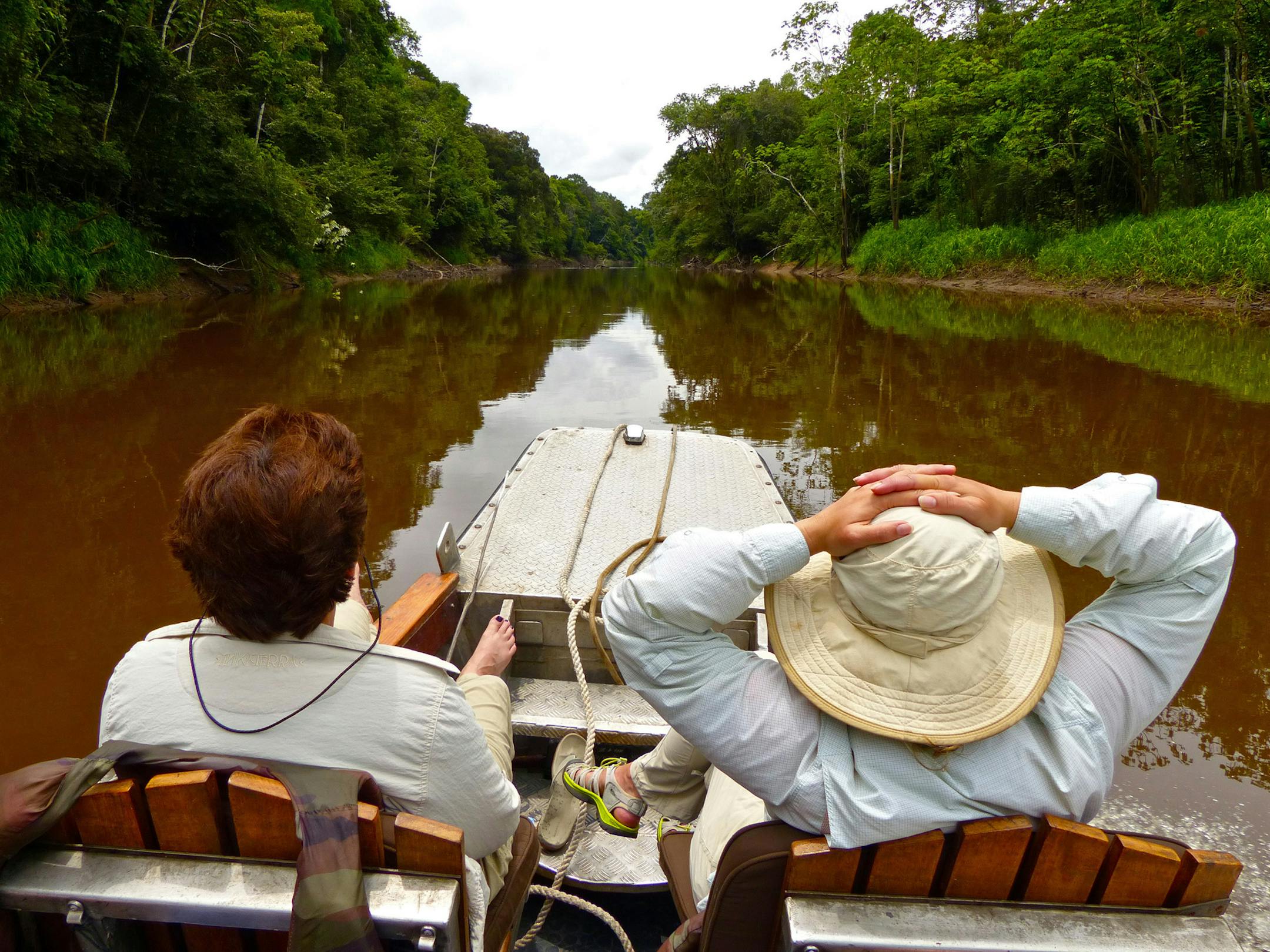
I'd always imagined that the entire Amazon region is covered in a canopy of trees so clotted with branches and leaves that the sun pokes through only in thin slants. That's certainly what it looked like from above — a pillow of emerald treetops cut through with a curving ribbon of water the color of a Hershey bar. Yet there I was, squinting even behind sunglasses, as I stepped out of the plane onto the tarmac of the Iquitos airport, deep in the Peruvian rain forest.
The Amazon River journey I took with friends offered other surprises, too. I'd headed there slightly panicked about possible dangers lurking in its waters and on shore. The nurse I saw at the international travel clinic before the trip had done nothing to discourage my paranoia, stabbing my shoulder with all manner of shots and arming me with malaria pills, a bottle of Cipro and a leaflet that spelled out the possibly fatal nature of Dengue fever, a tropical disease for which there is no vaccine. Yet, I would later stop taking my malaria pills. And I only smiled when, after we'd returned to Minnesota, one of my travel companions forwarded an Internet factoid about a man who got an infection from parasites who'd swum up his urine stream as he relieved himself off the side of a boat on the Amazon. Unlike me, she'd conveniently forgone the group swim in a tributary of the legendary river.
Iquitos is 2,000 miles from the Atlantic — the most remote inland port in the world — and is accessible only by plane or boat (most travelers fly from Lima). But it's hardly what you'd call sleepy. More than 400,000 people live in this city, and the main street is frenetic, with hundreds of merchants displaying their wares — coconuts, wigs, TVs, brooms, catfish — to the riders buzzing in and out of traffic on their motorcycles or motocarros, which are basically motorcycles attached to rickshaws.
That chaos dissolved the moment we pulled up to a dock on the edge of the city, where our home for the next three nights was moored. With only 12 guest rooms — each a harmonious blend of picture windows, modern lines and seriously high thread counts — the Aqua Amazon feels more like a country house from Dwell magazine than a cruise ship.
Launched in 2007 by a former Galapagos cruise company executive who wanted to bring luxury to the world's great rivers, the Aqua takes its guests up the Amazon and tributaries deep into the Pacaya Samiria National Reserve, a protected area in Peru that, at 5 million acres, is twice the size of Yellowstone.
Close-ups of wildlife
The first thing I noticed about the Amazon is that it's so wide it's difficult to make out the landmarks on the opposite shore. We were there in early November, which is considered the "dry" season, so the river was low and as still as a cup of coffee. As we glided out of Iquitos, cellphones went out of service. In fact, throughout the cruise, the only time I realized we were approaching anything close to civilization was when the crew rushed up to the deck to point their phones in the direction of stray lights blinking in the distance.
Days on the Aqua revolve around morning and afternoon excursions on two skiffs, each staffed by a driver, a naturalist and a medic. Our naturalists were Julio and Ricardo, who both grew up in the jungle and are passionate about preserving their region's ecosystem. Each is a bilingual encyclopedia of information, especially about the Amazon's birds.
For the entire first morning, the smaller rivers looked the same to me: brown water, vines, tree trunks, leaves, sky. But then Ricardo put his hand above his eyes and the skiff bumped to a halt.