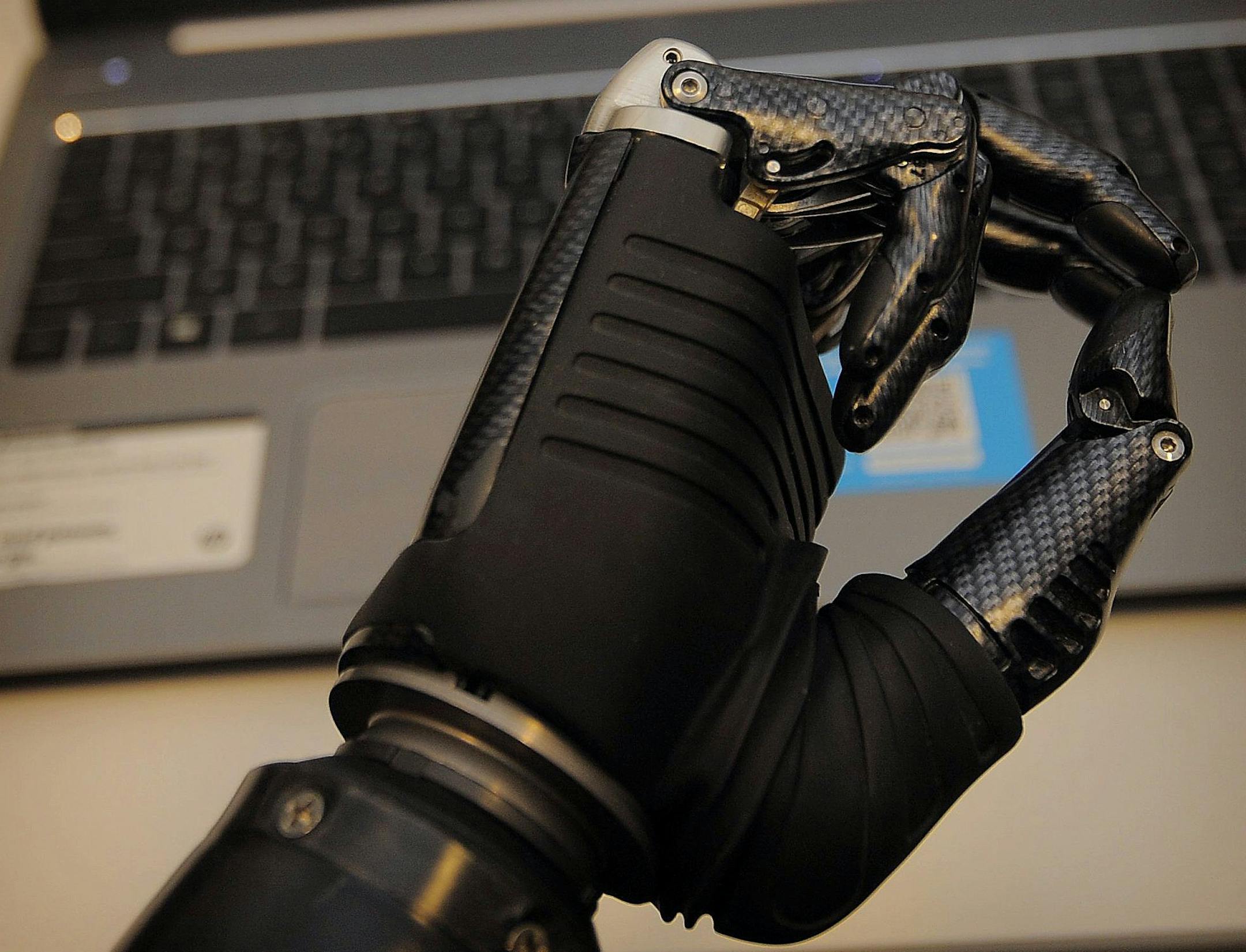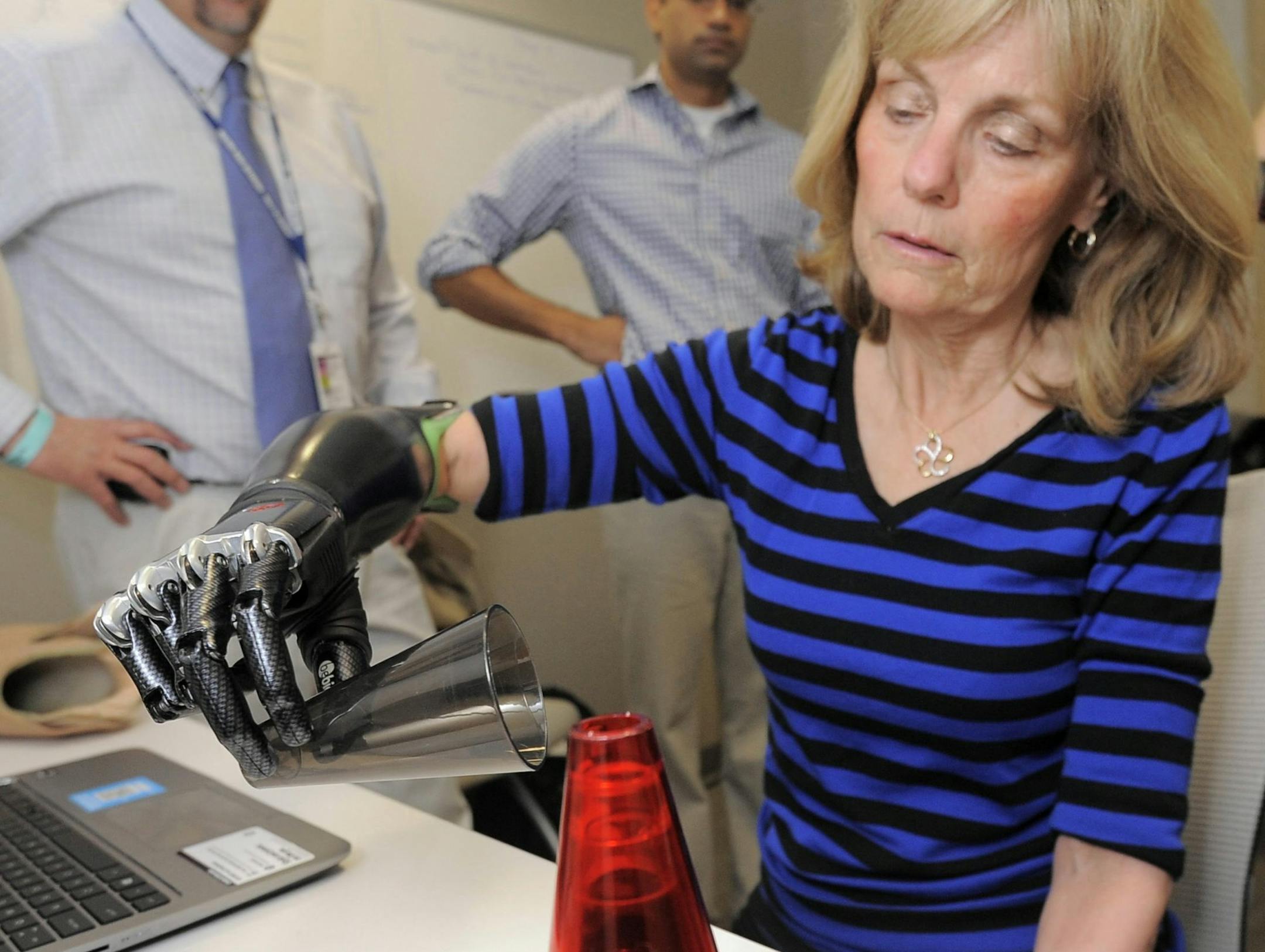
BALTIMORE – One minute, Anne Mekalian's brain is telling her prosthetic arm to unstack a set of multicolored plastic cones, and the shiny black metal limb is listening. Every now and then, the plastic clatters to the table, but quickly the cones are separated and restored to a neat pile. The next moment, though, the bionic hand doesn't know what to make of slight muscle movements in Mekalian's forearm, interpreted through a set of electrodes touching the skin on the rounded remnant limb that extends just below her elbow. Instead of pinching a red clothespin, the robotic hand spins like Linda Blair's head in "The Exorcist."
"This is why it's experimental, right?" Mekalian, of Joppatowne, Md., joked scientists who had gathered in an office at Johns Hopkins Hospital to watch her as part of clinical trials of advanced prosthetics.
The technology is advancing quickly. Over the past several months, Mekalian and two other amputees working with a Johns Hopkins Hospital surgeon and local company have been among the first in the nation to take home thought-controlled robotic arms designed for wounded veterans.
While the devices haven't been perfect replacements for limbs lost, they have brought a glimpse of what patients took for granted before being struck by infection, cancer or violence.
Trial and error applying the technology to their daily lives — putting on makeup, cooking, carrying a laundry basket — is leading to refinements.
The scientists say the technology could be available within a couple of years to countless others commercially, with plans for U.S. Food and Drug Administration review next year.
Before that can happen, the scientists are learning all they can through the 67-year-old Mekalian and the others. "We're almost inventing a new field of medicine," said Dr. Albert Chi, a Johns Hopkins trauma surgeon working with the patients. "We're kind of learning as we go. There's no textbooks out there."
For the past two years, Chi has worked with Baltimore's Infinite Biomedical Technologies and Advanced Arm Dynamics, a Texas-based developer of prosthetics, to blaze the trail, starting with Johnny Matheny, a West Virginian who lost his left arm to cancer in 2008. Dana Burke, a Pennsylvania woman who lost her right arm about 5 inches below her shoulder after a shooting 15 years ago, came next.