

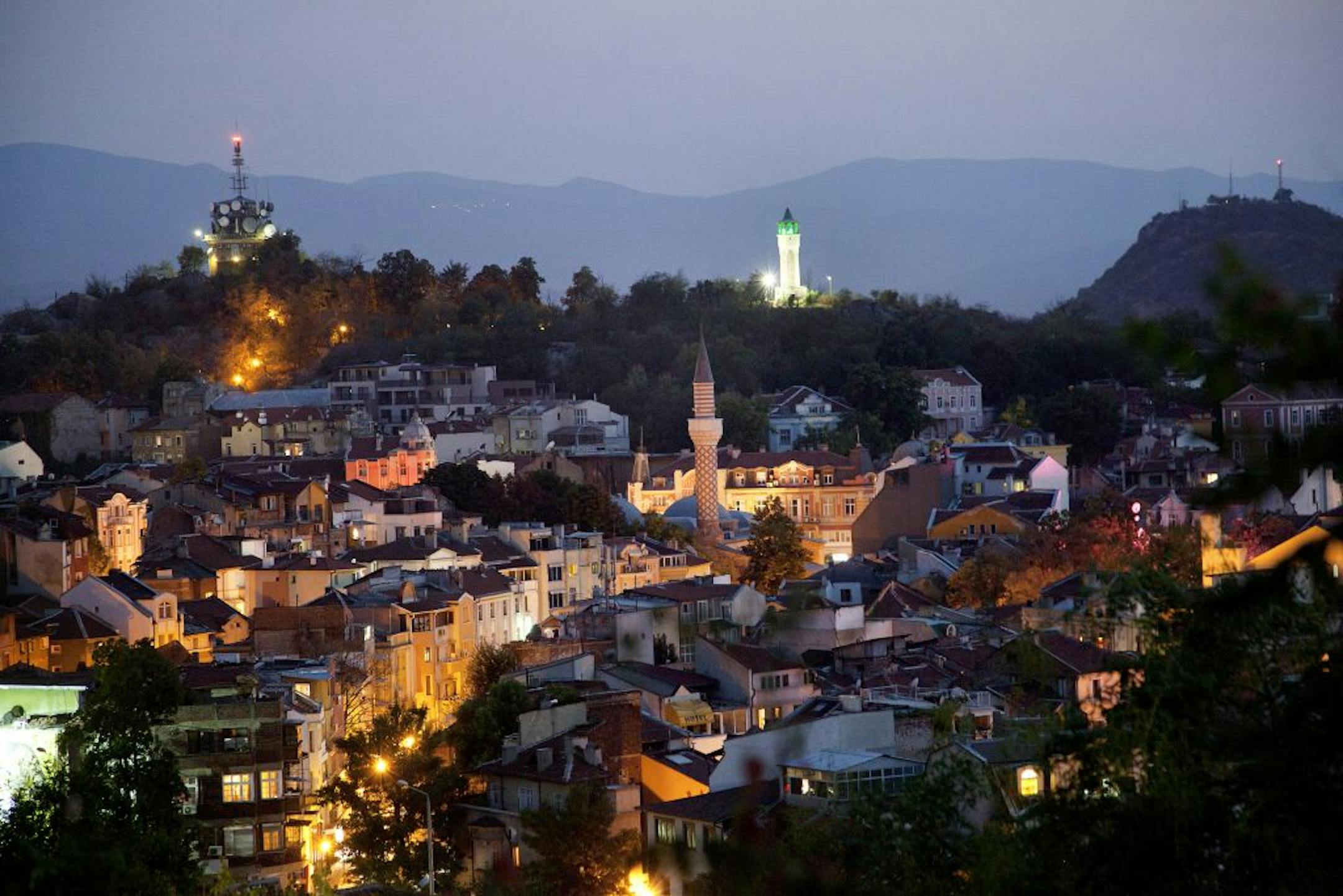
On a warm day in Plovdiv (Philippopolis in Roman times, or the City of Seven Hills to those who walk them today), I took respite in a park where a chunk of ancient colonnade served as a bench on which to eat greasy, cheesy banitza, the local pastry special.
Along for the journey was my friend Mia Agova, daughter of Assen Agov, the Bulgarian politician famous for his role in the democratic movement that helped free the country from Communism. Mia had come down from Sofia hoping to find the spot where her great-grandfather had been shot and killed in 1925 by the government operatives who considered him a fascist.
Hers is not the only Bulgarian family with history in Plovdiv.
One of Europe's oldest continuously inhabited cities, Plovdiv, on the banks of the Maritsa River, was at one time or another a Neolithic settlement, a Thracian hub and a Roman cultural and economic center complete with a glittering hillside theater.
Liberated from the Ottoman Empire in 1878, Plovdiv became the capital of autonomous Eastern Rumelia, before being folded into modern-day Bulgaria. Today, Plovdiv is a city of more than 400,000 people, many of whom work in tourism and the arts.
Plovdiv's residents are proud of their history, which is good: They could scarcely avoid it if they tried. Walking from dinner to drinks, you may, as Mia and I did, pass under the remnants of a Roman aqueduct and amphitheater. If you're looking for a bit of ancient Roman grandeur east of Italy's tourist hordes, you would do well to come here.
Nearly all the historical attractions are tucked into the quiet back streets in and around Old Town, a tree-lined maze of cobblestone streets, antiques stores, Roman ruins, restaurants and museums that is closed in many places to cars; it's possible to spend two or three days exploring, as we did.
Prehistoric times to now


