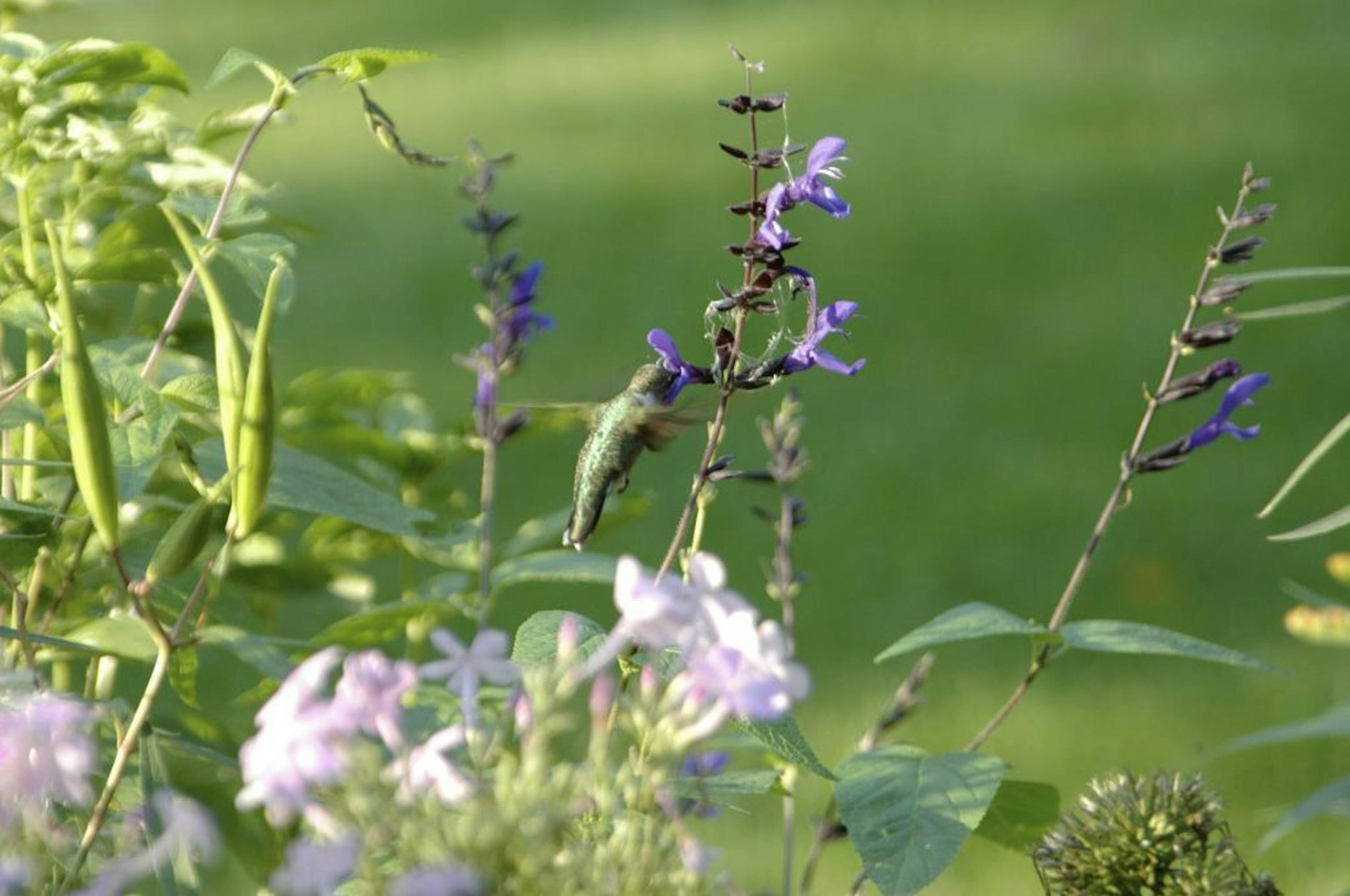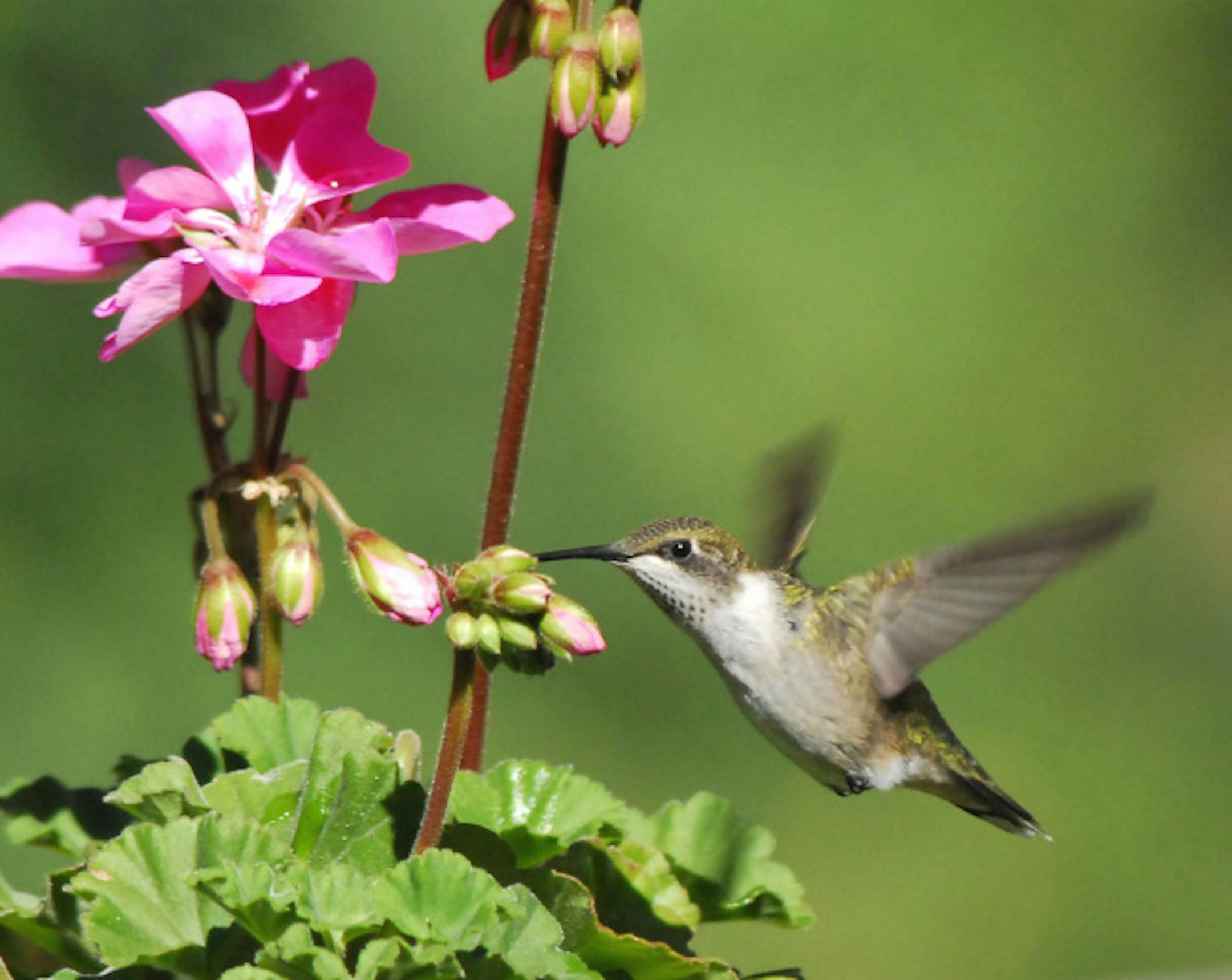
Some birds are controversial, admired by one group, loathed by others: Think American crow. But is there anyone, anywhere, who doesn't appreciate hummingbirds? People love these amazing, glittering little birds out of all proportion to their tiny size. We'd like to see them hovering over our gardens all summer long, but a typical lament in our area is: "Why do the hummingbirds disappear all summer?"
For many of us, these miniature birds seem hard to please. They dash through in early May, pausing barely long enough to drink nectar from whatever is flowering. In early spring this probably means annuals in hanging baskets or pots. The little birds don't appear again until late August, on their way back to their winter homes. In between times, somewhere other than in our back yards, females are nesting and males are engaging in fierce battles over feeding territories.
I'm jealous of friends in north central Minnesota, whose many summer hummingbird visitors require quarts of homemade nectar each week. And I turn a slight shade of green when a friend who lives near the Mississippi River tells of newly fledged hummingbird twins visiting her nectar feeders in late June.
There must be many of us who feel this way, since hummingbirds have such a large fan club. But there are things we can do to increase our landscape's attractiveness to ruby-throated hummingbirds, the only hummingbird that nests in the eastern half of the United States.
The earliest of these splendid little birds crossed the Gulf of Mexico and reached Gulf Coast states around the end of February. Hummingbirds began flying over the state's southern border at the end of April, and they're not in a lingering mood. Males are in a rush to carve out a territory and embark on breeding season. Females are in a hurry, too, to start building a nest, raise a set of twins, then start all over again, even while still feeding two fledglings from the first nest. They dash through the summer at warp speed and require the right conditions to maximize their short time in the temperate zone.
It takes more than a nectar feeder or two to convince hummingbirds to make your back yard a part of their breeding or feeding territory. They're looking for trumpet-shaped flowers to provide nectar, and they'll need a variety of plants to ensure blooms from May through September. Plants with small flowers attract the tiny insects that hummingbirds need for protein. A water source -- especially a spray or fountain--is an added attraction, especially to help clean off sticky beaks. And they need plenty of shrubs and trees to hide in, nest and perch to survey their realm.
A little-known fact about hummingbirds is that insects make up about one-fourth of their daily diet. They chase and scoop tiny flying insects out of the air, providing a source of protein for themselves and their nestlings. We think of hummingbirds as being in constant motion, but the truth is that they spend about 80 percent of each day sitting and surveying their territory. This is why perches -- tree branches, arbors, shepherd's hooks -- are so important.
And lastly, spiders (unwittingly) are a hummingbird nest staple. The female ruby-throat will pull apart a spider web, using some of the silky strands as a base for her nest on a tree or shrub branch. Then she attaches more webbing to the exterior of the nest, along with plant down. The elastic spider webbing stretches to allow the nest to expand as the youngsters grow.