

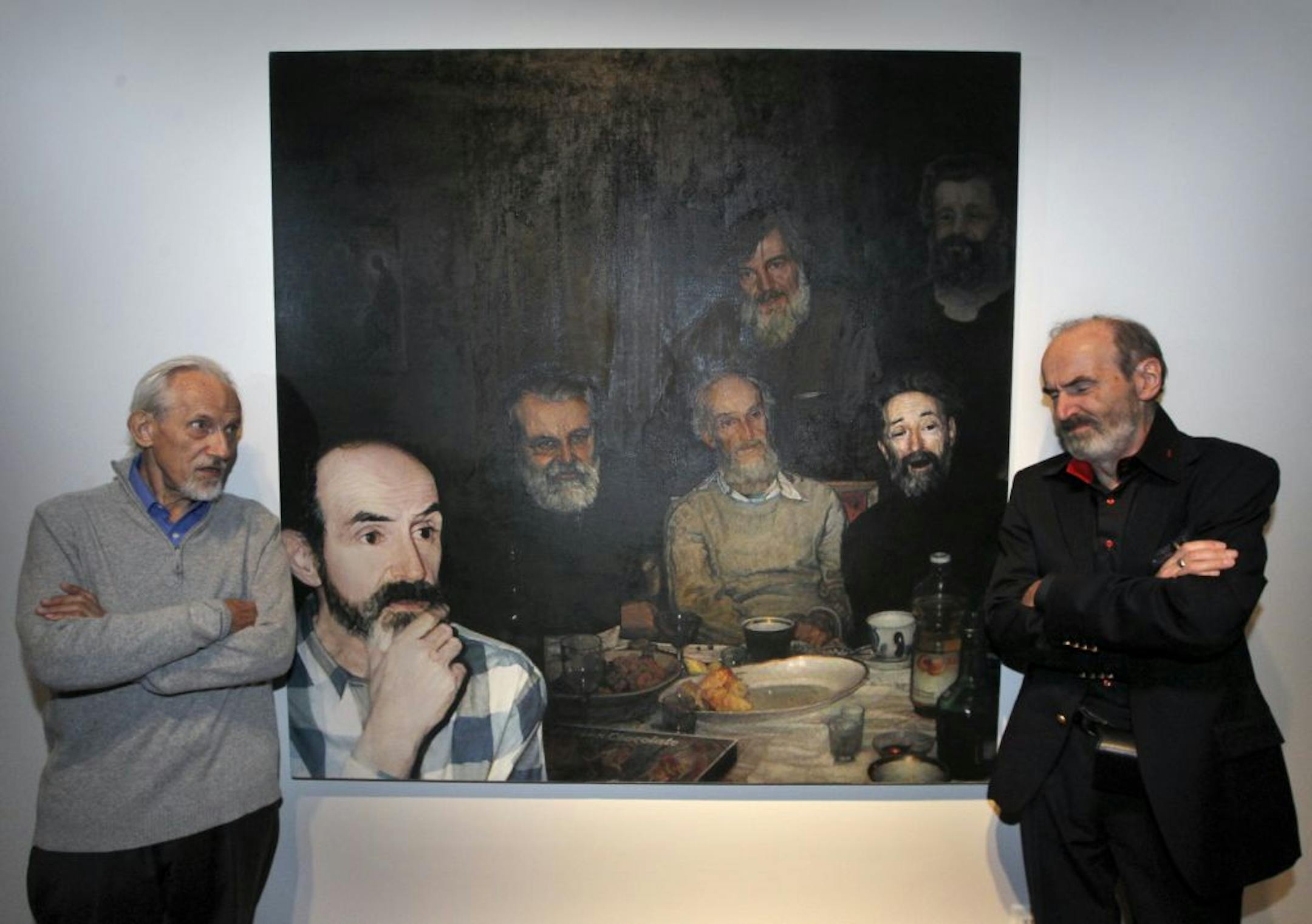
Turning 80 can be tough on the psyche, but for an artist at the prime of his powers it can be a happy moment, especially if friends from around the world fly in to celebrate. Last weekend's birthday fête for Russian-born artist Oleg Vassiliev at the Museum of Russian Art (TMORA) in Minneapolis drew admirers -- artists, publishers, collectors -- from Paris, Moscow, New York and even Columbus, Ohio.
Suddenly the oppressive Soviet politics that decades ago drove Vassiliev and his dissident colleagues out of their homeland was in the air again, but the dark memories of that era were mellowed by changing times and the artists' international success.
Adding to the mood, the reunion was hosted by a Minneapolis businessman whose collection mostly features "official" Soviet artists -- people who accepted the artistic dictates of the Soviet state and promoted its ideology rather than resisted it, as Vassiliev and his friends did.
TMORA is showcasing paintings and etchings by Vassiliev, a Moscow-born painter of modernist abstractions, elegiac portraits and poetic etchings infused with longing and loss. Although his work was hardly radical, its failure to promote Soviet ideology doomed Vassiliev to obscurity in his homeland. He never had a solo show there, aside from a one-night exhibition at a Moscow cafe in 1968. For more than 30 years, he and childhood friend Eric Bulatov worked as book designers, specializing in children's tales, samples of which are included in the show.
After the Soviet Union collapsed in 1991, Vassiliev and his wife emigrated, first to Paris and then to New York. Now a widower who speaks little English, he moved to St. Paul last year to be near a son who lives there. He has had some health issues, but still paints as much as eight hours a day. His homeland has belatedly recognized his work with exhibitions and purchases by major museums in St. Petersburg and Moscow.
Beyond politics
At TMORA last week, Bulatov and his wife, Natasha, who also left the Soviet Union and now live in Paris, nodded approval of the museum's elegant display. But the children's books he helped design stopped Bulatov in his tracks.
"Such a nightmare," he murmured in Russian, shaking his head.


