
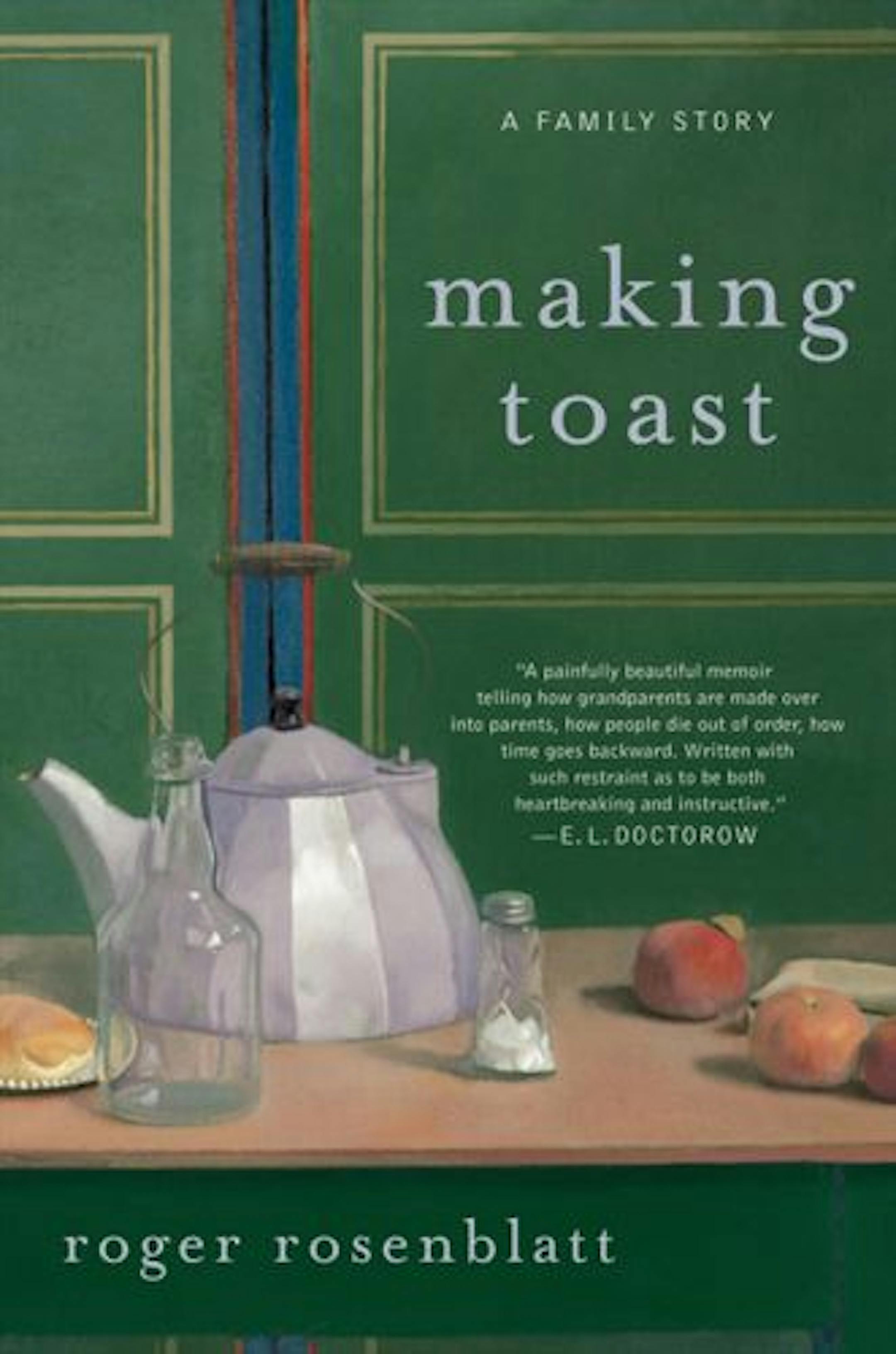
A memoir of loss and gain

When the author's daughter dies unexpectedly, he and his wife step in to help her husband raise their three young children.

For the Minnesota Star Tribune
May 8, 2010 at 7:40PM
Making Toast by Roger Rosenblatt
Making Toast by Roger Rosenblatt (Star Tribune/The Minnesota Star Tribune)

If a grandchild has ever called you a funny name, if you've made up a silly song to croon to that child, if one has ever depended on you for breakfast or a bedtime story, this book will touch someplace deep in you.

In December 2007, Roger Rosenblatt's 38-year-old daughter dropped dead on her treadmill. She left a husband and three children: ages 7, 5 and 20 months.

That shrunken family within two days gained a Mimi and a Boppo -- the kids' nicknames for their grandma and grandpa, who moved into the bedroom next to the playroom. The following morning, when 7-year-old Jessie wondered, "How long will you stay?" Boppo answered as he had to: "Forever."

"Making Toast: A Family Story" is not, however, the story of forever, but of the first 15 months or so of the Rosenblatts' commitment to their grandchildren. It reads as if the author kept his laptop always open to record a diary of insights, memories, anecdotes and the essential expectations of everyday life: who likes their toast how, who drinks soy milk and who prefers what a child calls "cow milk," when to speak up and when to stay silent as they grapple with the mystery of what befell them.

Tender moments are told straight on. The youngest is fussy. "I fed him pieces of apple, which were hard, so I chewed them a little first. Finally, he fell asleep."

Watching TV with the 5-year-old, as a mother steps into a scene, Boppo hears his grandson murmur, "No mom for me." He tries to explain to the boy that no, no, Mom is everywhere. There, there and yes, even there.

We see the futility of that, without having to be told.

Now and again he and his wife pay a visit to their previous home, the one with five bedrooms, a half-mile from the ocean. Taking a walk at dusk, though, "we feel older and smaller than we do with the grandchildren" -- a sensation I recognize, living 800 miles from my own granddaughter.

Later, of all the adults in the family: "Something about the momentum of our lives is good for us, keeps us from sinking. Given the choice between confessions of sorrow, however cathartic, and the simplest act of getting on with it, we'll get on with it."

Without the children and their son-in-law, they would be back home alone, "manufacturing conversations between dark silences."

Perhaps this memoir pays tribute to too many friends by name. Perhaps it dwells too much in the past, squeezing old memories for meaning. Perhaps Rosenblatt might have pushed himself harder to interpret his new role, rather than laying it out plainly, like a piece of buttered toast cut in half on a small white plate.

But here it is, a memoir of loss and gain, typed in between everything else to be done in a day, over and over forever.

Susan Ager, a former columnist for the Detroit Free Press, is at susan@susanager.com.

about the writer

about the writer

SUSAN AGER

More from Minnesota Star Tribune

See More
card image
J. SCOTT APPLEWHITE, ASSOCIATED PRESS/The Minnesota Star Tribune

The "winners" have all been Turkeys, no matter the honor's name.

In this photo taken Monday, March 6, 2017, in San Francisco, released confidential files by The University of California of a sexual misconduct case, like this one against UC Santa Cruz Latin Studies professor Hector Perla is shown. Perla was accused of raping a student during a wine-tasting outing in June 2015. Some of the files are so heavily redacted that on many pages no words are visible. Perla is one of 113 UC employees found to have violated the system's sexual misconduct policies in rece