

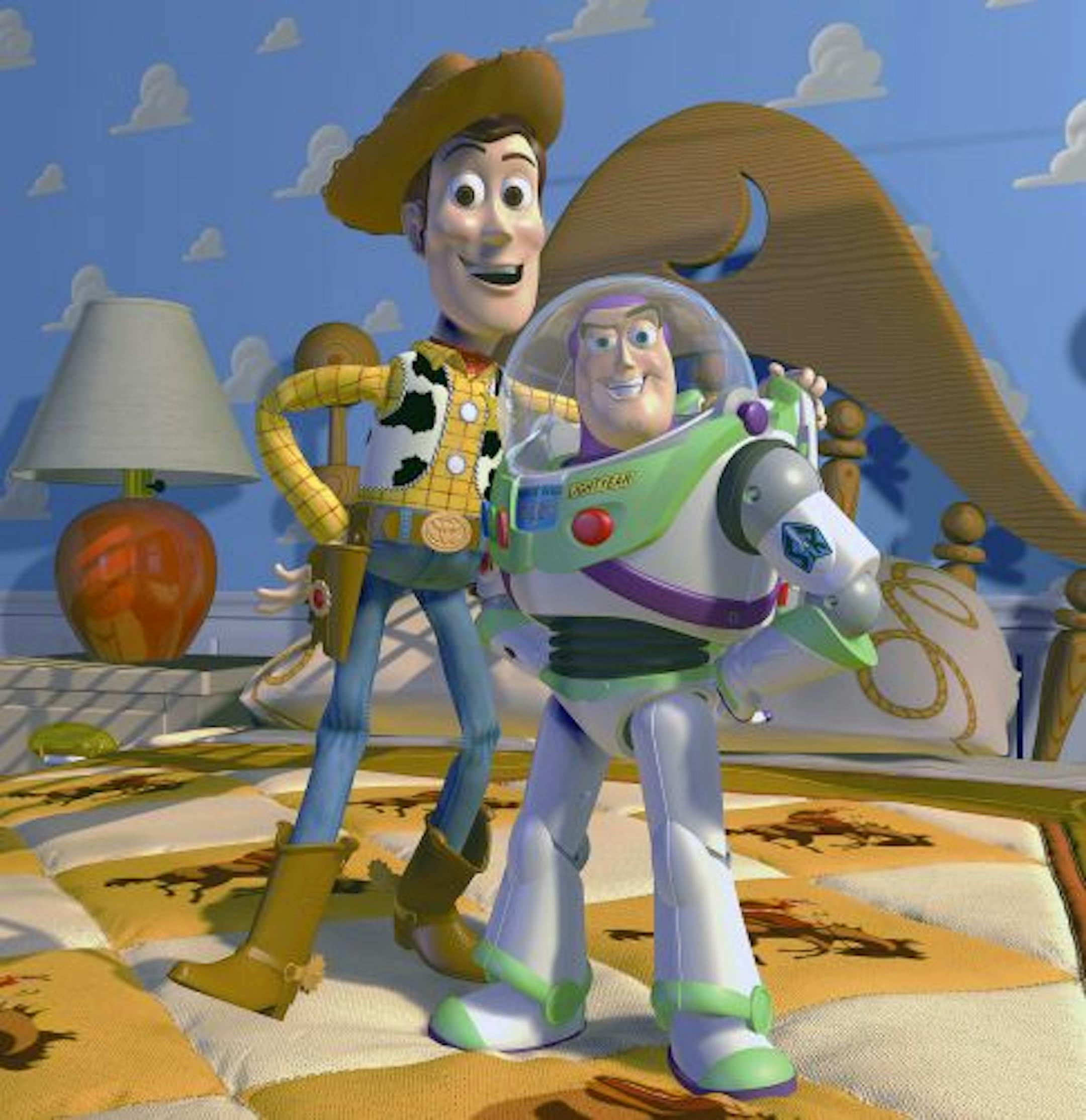
"Toy Story" has always been a 3-D film, even if moviegoers never saw it that way.
Computer-generated animation made the 1995 Pixar smash 3-D by design, with virtual cameras moving through a digital space, capturing the mass and dimension of each character and setting. At the time, though, theaters lacked the high-tech projectors required to show it that way, forcing filmmakers to collapse the images back down to two dimensions so the movie could play in multiplexes.
More than a decade later, projection technology has caught up with CG filmmaking, inspiring movie moguls such as Jeffrey Katzenberg, James Cameron, Peter Jackson and Pixar's John Lasseter to declare 3-D the future of film.
Disney-Pixar, which released "Up" in 3-D this year, is embracing the future and past at once by amping up the 3-D in "Toy Story" and "Toy Story 2" for a limited double-feature run that began last weekend.
"It's a great 3-D movie because [Pixar] had discovered this ability to move through these spaces in 3-D," said stereographer Bob Whitehill, who oversaw both film updates.
The Oscar-nominated tale of Woody, Buzz Lightyear and their toy box full of friends isn't the only beloved film getting a 3-D retrofit: Cameron's company, Lightstorm, reportedly has a 3-D re-release of "Titanic" in the works. "Star Wars" creator George Lucas' Lucasfilm has worked with a firm to develop technology to convert all six of his franchise films into 3-D, but a company spokeswoman said no timeline exists for now.
Converting a live-action film to 3-D is even more challenging, Whitehill said. Artists must duplicate the original film to create a right-eye view, then cut out each element in the scene to sculpt a three-dimensional image. Further depth is created by projecting flat images onto computer-generated geometric forms, so the eye perceives a natural distance between the nose and ears on a face, for example.
Although "Wall-E" and "Ratatouille" have been tested, Pixar has no plans to re-release them in 3-D -- but all of the company's future films will come in two-dimensional and three-dimensional versions.


