

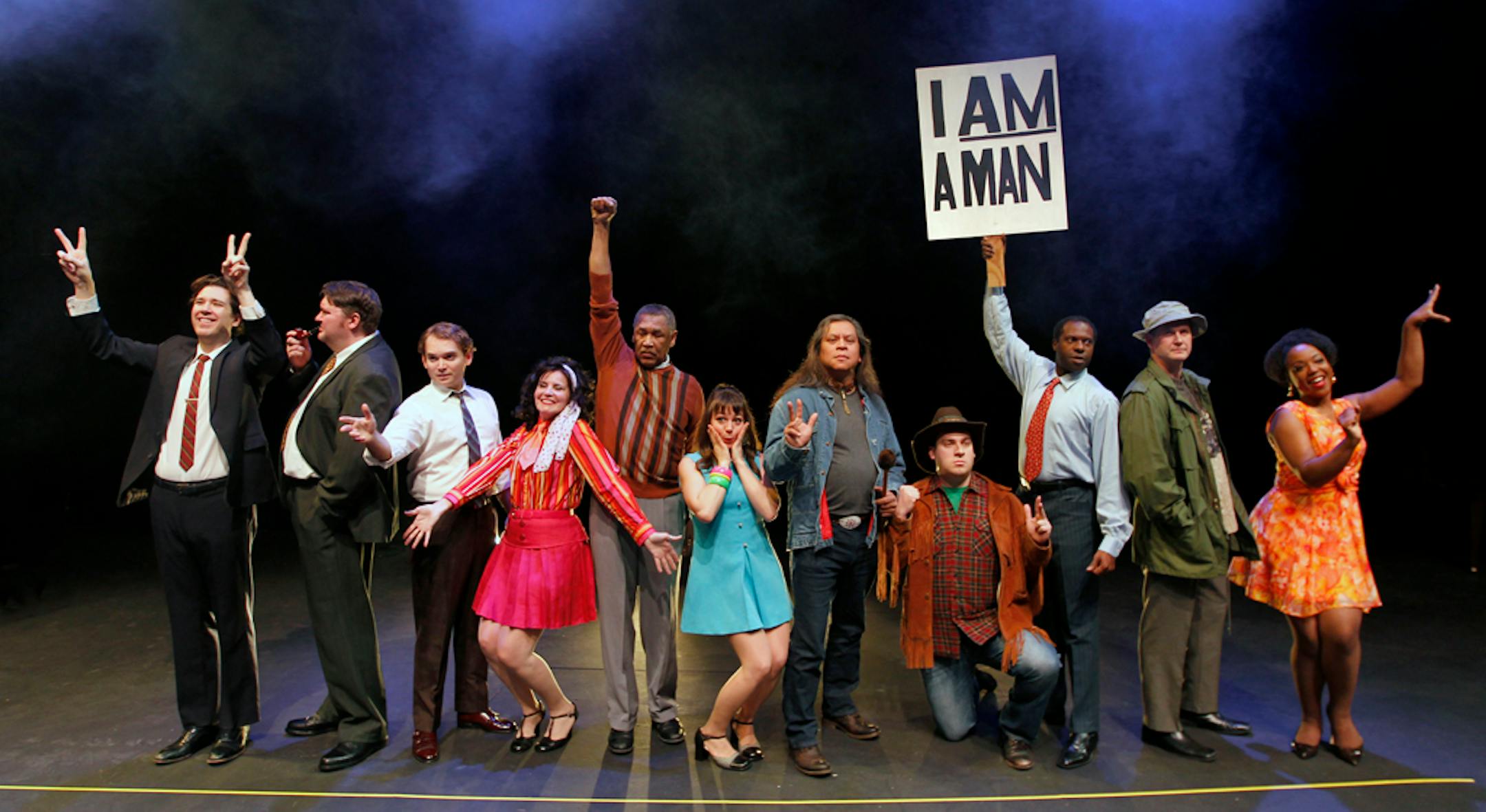
Ron Peluso was cruising along in his senior year of high school when 1968 crashed into him. On Jan. 23, North Korea captured the USS Pueblo; the Tet Offensive was launched eight days later. President Lyndon Johnson announced in March that he would not seek re-election; the Rev. Martin Luther King Jr. was shot and killed in April. The Prague Spring, the Parisian student revolts and the sit-in at Columbia University gave an immediate sense of history, and it dawned on Peluso that the world had hijacked a youth spent in a small steel town in western Pennsylvania.
"I was either going to have to get into college or get drafted," said Peluso, artistic director at History Theatre. "So I went from naive kid to a college freshman that fall, after assassinations and the Democratic convention and the election. It was an eye-opening experience for a 17-year-old."
Peluso is revisiting the year with "1968: The Year That Rocked the World." The History Theatre production opens Friday at Minnesota History Center, which has an exhibit about the same year. Peluso commissioned seven short works touching on key events from 1968; woven throughout is pop music from the era, performed by students from McNally Smith College of Music, directed by Gary Rue.
Some of the playwrights commented on their works:
Kim Hines wrote on sprinters John Carlos and Tommie Smith, who raised gloved fists when they received Olympic medals:
I want white audiences to understand that the black community is not a monolithic group of people. Not every black person was elated or even comfortable with what those athletes did. I also want white audiences to know that the action of those athletes was a turning point for black men. I want black audiences to see that this small action helped us to view ourselves differently. It was a brave act in 1968. Black people had to weather many things before they could stand up and challenge the dominant culture. I thank Carlos and Smith for their part in getting that ball rolling.
Reginald Edmund wrote on Vietnam veteran Jerry Miron and his painful re-entry into civilian life:
As I worked with Jerry Miron, I enjoyed getting the opportunity to give voice to people who never had the chance to tell their stories before, to offer a kind of therapy. It felt meaningful and gave me a satisfaction that I haven't experienced before in my artistic process. If there is anything that I want the audience to walk away with, it is that we have as a nation made so much progress toward being a better America, but we have so far to go to get there, and it's only together that we can reach it.


