Paul Douglas is a nationally respected meteorologist with 33 years of television and radio experience. A serial entrepreneur, Douglas is Senior Meteorologist for WeatherNation TV, a new, national 24/7 weather channel with studios in Denver and Minneapolis. Founder of Media Logic Group, Douglas and a team of meteorologists provide weather services for media at Broadcast Weather, and high-tech alerting and briefing services for companies via Alerts Broadcaster. His speaking engagements take him around the Midwest with a message of continuous experimentation and reinvention, no matter what business you’re in. He is the public face of “SAVE”, Suicide Awareness, Voices of Education, based in Bloomington. | Send Paul a question.
Head-Shaking Weather
"Paul, Minnesota Nice just got tossed out the nearest window this summer". Locals are fuming. I don't miss the heat, but a little sun would be nice as I cut back the vines in my backyard jungle.
I gave a talk to the Minnesota Emergency Managers Association yesterday. A women came up afterwards, a bit dazed. "We had brush fires up north, but couldn't get at water because the lakes were frozen. We had to pull snowplows off MSP's runways in early May because of lightning! You don't have to tell me the weather is getting weirder over time".
Two things on my mind today: if your county is ever under a PDS (Particularly Dangerous Situation) Tornado Watch pay extra-close attention: the risk of large tornadoes is greater. If a confirmed (large) tornado is moving into an urban area the NWS may issue a "Tornado Emergency". One notch more urgent than a regular Tornado Warning.
Expect a volatile, partly-severe summer for Minnesota as the jet stream howls overhead.
The sun comes out today; a few spotty T-storms late Friday into midday Saturday. Sunday looks like the sunnier day of the weekend; highs topping 80. A kink in the jet stream forces hot air north next week; I wouldn't be surprised to see a few sizzling 90s late next week.
Lovely.

Wednesday Severe Outbreak. For a time SPC upgraded the risk near Chicago from moderate to high, which doesn't happen very often. PDS Tornado Watches were issued from far southeastern Minnesota into Iowa, southern Wisconsin and northwest Illinois. 17 tornadoes were observed as of 11 pm last night, 79 severe wind observations and 104 large hail reports. Details from NOAA SPC.

Less Rain - More Warmth. Everything is taking longer this year. Early May felt more like late March, we may not sample typical June weather until July. I'm seeing a 3-6 week lag across the board. But the jet is showing signs of (slowly) migrating north over time. That should be good for low 80s Sunday, a stretch of mid 80s next week, maybe a few 90s late next week. ECMWF (European) forecast highs above in Celsius.

Weekend Preview. ECMWF guidance (courtesy of WSI) shows nocturnal T-storms Friday night, spilling over into a portion of Saturday morning, with patchy clouds and (isolated) late PM thunder, best chance near the Iowa border. Sunday looks better, drier, with a few late PM instability showers and T-showers over northern Minnesota, but dry weather across most of Minnesota most of the day. Fingers crossed for a better weekend.

Shifting Seasons. Canadian air is draining unusually far south, considering we're a little more than a WEEK from the Summer Solstice. The resulting atmospheric tug-of-war is playing out over the Great Lakes and New England, where some 2-4" rainfall amounts are predicted by next Tuesday, according to NOAA.

More Like Mid-May. The main branch of the jet stream is still pushing unusually far south - one major reason why we're seeing a big uptick in severe storms and tornadoes; the combination of June-like heat and humidity over the southern states, coupled with an energetic, early-May-like jet stream pattern dipping south, creating the instability and wind shear necessary for severe storm outbreaks. Today we watch the Mid Atlantic region for damaging winds and a few tornadoes. The next system kicks up a few showers Friday into early Saturday over Minnesota and the Upper Midwest, but much of the weekend should be dry from the Dakotas into Minnesota and Wisconsin, a better chance of T-storms Omaha to Des Moines and Chicago.

Thursday Severe Threat. Tomorrow atmospheric dynamics shift east, with a potential for damaging straight-line winds, even a few large tornadoes, from near Richmond to Washington D.C., Baltimore, Annapolis, the Delaware Valley and south Jersey. A slight risk of severe storms (and isolated tornadoes) extends from Birmingham and Atlanta to New York.

Black Forest Blaze. The wildfire burning just north/east of Colorado Springs continues to grow in size and intensity, record heat and gusty winds fanning flames and complicating rescue operations on the scene. Over 6,000 people have been evacuated from the zone - 80 to 100 homes lost, with over 8,000 acres burned. The evacuation order covers roughly 24,000 acres or 48 square miles. With 100-degree heat and winds gusting to 40 mph conditions are very similar to last June's Waldo Canyon Fire, which destroyed 300 homes in the Colorado Springs area. Click here for more information.

Pattern Shift? It's a little early to break out the bubbly and party hats, but there's growing evidence that the NAO (North Atlantic Oscillation) may be going into a positive phase, meaning stronger west to east (zonal) winds and warmer temperatures over much of the USA. Graph above showing NAO history since mid-February, and forecast for the latter half of June.


76 F. high in the Twin Cities Wednesday.
78 F. average high on June 12.
69 F. high on June 12, 2012.
.59" rain fell yesterday in the Twin Cities.
June 12 in Minnesota Weather History:
1991: Lightning struck a tree at the U.S. Open golf tournament in Chaska, MN. One spectator was killed, and 6 people were injured
1968: The 13 mile long path of an F5 tornado took it directly through Tracy, MN. Nine people were killed and 111 homes destroyed. Farms outside of town were swept completely away, two of which had been hit by a tornado 44 years earlier
1930: Tornado hits Northfield area, heavy damage at Randolph.
* source: Twin Cities National Weather Service.

TODAY: Plenty of sun, quite pleasant. Winds: NE 10. High: 76
THURSDAY NIGHT: Clear. Low: 58
FRIDAY: AM sun, late-day T-storm. High: 77
SATURDAY: Some sun, stray T-shower possible. Wake-up: 63. High: 79
SUNDAY: Partly sunny, better lake day. Wake-up: 65. High: 82
MONDAY: More clouds than sun, cooler. Wake-up: 63. High: 78
TUESDAY: Warm sunshine, feels like June. Wake-up: 61. High: 82
WEDNESDAY: Sticky sun, dew points: 65-70. Wake-up: 62. High: 84
Climate Stories...

Disease Outbreak Threatens The Future Of Good Coffee. Please God, not the coffee. Now we have to worry about "coffee rust", a fungus that is more prevalent in a warmer, wetter climate? Here's an excerpt from wired.com: "...Nobody knows precisely why the outbreak reached such extraordinary levels this year, though several factors are implicated. The most prominent is climate: In the past, environmental conditions at high Central American altitudes were not especially conducive to the fungus, which requires warm, humid air to thrive, said coffee rust specialist Cathy Aime of Purdue University. Since the mid-20th century, though, weather patterns in Central America and northern South America have shifted. Average temperatures are warmer across the region, with extremes of both heat and cold becoming more pronounced; so are extreme rainfall events..."
Photo credit above: "A rust-blighted leaf on a farm in Colombia." Image: International Center for Tropical Agriculture/Flickr.

Why Greenland's Darkening Ice Has Become A Hot Topic In Climate Science. The Guardian has the story - here's a clip: "Last July, a record melting occurred on the Greenland ice sheet. Even in some of the highest and coldest areas, field parties observed rainfall with air temperatures several degrees above the freezing point. A month before, it was as though Greenland expert Jason Box had a crystal ball; he predicted this complete surface melting in a scientific publication. Box's research then got broader public visibility after climate activist and writer Bill McKibben covered it in Rolling Stone magazine. The basic premise of Box's study was that observations reveal a progressive darkening of Greenland ice. Darkening causes the white snow surface to absorb more sunlight which in turn increases melting. Given that this process is likely to continue, the impact on Greenland melt, and subsequent sea level rise, will be profound..."
Photo credit above: "Climate scientist Jason Box during an expedition in Greenland in July 2008." Photograph: Byrd Polar Research Center

NASA Warns Arctic Thaw Could Have Huge Impact On Global Warming. Think we're in uncharted waters now, with increasingly erratic, head-shaking weather patterns? Wait until most of the ice is gone in the Arctic and permafrost melts at high latitudes worldwide. Then things will really start to get interesting. Here's an excerpt from The Verge: "The Arctic's permafrost soils have NASA worried. Scientists monitoring carbon levels in the top layers of Arctic soils have identified huge deposits that, if thawed sufficiently, could upset its carbon balance and magnify the impacts of global warming. The agency estimates that the Arctic's permafrost soils store as much as 1,850 petagrams (one petagram equals 1 billion metric tons), comprising around half of all the carbon stored in Earth's soils — most of it lying within 3 meters of the surface.

TV Weathermen And Climate Scientists Kiss And Make Up. Well, not quite, but manic weather is accomplishing what climate science couldn't - convince a critical mass of TV meteorologists that something is going on - something has changed. Here's an excerpt from Mother Jones: "...Ostro believes that clmate change is increasing the atmosphere's overall thickness and thereby forcing weather patterns to stay in place for longer - with sometimes devastating results. Francis, meanwhile, argues that the dramatic warming of the Arctic is, in turn, slowing down the hemisphere-sized loopings of the jet stream - with very similar consequences. And there are other signs that relations between climate scientists and weather forecasters are improving - signs that go considerably beyond the scientific mutual admiration society that is Francis and Ostro..."

Bloomberg's Race To Protect NYC From Climate Change. Here's a snippet of an Op-Ed at The Washington Post: "...By mid-century, up to a quarter of all New York City’s land area, where 800,000 residents live today, will be in the flood plain,” he said, and “40 miles of our waterfront could see flooding on a regular basis just during normal high tides.” We no longer have the luxury of ideological debate, he said. “The bottom line is we can’t run the risk.” Andrew Light, a global-warming specialist at the liberal Center for American Progress, explained to me the recent shift toward efforts to adapt to climate change rather than merely seeking to prevent it. “We’re starting to see very strong evidence of climate-related extreme events happening sooner than we thought with only a 1-degree [Celsius] rise in temperature,” he said, “and a more refined science saying now that we will more than likely edge up to or cross the 2-degree threshold...” (photo: AP).

Greenhouse Gases Nearing Highly Dangerous Levels, Study Finds. Here's a clip from a story at The Chicago Tribune: "...The IEA report, Redrawing the Energy-Climate Map, says carbon dioxide emissions grew at a rate of 1.4% in 2012, releasing a record 31.6 gigatons into the atmosphere. On this current path, the world’s average temperatures are on track to increase between 3.6 degrees Celsius to 5.3 degrees Celsius, or 6.48 degrees Fahrenheit to 9.54 degrees Fahrenheit, by the end of the century, said the IEA, an independent research group established by the world’s most industrialized nations. “Climate change has quite frankly slipped to the back burner of policy priorities,” said www.wired.com/wiredscience/2013/06/coffee-rust-epidemic/all/IEA Executive Director Maria van der Hoeven. “But the problem is not going away — quite the opposite...”

Waiting On A New Climate Deal "Will Set World On A Path to 5C Warming". Here's an excerpt from an Op-Ed at the International Energy Agency's Chief Economist in The Guardian: "...The world cannot afford to wait for a new global climate change agreement to come into force in 2020, because doing so will mean an end to hopes of limiting global warming to moderate levels, one of the world's foremost authorities on energy has warned. Carbon dioxide emissions from energy rose by 1.4% in 2012 to a record high of more than 31bn tonnes, according to a report from the International Energy Agency on Monday, driven in part by a striking 6% rise in emissions from Japan following its phase-out of nuclear power and continuing growth in emissions from China. Fatih Birol, chief economist at the IEA, and one of the world's most respected energy experts, told the Guardian that greenhouse gas emissions were continuing to rise so fast that pinning hopes on a replacement for the Kyoto protocol would set the world on a path to 5C of warming, which would be catastrophic..."

PDS Tornado Watch. SPC has issued a "Particularly Dangerous Situation" Tornado Watch, from southeastern Minnesota into southern Wisconsin, eastern Iowa and northwest Illinois until 9 pm this evening. An MCS or derecho may spin up with violent straight-line winds, a few supercell thunderstorms out ahead of the main squall line may spark 3" diameter hail and a few large, violent tornadoes. There's a high risk of severe weather in Chicago, for the first time since 2004, only the 16th "high risk" day for Chicago since 1980.

Over The Edge
"Paul, my parents came back from Arizona in April, thinking they were home free. Now they're threatening to never return north to the Land of 10,000 Weather Disappointments!" I'm hearing this a lot. People fed up by our 7-month winter, deflated by our cool, wet (late) spring and no-show summer. Will there be a few thousand additional snowbirds come December? Probably.
The reality: most of our winters since the late 90s have been pretty easy, but every now and then Mother Nature spanks us pretty hard.
A cool bias is keeping the most severe T-storms just to our south today; we'll get grazed by a few morning showers - skies brighten this afternoon, and Thursday will restore your faith in June. The next unstable swirl of cold air aloft sparks random T-storms late Friday into Sunday evening.
It won't rain all weekend, in fact most of the time should be dry with highs in the 70s. A string of 80s return next week. If this keeps up June will arrive..sometime in July.
Try to keep some perspective: Arizona is an oven. Florida's lovely, except for Texas-size storms with names. California's a relief, when the ground isn't shaking violently. 2013 has brought annoying weather. But it could always be worse.

5 Day Rainfall. Conditions are ripe for severe (training) thunderstorms - passing over the same counties of the Midwest and Ohio Valley into the Northeast by Thursday and Friday. Too much water east of the Mississippi, while wildfires grow in size and intensity from Colorado into New Mexico.

Weekend Preview. ECMWF model guidance (WSI) shows morning showers and T-storms Saturday giving way to partial clearing by midday and afternoon. A dry start Sunday may give way to a few instability T-showers by midday and afternoon Sunday. Trying to time weekend T-storms, 3-4 days in advance, is a fool's errand.

Trending Warmer - Slowly But Slowly. No heat spikes until the end of next week, when highs may surge into the 90s. Until then a southerly detour of the jet stream will keep highs in the 70s and 80s. ECMWF forecast highs above in Celsius.

Heat Spike Late Next Week? Denver saw 100 F. Tuesday, the earliest 100-degree high on record. Intense heat is likely from the Central Plains into the Rockies and Southwest for the next 1-2 weeks, ECMWF data hinting at 90s surging northward next week. The way this year is going I'm not holding my breath.

Storm Chasing From The Sky. Now this is how to storm chase - from an altitude of 40,000 feet. Within a few years NOAA may be sending jet aircraft into the vicinity of supercell thunderstorms capable of major tornadoes, similar to how they send 4 engine propeller "Hurricane Hunter" aircraft into tropical storms and hurricanes today. USA Today has the story; here's an excerpt: "...Early morning flights aboard the Gulfstream V jet have sampled the pre-storm atmosphere across several states in the Intermountain West and the Plains, cruising at 40,000 feet in altitude for up to six hours. The scientists have been looking for signs of bad weather that could be hiding far above the clouds. Specifically, the project is looking to better the weather forecasts that fall between two types of long-range alerts:
• Long term projections, known as convective outlooks, which show the risk of severe weather up to eight days in advance across large parts of the country; and...
• Tornado and severe thunderstorm watches, which are issued up to eight hours in advance for state-sized areas..."
Photo credit above: "The Gulfstream V is readied to take off on a mission to study Tropical Storm Gaston in 2010. This is the same aircraft used in the MPEX project this spring." (Photo: NCAR).

Our Worst Fear: A Large, Urban Tornado. Downtowns have been struck in recent years, including Nashville, Salt Lake City and Miami. An EF-4 tornado hit La Plata, Maryland, tracking about 30 miles south of the White House in D.C. There's no reason why an EF-4 or EF-5 couldn't strike a major downtown or close-in suburb. We've been relatively lucky over the years. But as suburban sprawl continues, the statistical odds of injury-producing tornadoes increases too, and at least one structural engineer and meteorologist is forecasting a day of reckoning in our lifetime. Details in today's edition of Climate Matters. I've also included footage of the recent waterspout/tornado in Baltimore, and new, remarkable police dashcam-video of the developing EF-5 that hit Newcastle, then Moore, Oklahoma on May 20.

Deadly Oklahoma Tornado Upgraded To Widest On Record, Rare EF-5 Twister. Here's an excerpt from the AP and the Seattle Times article that resonated: "...Like many Midwestern cities, the Oklahoma City metropolitan area continues to expand in the suburbs, but the rapid growth hasn’t quite reached as far west as where Friday’s tornado tracked. William Hooke, a senior policy fellow of the American Meteorological Society, said the continued growth of cities in tornado-prone areas makes it only a matter of time before another monstrous twister hits a heavily populated area. “You dodged a bullet,” Hooke said. “You lay that path over Oklahoma City, and you have devastation of biblical proportions."
Photo credit above: Alonzo Adams / The Associated Press. "The National Weather Service has upgraded the deadly tornado that struck near Oklahoma City last week to a top-of-the-scale EF5 twister, which packed winds reaching 295 mph. The weather service also says the twister's 2.6-mile width is the widest ever recorded."

Enhanced Ohio Valley Tornado Risk Wednesday. All the ingredients are present for a few larger, more violent EF-2+ tornadoes Wednesday afternoon, from Chicago to Indianapolis, South Bend, Cincinnati, Dayton and Columbus. I expect SPC to issue Tornado Watches for portions of the red-shaded area by 2 or 3 pm tomorrow, with a 1 in 3 chance of a PDS (Particularly Dangerous Situation) Tornado Watch, implying a high risk of damaging tornadoes. We may also see an MCS or even a derecho capable of violent straight-line winds.

Black Forest Blaze Near Colorado Springs, Colorado. Record heat Tuesday (highs topping 100F) coupled with high winds and tinder-dry conditions have resulted in a significant blaze outside Colorado Springs. At least 6 homes have been consumed by flames, dozens more evacuated. Thousands of local Black Forest residents have been evacuated, as a precaution.

Tropical Storm Yagi. Yagi is a Tropical Storm, with sustained winds of 46 mph, gusts to 48 mph. The storm is pushing into cooler Pacific Ocean water and greater low-level wind shear, and it has shown weakening over the last 24 hours. It is not expected to achieve hurricane/cyclone status off the coast of Japan, but rather do a U-Turn and weaken to depression status. But the storm is tracking uncomfortably close to Tokyo - we'll continue to watch it carefully.

El Reno Tornado Had Rare Anticyclonic Companion. When tornadoes get that big all kinds of strange things can happen; LiveScience has the story - here's a clip: "As if the massive EF5 tornado that hit El Reno, Okla., last week weren't already noteworthy — it ranks as the widest tornado on record, at 2.6 miles (4.2 kilometers) across — it was also accompanied by a rare anticyclone twister that formed 3 miles (4.8 km) to the southeast, reports the Washington Post's Capital Weather Gang blog. Anticyclonic tornadoes are ones that spin clockwise instead of the usual counterclockwise (in the Northern Hemisphere, that is). These usually only form as waterspouts or twisters generated by non-supercell storms (those that don't have a rotating updraft), the Capital Weather Gang notes..."
Image credit above: "The path of the tornado that hit near El Reno, Okla., a suburb of Oklahoma City, on May 31, 2013. The tornado was judged by researchers to have been an EF5 at its peak and to have reached 2.6 miles wide at its peak (marked on the map)." Credit: NWS/NOAA.

Could Lightning Provide Earlier Tornado Warnings? Here is an avenue of research that holds tremendous potential to lengthen lead times for severe storms, including tornadoes. Scientific American has the story - here's a clip: "...On the day the devastating tornado hit Moore, Okla., Robert Marshall sat glued to the news, watching images of the deadly twister on CNN while he also monitored it on his computer. Marshall, the energetic CEO of Earth Networks, a company that owns and operates an enormous network of weather sensors, was looking for one thing in particular: lightning. But he didn't see it. "These tornadoes from a couple weeks ago were probably the most videotaped tornadoes in history. If you just watched the video, there's almost no lightning," Marshall said. Visible lightning, that is. In fact, as Marshall explained, there actually was lightning, a whole lot of it, in the storm that caused the Moore tornado. It's just that most of it didn't hit the ground and was thus unseen by humans..."

Storm Chasing Critical, Profitable, And Dangerous. Yes to all three. Here's a portion of a story from AP and The Grand Forks Herald: "...Professors at the University of Oklahoma's School of Meteorology strongly discourage their students from storm chasing and rarely bring them into the field for research unless it's part of a well-planned, coordinated project. "I can tell you that from a university perspective, we do not condone storm chasing at all. It's not something we teach in classes," said Melissa Bird, spokeswoman for OU's College of Atmospheric and Geographic Sciences. "It's dangerous, and students are not considered weather experts." In the end, meteorologists, like Armstrong, believe storm trackers play an important role in keeping the public safe. "There are aspects of it where storm chasers and storm trackers are always going to play a vital role in the warning process," Armstrong said. "But it is inherently dangerous to be around these storms..."

EF5 Tornadoes Since 1950. NOAA SPC has an online graphic showing the location (and year) of every F5 and EF5 since 1950.

How Swarming Drones Can Explore a Hurricane. It just dawned on me - I need a drone. Not sure why, I just know I need one. Here's a clip from an eye-opening story at Smithsonian.com: "...Kamran Mohseni thinks there may be a better way to gather storm data. It’s about thinking small. Mohseni, an engineering professor at the University of Florida, believes the next generation of hurricane hunters will be drones small enough to almost fit into the palm of your hand, but able to engage fierce hurricanes by riding the wind rather than trying to punch through it. Its weight–about as much as an iPod Nano–is an asset in his mind. “Our vehicles don’t fight the hurricane,” he says. “We use the hurricane to take us places.” His take is that instead of relying on a few “super-duper” aircraft, why not use hundreds of little drones that through their sheer numbers, could make the data that much more accurate or, as he put it, “You get super duper on an aggregate level.” Mohseni’s drones, with their sensors, would be launched with commands from a laptop, and then, with the help of mathematical models that predict where the best wind currents can be found, would be able to hitch a ride into the storm..."
Photo credit above: "Can this little thing really ride hurricane winds?" Photo courtesy of the University of Florida.

Stalled Take-Off For NOAA Satellite Plan? Politico has the story; here's an excerpt: "To save weather jobs on the ground, the Obama administration would take money from weather satellites in the sky. That’s the bottom line to a proposal by the National Oceanic and Atmospheric Administration (NOAA) that would drain the last 2013 funds for a promising U.S.-Taiwan COSMIC-2 satellite program in order to prevent furloughs of NOAA’s Weather Service personnel this summer...The beauty of this program is it generates an extraordinary amount of useful data and we don’t have to pay the whole freight,” said Clifford Mass, a professor of atmospheric sciences at the University of Washington. “It is an extraordinary mistake to take away the money,” he told POLITICO. “This will be really controversial in the discipline.” The COSMIC system’s design rests on a technique known as radio occultation, which measures changes in radio signals as they pass through the atmosphere. By measuring the bending of signals from GPS satellites, it is possible to collect thousands of temperature and humidity soundings that can very useful in improving weather forecasting..."

Europe Is Under Water. The Chive has an amazing collection of photos from recent (historic) flooding across Europe, in some cases the worst since the early 1500s: "These images show how the recent heavy torrential rainfall has resulted in dangerous flooding across Germany, Austria, Switzerland, Slovakia, Poland and the Czech Republic."
.jpg)
Flood Survival: What You Need To Know. I have a feeling it's going to be a long, tough summer with plenty of flash flooding from training thunderstorms. Here's an excerpt of a timely story at Outdoor Life Survival: "...Some floods develop slowly over a period of days from heavy rains and hurricanes. Flash floods can develop quickly, sometimes in just a few minutes and without any visible signs of rain. Tidal flooding can also happen with or without rain in your area. Be aware of flood hazards no matter where you live, but especially if you live in low-lying areas, near rivers and bays, or downstream from a dam. Keeping an ear to the radio or local TV stations is a great way to stay informed. In low-lying or flood prone areas, a NOAA weather radio with an alarm can be a life-saving investment.
FEMA and the National Weather Service use the following terms to announce flood information:
- Flood Watch: Flooding is possible. Tune in to NOAA Weather Radio, commercial radio, or local television for updated information.
- Flash Flood Watch: Flash flooding is possible. Be prepared to move to higher ground. Listen to NOAA Weather Radio, commercial radio, or television for information..."
Photo credit above: NOAA.

A Surreal Sight. Check out this story and collection of flood-related photos from Europe, courtesy of Business Insider and Reuters: "A garden with a swimming pool is inundated by the waters of the Elbe river during floods near Magdeburg in the federal state of Saxony Anhalt, June 10, 2013. Tens of thousands of Germans, Hungarians and Czechs were evacuated from their homes on Wednesday as soldiers raced to pile up sandbags to hold back rising waters in the region's worst floods in a decade..."

Space Weather Needs More Attention, Experts Say. It would be ironic if the biggest threat originated not from a tornado, hurricane, earthquake or tsunami, but from our nearest star. Could a G-class (Black Swan) solar flare bring down our power grid? The idea isn't as far-fetched as it sounds. Here's a clip from the Courier-Post: "...Experts say the public pays little attention to solar flares, geomagnetic storms and other conditions lumped into the “space weather” category. Scientists themselves have begun only recently to understand its patterns and effects and are developing more reliable ways to predict activity. What they do know is there’s a lot at stake. A 2009 National Academy of Sciences report warned of global disruption if a powerful solar-powered storm affected Earth. Using evidence from storms in 1859, 1921 and 1989, the report said massive power outages would be accompanied by radio blackouts and satellite malfunctions. Telecommunications, GPS navigation, banking, finance and transportation would all be affected..."
Image credit above: "The largest solar storm in five years erupted in March 2012, sending charged particles toward Earth with the potential to disrupt power grids, navigation systems and satellites." / AP

Play Misty For Me: Cubs, White Sox Play Fog Ball. The game must go on! Here's a funny clip from SportsGrid: "Brandon Phillips is The Smoke Monster. On a ridiculous fog-shrouded day at Wrigley Field (I mean, look at the field), Phillips had a grand slam and drove in all six of the Reds’ runs in a 6-2 win over the Cubs..."
79 F. high Tuesday in the Twin Cities.
78 F. average high for June 11.
74 F. high on June 11, 2012.

TODAY: Morning T-storms likely with locally heavy rain, gradual PM clearing. Winds: N 10-15. High: 77
WEDNESDAY NIGHT: Clearing and pleasant. Low: 59
THURSDAY: Plenty of sun, pleasant. Best day in sight. High: 78
FRIDAY: Fading sun, late day thunder. Wake-up: 58. High: 76
SATURDAY: AM storms, then clearing. Wake-up: 63. High: near 80
SUNDAY: Sticky, few pop-upT-storms possible later in the day. Wake-up: 64. High: 82
MONDAY: Partly sunny, pleasantly warm. Wake-up: 63. High: 77
TUESDAY: Generous sunshine. feels like June again. Wake-up: 64. High: 81
Climate Stories...

Greenhouse Gases Nearing Highly Dangerous Levels, Study Finds. Here's a clip from a story at The Chicago Tribune: "...The IEA report, Redrawing the Energy-Climate Map, says carbon dioxide emissions grew at a rate of 1.4% in 2012, releasing a record 31.6 gigatons into the atmosphere. On this current path, the world’s average temperatures are on track to increase between 3.6 degrees Celsius to 5.3 degrees Celsius, or 6.48 degrees Fahrenheit to 9.54 degrees Fahrenheit, by the end of the century, said the IEA, an independent research group established by the world’s most industrialized nations. “Climate change has quite frankly slipped to the back burner of policy priorities,” said IEA Executive Director Maria van der Hoeven. “But the problem is not going away — quite the opposite...”

Waiting On A New Climate Deal "Will Set World On A Path to 5C Warming". Here's an excerpt from an Op-Ed at the International Energy Agency's Chief Economist in The Guardian: "...The world cannot afford to wait for a new global climate change agreement to come into force in 2020, because doing so will mean an end to hopes of limiting global warming to moderate levels, one of the world's foremost authorities on energy has warned. Carbon dioxide emissions from energy rose by 1.4% in 2012 to a record high of more than 31bn tonnes, according to a report from the International Energy Agency on Monday, driven in part by a striking 6% rise in emissions from Japan following its phase-out of nuclear power and continuing growth in emissions from China. Fatih Birol, chief economist at the IEA, and one of the world's most respected energy experts, told the Guardian that greenhouse gas emissions were continuing to rise so fast that pinning hopes on a replacement for the Kyoto protocol would set the world on a path to 5C of warming, which would be catastrophic..."
Mega Doppler
One of the local news channels in Los Angeles touts "Megadoppler", which is ironic, since most summer days the only thing their Doppler is detecting is dust, drizzle, wildfire plumes - maybe an occasional L.A. Laker?
Doppler has revolutionized tornado prediction, allowing us to zero in on rotating T-storms most likely to spin up a twister. The problem: not every twisting storm will tornado. In fact 70 percent of tornado warnings wind up as false alarms.
It's always good to err on the side of safety & caution but too many false alarms & people tune out.
If these rains keep up you'll need a machete to cut your jungle-like lawn this weekend. We've gone from dry, dusty topsoil to farmers unable to get into their muddy fields, all in the span of a few months. A remarkable turn-around.
The core of the jet stream is creeping farther north, allowing warmer, more summer-like air to push into Minnesota. Dew points may hit 70F today: tropical jet-fuel for strong storms tonight and Wednesday; another chance of T-storms late Friday into Saturday morning. Sunday looks like the drier day to salvage some sunscreen-time on the bike, boat or deck.
Amazingly, you may even be able to work up a minor sweat!

Out On A Limb - Again. Is our cool, unsettled, sloppy June a preview of the summer to come? Probably. There is a correlation, and to pretend otherwise would be a waste of your time. We'll see heat spikes, but the pattern is remarkably persistent and resilient, jet stream steering currents setting up an average of 300 to 600 miles farther south than 2012. That means chilly air at our northern doorstep, a tug-of-war taking place overhead, meaning frequent weather changes and a cool, wet bias, probably into at least July, maybe longer. Here is the latest edition of Climate Matters.

Tuesday Severe Risk. A slow moving warm frontal passage, coupled with rising dew points (close to 70F) and strong instability + marginal wind shear may set off a few severe storms later today and tonight - the greatest risk coming from large hail and damaging straight-line winds. Source: NOAA SPC.

Tracing The Outline Of Prevailing Jet Stream Winds. Check out the plume of 1-3"+ rains predicted from Montana to Iowa, Chicago, Pittsburgh and Boston, evidence of jet stream winds still unusually far south for mid June. More flash flooding is likely from the Ohio Valley into New England. Map: NOAA NCEP.

Trending Warmer. We've graduated from 60s to 70s and low 80s - temperatures inching in the right direction. ECMWF model data indicates a slight thunder risk later today, a better chance of T-storms Wednesday. Odds favor a drier, warmer weekend - it HAS to be better than last weekend.

Weekend Preview. No widespread, steady or sustained (frontal) rains are expected right now for the weekend; scattered T-storms are most likely south of MInnesota Saturday, a few T-storms may sprout over central and northern Minnesota by midday Sunday as a warm frontal boundary creeps north across the state. ECMWF model data courtesy of WSI.

After Drought, Rains Plaguing Midwest Farms. Weather whiplash over the Midwest is making national news. From drought to flood, in the meteorological blink of an eye, and once againmany farmers are suffering. Here's an excerpt from The New York Times: "...One of the worst droughts in this nation’s history, a dry spell that persisted through the early part of this year, has ended with torrential rains this spring that have overwhelmed vast stretches of the country, including much of the farm belt. One result has been flooded acres that have drowned corn and soybean plants, stunted their growth or prevented them from being planted at all. With fields, dusty and dry one moment, muddy and saturated the next, farmers face a familiar fear — that their crops will not make it. “This is the worst spring I can remember in my 30 years farming,” said Rob Korff, who plants 3,500 acres of corn and soybeans here in northwestern Missouri. “Just continuous rain, not having an opportunity to plant. It can still be a decent crop, but as far as a good crop or a great crop, that’s not going to happen...”
Photo credit: "Rob Korff, a corn farmer who planed about a month late this year after heavy rains that have made growing difficult, in Norborne, Missouri, June 7, 2013. In many areas of the Midwest, one extreme has given way to another, as flooded pastures have delayed planting or washed away young shoots." (Steve Hebert/The New York Times).
* Flood zone will cover roughly 1/4 of New York City metro by 2050s. The New York Times has details here.

Bloomberg To Propose Spending Billions to Reduce Storm Risk. Bloomberg (the excellent news and information web site, mobile app and TV station) has more details: "Almost eight months after Hurricane Sandy flooded New York’s subways, destroyed homes and blacked out half of Manhattan, Mayor Michael Bloomberg will propose spending billions of dollars to mitigate storm risk along the city’s more than 500 miles of coastline. Mindful of environmental scientists’ predictions that sea levels around the city may rise 12 to 55 inches by 2080, the mayor tomorrow will unveil a capital spending plan to mitigate the dangers, his office said. “As bad as Sandy was, future storms could be even worse,” the mayor said in remarks prepared for delivery tomorrow. “Because of rising temperatures and sea levels, even a storm that’s not as large as Sandy could be -- down the road -- even more destructive.” By mid-century, as much as one-quarter of New York’s land area, where 800,000 residents live, will be in a flood plain, the mayor plans to say..."

Visualizing The May 2013 Moore, Oklahoma Tornado. Here's interesting perspective from NOAA NCDC, the National Climatic Data Center, showing how tracking tornado debris on Doppler can provide clues about the wind circulation inside the supercell that whipped up an EF-5 strength super-tornado over Moore, Oklahoma on May 20: "...The Oklahoma City weather radar, or KTLX, is about 13 miles directly east of the Moore, Oklahoma, tornado, and it observed the entire life of the tornado from 2:56 p.m. to 3:35 p.m. Central Time on May 20, 2013. The KTLX weather radar took 14 different elevation scans of the atmosphere between 3:16 p.m. and 3:20 p.m., detecting the tornado debris as it moved eastward. NCDC scientists used the Weather and Climate Toolkit to produce multiple visualizations of the tornado and its devastation based on the data from the KTLX weather radar. In these visualizations, the vertical scans are exaggerated by a factor of two, making them easier to see. Google Earth is also used to display the data in three dimensions. Click the links below to download and view the visualizations of the Moore, Oklahoma, tornado produced by NCDC..."

Insight: In Tornado Alley Building Practices Boost Damage. The reality: it all comes down to building codes. Outside of Hurricane Alley (coastal communities from Brownsville to Portland) building codes are more lax; homes only built to withstand 75 mph winds. A home or office could be constructed to be "tornado-proof", but costs would probably be prohibitive. Could (most) homes be constructed to withstand (most) tornadoes? Probably. If Oklahoma building codes could be raised to the standards of Florida more homes (and homeowners) could survive tornadoes. Here's an excerpt of an interesting story at The Chicago Tribune: "...This notion that we cannot engineer buildings economically to withstand tornado loads is a fallacy," said Prevatt, who has studied damage from hurricanes and the devastating tornadoes in 2011 in Joplin, Missouri and Tuscaloosa, Alabama. The cost of damage from tornadoes is soaring in the United States even though National Weather Service historical data shows no significant rise in the number of storms.
The last five years have seen the highest losses from thunderstorm damage in U.S. history, according to an analysis by insurer Munich RE..."
Photo credit: "A sign warning against insurance fraud is displayed as heavy equipment is put to use removing debris from a home destroyed by the May 20th tornado in the Plaza Towers neighborhood of Moore, Okla., Friday, June 7, 2013." (AP Photo/Sue Ogrocki)

Scientists Hope To Predict Tornadoes By Using Little Drones. I can see every TV station having their own drone. Drone7! Just when you thought it couldn't get any crazier, check out this story at The Los Angeles Times: "Tornadoes used to strike without any warning. Since the 1970s, meteorologists have worked to bring the average warning time up to 13 minutes. A combination of weather balloons, radar and on-the-ground observations form the core of today's forecasting technology. Now scientists have a new goal: extending the warning time from minutes to hours by sending unmanned aircraft — drones — into a brewing storm. Pulling that off would require not only technological expertise but also flexibility in government rules that block most such flights. Until now, most of the work on unmanned aircraft has been for military or public safety uses. But researchers are increasingly exploring their use in science, including severe weather research..."

Is Climate Change Increasing Tornado Intensity? The short answer: we're not sure. A warmer, wetter atmosphere may fuel more severe thunderstorms, but changes in wind shear in a warming world may impact tornadogenesis. Here's a clip from Huffington Post: "...Global warming is making wet places wetter and dry places drier, and creating moisture-laden air that fuels hurricanes and snowstorms, making them much worse than they otherwise would be in a climate unchanged by human behaviors. [The New Normal: Deluge] But we can't necessarily say the same about tornadoes, at least not yet. The tornado connection to global warming is tenuous, and for several reasons. Chief among them is the fact that climate change apparently affects the two major factors influencing tornadoes — energy and wind shear — in completely opposite ways..."
Photo credit above: AP. "Lightning strikes from a storm illuminate a home damaged by a tornado on Hyde Park Lane at Country Club Rd. in Cleburne, Wednesday night, May 15, 2013."

Inside The Immortality Business. Here's an amazing read (troubling on so many levels) from Buzzfeed: "Some things should not be left to the last minute. For instance, having yourself frozen. The act of being preserved in a giant thermos cooled by liquid nitrogen in the hopes that the scientists of the future will figure out how to revive you and repair whatever it was that drove you to require freezing in the first place is no small matter. There are insurance policies to settle upon. Legal documents to notarize. Relatives to appease. And all of this must be done far enough in advance that arrangements can be made for a field response team to reach you on your deathbed and stand by until a doctor declares you medically deceased, at which time they will leap into action and begin your cryopreservation. Legally speaking, cryonics is okay because it’s considered an extravagant funeral practice. Its few practitioners would not argue with the notion that the procedure would be more effective if started before the heart has taken its final beats, but to do so would be illegal, even if the soon-to-be-deceased is a willing participant. Thus, the process waits for death, and the longer after death it begins, the worse off you are. This is why the Alcor Life Extension Foundation really doesn’t like to accept last-minute cases...."


TODAY: Dew point near 70. Very sticky, isolated T-storm possible. Winds: SE 5. High: 81
TUESDAY NIGHT: Muggy with T-storms, locally heavy rain possible. Low: 65
WEDNESDAY: More numerous T-storms, downpours possible. High: 78
THURSDAY: More sunshine, a good June day. Wake-up: 62. High: 82
FRIDAY: Warm sun; late PM T-storms. Wake-up: 64. High: 81
SATURDAY: Early thunderstorms, some PM sun. Wake-up: 65. High: 79
SUNDAY: Partly sunny, PM storms up north. Wake-up: 63. High: 82
MONDAY: Muggy sunshine. Stray storm possible. Wake-up: 65. High: 83
Climate Stories...

Op-Ed: Climate Change Threatens America's National Security. Retired Marine Corps Brig. Gen. Stephen Cheney, of the American Security Project, says rising sea levels and extreme drought could be just as dangerous as terrorists and crises. Here's an excerpt from takepart.com: "...The effects of this temperature change are severe. Climate change is usually presented as an environmental problem, but the consequences—and the consequences of the consequences—present real national security threats to the United States. First, climate change generates new security risks around the world. Although climate change may not directly cause violent conflict, it acts as “an accelerant of instability” or a “threat multiplier.” That is, it makes conflict more likely, or intensifies conflict already underway. For example, climate change wreaked havoc on Mali, a poor, dry Saharan nation with an unstable government. As rivers dried up and agricultural production suffered, Al-Qaeda-linked militants capitalized on instability and overthrew the government in 2012. We cannot say that climate change has caused conflict in Mali, but it clearly multiplied the already existing threats..."

Elite Flyers Pressure United Airlines To Act On Climate Change. Reuters and The Chicago Tribune has the story; here's an excerpt: "...A group of United Airlines' most frequent flyers, including billionaire investor Tom Steyer, on Monday called on the big airline to stop blocking climate change actions. United Airlines Inc has opposed "multiple efforts to curb climate change pollution, at home and abroad," the group, Flying Clean, said in a letter to Chief Executive Jeff Smisek. Flying Clean, launched by several nongovernmental organizations seeking to reduce carbon emissions from airplanes, sent its letter ahead of United's annual shareholder meeting on Wednesday in Arlington, Virginia. It had 85,000 electronic signatures including 2,700 elite frequent flyers..."

Global Floods Of The Future. It's basic physics: as the atmosphere warms it can hold more water vapor, more fuel for storms (and floods). Here's an excerpt from Discovery.com: "...In terms of the number of people exposed to flood risks, they found that depends on the temperatures to which things heat up. With a 2-degree Celsius rise in temperature, about 27 million people will be exposed to more floods. With a 4 degrees C warming the exposure rises to 62 million and at 6 degrees C it is up to 93 million people. The climate models were also used to study the outlets of some river basins. There they saw the frequency of floods increasing during the twenty-first century in just about every selected rivers in South Asia, Southeast Asia, Oceania, Africa and Northeast Eurasia. They also predict that what were considered 100-year floods in the 20th century will occur every 10 to 50 years in the 21st century..."
Graphic credit above: "Projected return period (in years) in the 21st Century for river discharges matching what in the 20th Century were 100-year floods." Dr Sujan Koirala

Climate Science Tells Us Alarm Bells Are Ringing. Here's a portion of an Op-Ed at The Washington Post: "...projections from an array of scientific analyses summarized by the National Academy of Sciences and most of the world’s major scientific organizations indicate that by the end of this century, people will be experiencing higher temperatures than any known during human civilization — temperatures that our societies, crops and ecosystems are not adapted to. Computer model projections from at least 27 groups at universities and other research institutes in nine countries have proved solid. In many cases, they have been too conservative, underestimating over the past 20 years the amounts of recent sea-level rise and Arctic sea ice melt. Much has been made of a short-term reduction in the rate of atmospheric warming. But “global” warming requires looking at the entire planet. While the increase in atmospheric temperature has slowed, ocean warming rose dramatically after 2000. Excess heat is being trapped in Earth’s climate system, and observations of the Global Climate Observing System and others are increasingly able to locate it. Simplistic interpretations of cherry-picked data hide the realities..." (Image: Climate Central).

I just got home from Los Angeles, where I gave a talk on extreme weather trends to the Department of Homeland Security. No, I didn't fly to California to "see the sun" but I did manage to snap a few photos of sunsets and smiling locals.
The timing was ironic, as Tropical Storm Andrea unleashed record rains on New England and some towns in Europe were cleaning up from the worst flooding in 500 years.
A few Santa Monica residents griped about June Gloom, a thin, moist maritime layer sparking early overcast, typical for June. Yes, the big forecast challenge in LA this time of year is "what time will the sun come out?"
Insert yawn here.
We have our own unique flavor of meteorological misery this year: stuck in a cool, wet rut, with storms every other day, it seems. Some are wondering if we'll have a real summer? I'm still betting on status quo - cooler than average with an occasional heat spike. Nothing like last summer. The jet stream is too far south; the main superhighway for storms howling almost directly overhead.
No sudden drought this summer.
The sun pops out today; a few 80s in the 7-Day. T-storms may sprout by Wednesday, again late Friday into Saturday AM.
Next weekend should be more lake-worthy. Like LA, without the gloom.
* I snapped the photo above from The Getty Museum Saturday morning, when the "June Gloom", moisture streaming in off the Pacific, kept skies overcast.

Weather Maps: More Like early May. The core of the jet stream is (consistently) blowing 400-600 miles farther south than normal for this time of year, pulling cooler Canadian air into the northern tier states of the U.S. - setting the stage for a series of sloppy storms from Seattle to the Twin Cities to Boston. I have a hunch this will be the prevailing pattern for much of the summer. Translation: cooler, and much wetter/stormier than normal.

June Skiing. I snapped this photo at 35,000 feet somewhere above central Colorado last Thursday, amazed by the amount of snow still on the ground above 7,000 feet - another symptom of our tenuous spring. April was more like a (severe) March, May was typical for early April. Maybe we'll finally get June weather after the 4th of July.

Risk Of A Warm-Up. This week we finally limp into June, highs mostly in the upper 70s to mid 80s. A few T-showers are possible late Tuesday into early Saturday, another chance late Friday into the first half of Saturday. No heat spikes (or heavy jackets) looking out the next 7-9 days.

Tuesday Severe Threat. A wave of low pressure rippling along a warm frontal boundary (with dew points well up into the 60s south and west of MSP) may spark a few strong to severe storms tomorrow, especially central South Dakota into southern Minnesota and northern Iowa. Source: NOAA SPC.

Waves Of Showers and T-storms. A surge of heat pushing northward across the Plains will set off more strong to severe storms Tuesday, conditions ripe for locally heavy rain across the Ohio Valley the latter half of the week. 84 hour NAM loop: NOAA NCEP.

After Drought, Rains Plaguing Midwest Farms. Weather whiplash over the Midwest is making national news. From drought to flood, in the meteorological blink of an eye, and once againmany farmers are suffering. Here's an excerpt from The New York Times: "...One of the worst droughts in this nation’s history, a dry spell that persisted through the early part of this year, has ended with torrential rains this spring that have overwhelmed vast stretches of the country, including much of the farm belt. One result has been flooded acres that have drowned corn and soybean plants, stunted their growth or prevented them from being planted at all. With fields, dusty and dry one moment, muddy and saturated the next, farmers face a familiar fear — that their crops will not make it. “This is the worst spring I can remember in my 30 years farming,” said Rob Korff, who plants 3,500 acres of corn and soybeans here in northwestern Missouri. “Just continuous rain, not having an opportunity to plant. It can still be a decent crop, but as far as a good crop or a great crop, that’s not going to happen...”
Photo credit: "Rob Korff, a corn farmer who planed about a month late this year after heavy rains that have made growing difficult, in Norborne, Missouri, June 7, 2013. In many areas of the Midwest, one extreme has given way to another, as flooded pastures have delayed planting or washed away young shoots." (Steve Hebert/The New York Times)

Flood Alert Forces 15,000 Germans To Flee, Threatens Hungary. Here is a clip from AFP & The Australian: "GERMAN authorities have urged 15,000 more people to flee their homes in a city on the swollen Elbe river as central Europe's worst floods in a decade also threatened Hungary after causing havoc in the Czech Republic and Austria. The river Danube reached a new record high in Budapest but the Hungarian capital's mayor sought to ease concerns, saying water levels were stabilising, although about 1200 people were evacuated along the river. The deluge has also sparked massive emergency responses in Austria and Slovakia. A torrent of flood waters in Germany has turned vast areas into a brown water world, sparked a mass mobilisation of emergency workers and caused billions of euros in damage in what one MP termed a "national catastrophe"...
Photo credit above: "German army soldiers work at a dike in the city of Magdeburg, eastern Germany, Sunday June 9, 2013. Thousands of people have been evacuated from their homes in a region of eastern Germany where the Elbe river has flooded and burst through a dam, officials said Sunday. More than 20 people have been killed by a week of flooding in central Europe, as rivers such as the Danube, the Elbe and the Vlatava have overflowed after heavy rains and caused extensive damage in central and southern Germany, the Czech Republic, Austria, Slovakia and Hungary." (AP Photo/dpa, Jens Buettner)

Insight: In Tornado Alley Building Practices Boost Damage. The reality: it all comes down to building codes. Outside of Hurricane Alley (coastal communities from Brownsville to Portland) building codes are more lax; homes only built to withstand 75 mph winds. A home or office could be constructed to be "tornado-proof", but costs would probably be prohibitive. Could (most) homes be constructed to withstand (most) tornadoes? Probably. If Oklahoma building codes could be raised to the standards of Florida more homes (and homeowners) could survive tornadoes. Here's an excerpt of an interesting story at The Chicago Tribune: "...This notion that we cannot engineer buildings economically to withstand tornado loads is a fallacy," said Prevatt, who has studied damage from hurricanes and the devastating tornadoes in 2011 in Joplin, Missouri and Tuscaloosa, Alabama. The cost of damage from tornadoes is soaring in the United States even though National Weather Service historical data shows no significant rise in the number of storms.
The last five years have seen the highest losses from thunderstorm damage in U.S. history, according to an analysis by insurer Munich RE..."
Photo credit: "A sign warning against insurance fraud is displayed as heavy equipment is put to use removing debris from a home destroyed by the May 20th tornado in the Plaza Towers neighborhood of Moore, Okla., Friday, June 7, 2013." (AP Photo/Sue Ogrocki)

Scientists Hope To Predict Tornadoes By Using Little Drones. I can see every TV station having their own drone. Drone7! Just when you thought it couldn't get any crazier, check out this story at The Los Angeles Times: "Tornadoes used to strike without any warning. Since the 1970s, meteorologists have worked to bring the average warning time up to 13 minutes. A combination of weather balloons, radar and on-the-ground observations form the core of today's forecasting technology. Now scientists have a new goal: extending the warning time from minutes to hours by sending unmanned aircraft — drones — into a brewing storm. Pulling that off would require not only technological expertise but also flexibility in government rules that block most such flights. Until now, most of the work on unmanned aircraft has been for military or public safety uses. But researchers are increasingly exploring their use in science, including severe weather research..."

Is Climate Change Increasing Tornado Intensity? The short answer: we're not sure. A warmer, wetter atmosphere may fuel more severe thunderstorms, but changes in wind shear in a warming world may impact tornadogenesis. Here's a clip from Huffington Post: "...Global warming is making wet places wetter and dry places drier, and creating moisture-laden air that fuels hurricanes and snowstorms, making them much worse than they otherwise would be in a climate unchanged by human behaviors. [The New Normal: Deluge] But we can't necessarily say the same about tornadoes, at least not yet. The tornado connection to global warming is tenuous, and for several reasons. Chief among them is the fact that climate change apparently affects the two major factors influencing tornadoes — energy and wind shear — in completely opposite ways..."
Photo credit above: AP. "Lightning strikes from a storm illuminate a home damaged by a tornado on Hyde Park Lane at Country Club Rd. in Cleburne, Wednesday night, May 15, 2013."

Only In L.A. Friday evening we attended a free block party outside City Hall, honoring the outgoing mayor. In attendance: (from left to right) Ryan Seacrest, Stevie Wonder, Mayor Villaraigosa, Bill Clinton, Wanda Sykes and Placido Domingo. Only in L.A.
69 F. high in the Twin Cities Sunday.
77 F. average high on June 9.
92 F. high on June 9, 2012.
.54" rain fell yesterday at KMSP.

TODAY: Partly sunny, pleasant again. Winds: W 3-8. High: 78
MONDAY NIGHT: Partly cloudy, dry. Low: 63
TUESDAY: Warmer. Isolated T-storm late, a few may be severe south/west of MSP. High: 83
WEDNESDAY: Muggy, few T-storms nearby. Wake-up: 66. High: 81
THURSDAY: Plenty of sun, take the day off. Wake-up: 62. High: 82
FRIDAY: Sunny start, T-storms arrive late. Wake-up: 64. High: 81
SATURDAY: Wet, stormy start. Slow PM clearing. Wake-up: 66. High: 82
SUNDAY: Partly sunny. Late-day thunder possible. Wake-up: 65. High: 83
Climate Stories...

Climate Science Tells Us Alarm Bells Are Ringing. Here's a portion of an Op-Ed at The Washington Post: "...projections from an array of scientific analyses summarized by the National Academy of Sciences and most of the world’s major scientific organizations indicate that by the end of this century, people will be experiencing higher temperatures than any known during human civilization — temperatures that our societies, crops and ecosystems are not adapted to. Computer model projections from at least 27 groups at universities and other research institutes in nine countries have proved solid. In many cases, they have been too conservative, underestimating over the past 20 years the amounts of recent sea-level rise and Arctic sea ice melt. Much has been made of a short-term reduction in the rate of atmospheric warming. But “global” warming requires looking at the entire planet. While the increase in atmospheric temperature has slowed, ocean warming rose dramatically after 2000. Excess heat is being trapped in Earth’s climate system, and observations of the Global Climate Observing System and others are increasingly able to locate it. Simplistic interpretations of cherry-picked data hide the realities..." (Image: Climate Central).
Soggy Weather Continues
By Todd Nelson
"Patience is a virtue" - HA! Tell that to any Minnesotan right now and you might get bopped in the nose. I'm beginning to think that most Minnesotan's patience for the weather is running out, I know mine is a bit thin.
This will be the 11th consecutive weekend that there has been precipitation reported 'officially' at the Minneapolis/St. Paul International Airport. I had to go back all the way to March 23rd and 24th to find a weekend that was COMPLETELY dry! The Twin Cities had it's 4th wettest Meteorological Spring on record with 13.5" of precipitation, which was nearly 6" above normal! Rochester actually had it's wettest and 7th coolest March-April-May period on record. Fish cycles at Minnesota lakes seem to still be a bit goofed up thanks to a number of record latest ice out dates too.
It almost seems like our local weather is running one month behind itself this year. May turned out to be a little more like April and June may turn out to be a little more like May. With that said, I do see some potential warmth in the extended forecast. Temperature maps near you may actually get back into the 80s this week! Now, if we could just get some sun...
__________________________________________
Todd's StarTribune Outlook for the Twin Cities and all of Minnesota
SUNDAY: Cooler, soggier day of the weekend with scattered showers and storms High: 65. Winds: E 15mph
SUNDAY NIGHT: Mostly cloudy with a few showers. Low: 56
MONDAY: Lingering AM clouds and sprinkles. A little more PM sun. High: 76
TUESDAY: Drier, a little sunnier and warmer. Isolated storm possible in SW MN late? Wake-up: 62. High: 81
WEDNESDAY: Spotty storms drift through southern Minnesota. Wake-up: 63. High: 78
THURSDAY: More June-like. Wake-up: 63. High: 80.
FRIDAY: Mild. A few late day storms. Wake-up: 63. High: 81.
SATURDAY: Unsettled start. Better/warmer afternoon. Wake-up: 64. High: 82.
_____________________________________________
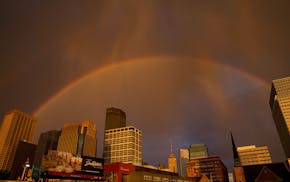
Somewhere Over The Rainbow
This is truely one of the best pictures I've seen in quite some time. Thanks to the Denali, AK National Park Service for the picture below. There has to be one massive pot of gold on the other side of those trees!
Soggy Sunday Ahead
NOAA's HPC precipitation forecast for Sunday looks a bit wet for some. Note the bigger blob of heavier rainfall over the northcentral part of the country and also down in the Gulf Coast region. Convective showers (thunderstorms) look to dump heavy pockets of rainfall (1" to 2"+ possible) in spots from PM Saturday thru PM Sunday. Note also how the West looks to stay dry.
Sunday Severe Threat
The Storm Prediction Center has issued a SLIGHT RISK of severe weather for parts of the Mid Mississippi Valley on Sunday. A fairly vigorous area of low pressure in the Midwest will help to initiate more strong thunderstorm and heavy rain potential across the northcentral part of the country.
Tornado Look-Alike?
I thought this was interesting... I was driving around the Northwest Twin Cities suburbs Friday evening and spotted a tornado look-alike! This 'feature' has been actually been reported as a tornado during stormier times in the past. As it turns out, this is actually from a powerplant! Note: It is always best to be aware of your surroundings and know what's what before reporting any scary looking clouds!

So Long Andrea
Our first named storm of the 2013 Atlantic Hurricane Season has come and gone. Other than some tornado reports on Thursday and isolated wind damage reports through the early weekend, Andrea was more of a heavy rain producer. Keep in mind that the eastern half of the country is generally drought free, so it's not necessarily busting any drought. It would be nice to see one of these tropical storms (light wind threat), slide into the Gulf of Mexico and bring rain to parts of the Rockies and the Front Range of the Rockies where the drought is at it's worst!
Soaking Eastern Rainfall
Radar estimated rainfall over the past 7 days suggests that 3" to 6"+ fell in a widespread area across the Eastern Seaboard, mostly thanks to Andrea. Note the heavier pockets of rain in the Central and Southern Plains (and Montana). Nice to see some rainfall there, where drought conditions persist. Also note how the Southwest was mainly dry during the last 7days! Unfortunately, hot and dry weather conditions are aiding in fire weather concerns.
U.S. Drought Monitor
The U.S. Drought Monitor shows the worst drought conditions in deep red over the western Plains and New Mexico, while drought conditions are worsening in the Southwest.
"The South: Modest rainfall over Arkansas and Texas led to some minor improvements this week. In Arkansas, locally heavy rainfall led to the removal of an area of Abnormally Dry (D0) in northwestern Arkansas. In the Texas Panhandle, moderate rainfall this week led to improvement from Exceptional Drought (D4) to Extreme Drought (D3). Continued longer-term dryness over west Texas and north central Texas led to expansion of areas of Exceptional Drought (D4) and Extreme Drought (D3). In southeast Texas, modest rainfall totals ranging from one to two inches led to one-category improvements from Severe Drought (D2) to Moderate Drought (D1). In east Texas, locally heavy rainfall in excess of three inches helped to improve areas of Moderate Drought (D1) and Abnormally Dry (D0). Temperatures were above normal throughout the region over the past week, with exception of northern Arkansas.
The Plains: In Oklahoma, heavy rainfall and severe weather continued this week. A sharp drought gradient has been developing between the eastern and western sections of Oklahoma. According to the Oklahoma Climatological Survey, El Reno, Oklahoma (site of the EF-5 tornado on May 31), had a 30-day total rainfall accumulation of 12.65 inches while neighboring Watonga to the west had only 2.4 inches for the same period. Much of eastern Oklahoma returned to normal or near-normal conditions, while the western one-third remained dry. This week, one-category improvements were made in central, north central, and northeast Oklahoma along the eastern edge of the drought boundary. In Kansas, heavy rainfall in excess of six inches fell over the southeastern portion, leading to one-category improvements in areas of Severe Drought (D2), Moderate Drought (D1), and Abnormally Dry (D0). In south central Kansas, improvements were made in an area of Extreme Drought (D3). Mirroring Oklahoma, the far western part of Kansas has been much drier with long-term deficits remaining, leading to a slight expansion of Exceptionally Dry (D4). In Nebraska, drought conditions eased as widespread rainfall ranging from one to five inches fell over the eastern two-thirds of the state. One-category improvements were made in areas Exceptional Drought (D4), Extreme Drought (D3), Severe Drought (D2), Moderate Drought (D1), and Abnormally Dry (D0). In South Dakota, heavy rainfall this week (two to seven inches) led to widespread one-category improvements in the northwestern quarter of the state. Temperatures throughout the region were below normal over the past week.
The West: During the last seven-day period, most of the West was generally dry, with the exception of Montana and northern Wyoming. Widespread heavy rain fell over the eastern half of Montana and the northeast quarter of Wyoming, helping to significantly improve drought conditions. Some areas of central and eastern Montana received over eight inches of rain, leading to one- and two-category improvements in southeastern Montana. The combination of recent rainfall and near-normal winter precipitation led to one-category improvements across northern Wyoming, including the removal of an area of Extreme Drought (D3) along the Wyoming-Montana border. Conditions continued to deteriorate over southern Idaho, the northern Great Basin, and southeastern Oregon as a result of below-normal precipitation throughout the winter and spring months. One-category degradations were made in these areas. In California, below-normal precipitation for the Water Year (starting October 1) and wildfire-related impacts led to the expansion of areas of Severe Drought (D2) in southern California as well as central California. Currently, the Powerhouse fire in southern California has charred over 32,000 acres, marking an early start to the wildfire season in the California. In the Four Corners region, a new area of Extreme Drought (D3) was introduced in response to below-normal precipitation throughout the winter and spring months."
See more from the U.S. Drought Monitor HERE:
Los Angeles
Since the first of the year, Los Angeles International Airport has only seen 2.61" of rainfall since January 1st. 2013 has been very dry for folks in the western part of the country. LAX airport is nearly 6" below normal precipitation since January 1st. Thanks to Paul Douglas for the pictures below from LA.


Precipitation Needed to End Drought
Take a look at how much precipitation is needed to end the drought out west! Some spots need over 12" to end the drought!

5 Day Precipitation
NOAA's HPC 5 day precipitation forecast suggests more rain for folks in the eastern half of the country vs. in the western half of the country.

Drought Oulook
Unfortunately, it looks like drought conditions will persist in the Southwest, while some improvement will be found in the Plains.
"Latest Seasonal Assessment - During the past three weeks (since May 16), an active weather pattern, consisting of a series of slow-moving storm systems tracking across the northern tier of the Nation, brought ample rainfall to the Pacific Northwest, the northern thirds of the Rockies and High Plains, much of the Great Plains, Midwest, Delta, Great Lakes Region, New England, and southern half of Florida. 3-week temperatures have averaged below normal in the Northwest , northern Rockies and Plains, and upper Midwest. Since May 1, the heaviest rains (more than 7 inches) have fallen on parts of the northern High Plains, the middle Mississippi Valley, central Great Plains, the upper and lower Delta, parts of Florida, and the southern Appalachians. In contrast, drier conditions were observed in the Southwest, the southern Rockies and High Plains, portions of the Southeast, especially Alabama, the eastern Ohio Valley, and the mid-Atlantic."
See more on the U.S. Seasonal Drought Outlook HERE:

More Excessive Heat
The National Weather Service continues EXCESSIVE HEAT WARNING for parts of the Desert Southwest through PM Sunday. High temperatures will top out in the 110s to 120s again on Sunday and will likely stick in the 100s to 110s through much of next week! WHEW!

Sunday High Temps

Thanks for checking in, have a great rest of your weekend
Don't forget to follow me on Twitter @TNelsonWNTV

ADVERTISEMENT
ADVERTISEMENT
ADVERTISEMENT