StarTribune.com
stadium042806

Home | Sports | Gophers

Stadium plans raise tax talk

A new metro sales tax along with a tax on sports merchandise would be a better way to pay for all three stadiums, various DFLers say.

Last update: April 27, 2006 - 10:08 PM

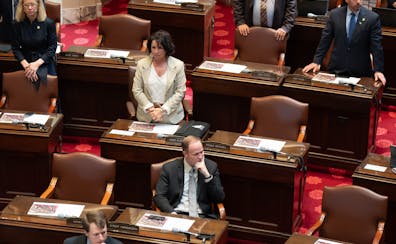
A long day of wrangling over stadium proposals in the Senate Taxes Committee yielded little progress Thursday but lots of talk about new taxes to help build $1.5 billion worth of new facilities for the Twins and Vikings and the University of Minnesota football team.

Two DFLers informally floated a plan for a half-cent sales tax increase in the seven-county Twin Cities area that would pay off the two professional stadiums within eight years while also pumping $12 billion into metro transit development over 30 years.

Republicans quickly pronounced that idea dead on arrival, and they were no more supportive of Taxes Chairman Larry Pogemiller's proposal for a 13 percent tax on all sports memorabilia to defray state costs of a Gophers stadium. With opposition from all of the GOP senators on the panel as well as from Sen. John Marty, DFL-Roseville, Pogemiller couldn't get his Gophers plan out of the committee on Thursday.

After a meeting that spanned nearly six hours, with several long recesses for informal talks among members, Pogemiller, DFL-Minneapolis, declared the committee "at a bit of an impasse" and adjourned for the evening.

The panel will reconvene today for more work on all of the stadium bills.

"We're going to pass a Gopher bill that will be signed by the governor," Pogemiller said.

Senate tinkering

While the full House has approved Gophers and Twins stadium bills in forms largely proposed by their promoters, some senators have taken to tinkering with them.

DFL Sens. Steve Kelley of Hopkins and Don Betzold of Fridley -- sponsors, respectively, of the Twins and Vikings bills -- outlined the concept of a 0.5 percent increase in the sales tax in the metro area. It would raise $220 million next year and a projected $759 million by 2036, although by 2015 all the money would go to transit.

Kelley said it would save taxpayers hundreds of millions of dollars in interest payments from the 30-year financing plans contemplated for the Twins and Vikings stadiums.

It also would allow the Twins ballpark to be built with a retractable roof and be paid off by 2011. Payments toward the Vikings stadium would begin that year and end in 2014, Kelley said.

"I think it's a better solution," he said. "It has a pretty darn good chance on the Senate floor." As for the Republicans, he said, "I hope they'll think seriously about it."

House Speaker Steve Sviggum, R-Kenyon, seemed disinclined to do that. "It's not going to happen," he said. "The Senate is trying to mess up the bills."

Pogemiller's proposal would tack on a 13 percent levy at the wholesale level on all licensed collegiate and professional sports memorabilia, including jerseys, trading cards, caps and sports equipment. That became a sticking point in a 6-6 tie vote that failed to move the Gophers bill out of the panel Thursday.

Funding differences

The Gophers bill that passed the House last week called for 25 annual state payments of $9.4 million to cover the state's 50 percent share of a 50,000-seat, open-air stadium on the university's Minneapolis campus. In addition, the university would transfer to the state a 2,800-acre tract in Dakota County that has been touted as a nature preserve but also may have pollution problems.

Other financing for the $248 million stadium under the House bill would come from student fees and parking fees, plus a $35 million naming-rights contract with TCF Financial Corp.

Pogemiller's stalled bill would eliminate the TCF deal and student fees, while increasing the state's share to $12.9 million a year over 25 years. He said his memorabilia tax proposal would honestly fund the state commitment. The House bill contains no financing source other than state general fund money that would have to be appropriated by the Legislature beginning next year.

Proposals call for increasing the sales tax in Hennepin County by 0.15 percent for the Twins project and by 0.75 percent in Anoka County for the Vikings stadium.

With a roof added, the price of the 42,000-seat Twins ballpark in downtown Minneapolis would rise from the current estimate of $522 million to $605 million. For the Vikings' proposed 70,000-seat retractable-roof stadium in Blaine, the full cost would be $675 million.

Vikings owner Zygi Wilf is expected to join other team officials who hope to testify before the Taxes Committee today.

Conrad deFiebre • 651-222-1673

Staff writer Paul Levy and the Associated Press contributed to this report.


Comment on this story  |  Read all 0 comments  |  Hide reader comments

Subscribe
Shopping + Classifieds
Renter's Reward

Get $125 When You Move

No catch. We pay renters when they sign a new rental lease. Learn more.
Dog Classified

New Home Wanted

Hundreds of puppies and dogs seeking new homes. Find one now!

Win tickets to the 416 Club with host Jim Walsh at Cedar Cultural Center.

Vita.mn presents the 416 Club with host Jim Walsh at Cedar Cultural Center on Jan. 17.

See all contests