Get personalized candidate information and election results.
Legislators passed major budget bills, not knowing whether the governor would veto them and possibly call a special session.
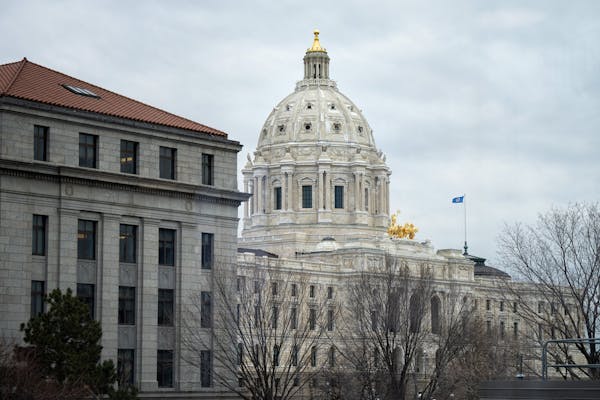
The 2007 legislative session lurched Monday night to one of the most unusual finishes in memory, leaving Gov. Tim Pawlenty to decide single-handedly whether it succeeded or faltered.
Lacking the overall agreement that typically provides the guardrails for last-minute bill passage, legislators voted on major budget bills Monday without knowing whether Pawlenty would veto those bills and possibly call the Legislature back into special session.
Adding to the drama, shortly before the midnight deadline, House DFLers suddenly made good on their threat to take up an override of the governor's transportation bill veto.
On a roll-the-dice strategy, it halted discussion of the tax bill and pushed through a vote on a transportation bill that would increase gasoline taxes and fees.
The vote failed 83-50, falling seven votes short of the needed two-thirds majority.
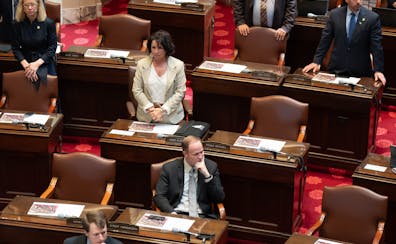
As chaos broke out on the House floor, with members shouting over one another, House Speaker Margaret Anderson Kelliher pushed through the tax bill at midnight, ignoring requests by Republican legislators to speak.
When the tax bill passed, House Minority Leader Marty Seifert, R-Marshall, predicted that Pawlenty would veto the bill, which contains homeowner property tax relief and local government aids. Pawlenty, he said, had made plain his opposition to a last-minute provision to restore inflationary increases to the state budget forecasts.
"It's a poison pill placed in the bill by the Senate," Seifert said. "They've got a whole medicine chest of them."
Hours earlier, Pawlenty had described the end of the session as a "leap of faith," noting that he was "not entirely sure" what was in the bills and reserved his right to veto or line-item veto bills over the next few days. He can line-item veto spending appropriations only.
Pawlenty said he closed negotiations at midday because DFL leaders kept angling for more money for health and human services and K-12 education.
"They just ran out of time," he said. "I just shut it down and said, 'Wrap it up as best you can, treat us fair.' "
Despite the lack of an agreement, all sides professed satisfaction with the session's outcome. Kelliher ticked off her list, citing the expansion of health care to 30,000 Minnesota children and 20,000 adults, additional all-day kindergarten, stabilized school funding and conservation advances.
"We may not have had the customary handshake, but I'll tell you, it's a deal that's going to last," Kelliher said just before the debate on transportation and taxes. The prolonged debate forced the House to adjourn without passage of a constitutional amendment to fund the outdoors and arts and without a bonding bill that was to have funded projects across the state.
Typically, by the last day of the session, it becomes apparent whether everything is coming together or falling apart, but late on Monday night either outcome remained possible.
There's no agreement on vetoes or line-item vetoes," Senate Majority Leader Larry Pogemiller, DFL-Minneapolis, said earlier in the evening. "We've come to the point where not every item can we agree to. ... We're simply going to process these bills. There's nothing more I can do."
All options open
By late evening, the House and Senate had worked through much of the budget, including spending bills for schools, health and human services and a bare-bones transportation bill, but several major pieces, including the tax bill, remained in doubt.
Pawlenty will have three days to veto whatever bills legislators send him, but can apply a line-item veto to spending only. If he has disagreements on the policy in a bill, he either must sign the bill anyway or veto the entire bill.
"We're holding all our options open," Pawlenty's spokesman Brian McClung said.
The session had started out with high hopes all around. DFLers had won super-sized majorities in the House and Senate and set out ambitious agendas that would have, at one point, extended health insurance to all Minnesota children, cut college tuition costs, expanded all-day kindergarten and preschool, and pumped hundreds of millions of dollars into property tax relief and local government aids.
Shortly after his narrow re-election, humbled by his 1 percent victory margin in a strong DFL year, Pawlenty had pledged cooperation with the new majorities.
But when the scope of the DFL agenda became apparent early in the session, harmony vanished. To pay for their proposed spending, DFLers trotted out one tax increase after another, capping them with a Senate proposal for a tax on the state's top wage earners that would have produced the highest marginal income tax rate in the nation.
Despite polls that showed the tax-the-rich proposals had public support, DFLers never gained traction, running headlong into a gubernatorial wall. Pawlenty remained adamant that the 9.8 percent in new spending he had proposed was sufficient, effectively suffocating most DFL initiatives.
As Pawlenty vetoed bill after bill, DFLers yielded a string of concessions, unable to pick off enough Republican votes to achieve two-thirds majorities and override Pawlenty.
On Monday night, Pawlenty counted among his victories staving off what he said would have been more than $5 billion in new taxes from the DFL, but said there also had been bipartisan gains, such as a nation-leading renewable energy standard passed early in the session.
With much of the session's most serious deals made in the middle of the night, some legislators complained of closed-door mischief, such as a short-lived attempt to allow St. Paul to levy a 3 percent food and beverage tax that was made in the pre-dawn hours on Monday and pulled by evening.
Important gains
Kelliher said that DFLers had still made some important gains during the session, and expressed hope that Pawlenty would sign their bills.
A veto of the tax bill, she said, "would be disappointing." She blamed Republican legislators for the last-minute turmoil, accusing them of attempting to force a special session. "Because of that behavior, dedicated funding (of the outdoors and arts) and a bonding bill were left on the side of the road and that is unfortunate," she said.
Patricia Lopez 651-222-1288 plopez@startribune.com
| McCain |
|
$181,090,376 | |
| Obama |
|
$401,311,983 | |
| $582,402,359 | |||
|
Minnesota Contributions
|
|||
| McCain |
|
$1,136,506 | |
| Obama |
|
$2,705,649 | |
| $3,842,155 | |||
![]() Open positions!A new career awaits. Look through thousands of listings to find your new job. Start now!![]() $125 Cash Signing BonusChoose one of hundreds of apartments to lease and we'll send you $125. Learn more. |
Comment on this story | Read all 0 comments | Hide reader comments