Tuesday: Pawlenty signs Haryana sister-state agreement
Plans are to focus on food processing and cold-food distribution, information technology, medical technology and renewable energy.
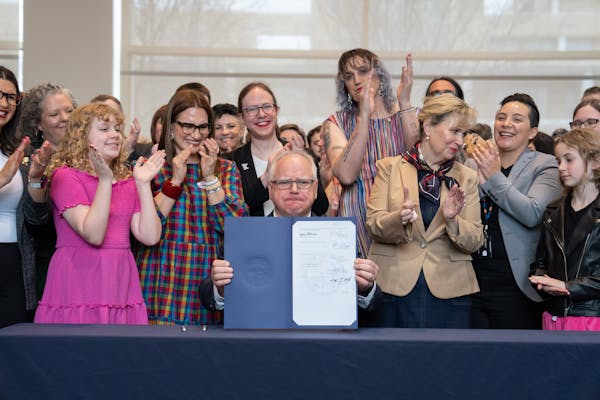
NEW DELHI - Gov. Tim Pawlenty made history Tuesday by signing India's first sister-state agreement, tying Minnesota to the Indian state of Haryana, the most prosperous section of the country.
The ceremony at an elegant Hyatt Regency was called an important first step in boosting trade between Minnesota and Haryana, which lies just west of New Delhi, has a population of 22 million and attracted $1.8 billion in foreign investments last year.
The pact is only the second for Minnesota, which signed its first such deal with China's Shaanxi state 25 years ago.
Haryana's chief minister, Bhupinder Singh Hooda, the equivalent of a U.S. governor, said in signing the agreement that he would like to focus on several key trade initiatives, including helping to bring more badly needed food processing, packaging, cold storage and distribution capabilities to India.
He said India is also seeking contracts involving clean energy, information technology and medical technology products.
Pawlenty noted privately that about 40 percent of India's fruits and vegetables end up rotting because the country lacks cold storage facilities. Traveling to and from the city of Agra on Sunday, Pawlenty saw firsthand how many rural families make do without electricity, and carts of limes, bananas and other fruit that sit open to the elements for days.
Because Minnesota is home to General Mills and Land O'Lakes, and to trade-mission delegates from transportation logistics firm C.H. Robinson and electrical appliance retailer Best Buy, Pawlenty and Haryana officials said they hope future contracts could help improve food conditions.
In addition to the practical business partnerships that are likely to evolve between the new sister states, the document signed Tuesday is also expected to foster educational and cultural exchanges, Pawlenty said.
"At the onset of our decision to lead this mission to India, we set forth an objective [to] build relationships with India that would enhance our mutual understanding and our mutual prosperity," Pawlenty said. "I can't think of a more appropriate and impactful way to do that other than to enter into a formal agreement committing our respective states to continue dialogue and to continue interaction and exchanges."
The governor publicly praised state Sen. Satveer Chaudhary, DFL-Fridley, for his role in making the historic agreement happen. Chaudhary, the first Indian to be elected a state senator in the United States, was visibly moved.
"For me this is personal," Chaudhary said. "This is my ancestral home ... and this [agreement] is my dream. Minnesota is the Haryana of the United States. We have so many similarities," including a strong agricultural history along with representation in the high-technology and biotechnology industries.
To loud applause, he continued, "This is a tremendous occasion, and I have to say, a very personal one for me."
Haryana, which exported $7 billion worth of products last year, already is home to scores of big U.S. businesses, such as Whirlpool, Goodyear, Duracell, IBM and Samsung.
Visiting a hospital
Delegates spent the rest of Tuesday visiting the posh and private Fortis Hospital with First Lady Mary Pawlenty. The hospital, a leading-edge cardiac, brain and spinal care facility with the highest technology, works regularly with Medtronic. The hospital not only buys Medtronic's stents, pacemakers and defibrillators, it also hires Medtronic to instruct its doctors in the latest procedures, said Medtronic International director Trevor Gunn, who flew in for the day's event. Medtronic has 150 employees in India.
Other delegates spent time at India's Ministry of the Environment and Forest, hoping to learn more about what India needs as it continues to improve its dismal infrastructure, sewage and water systems.
Ministry Secretary Meena Gupta praised the meeting as an "excellent first step" in learning about several Minnesota's technologies that could be of interest to her colleagues. She said that India has reverse-osmosis water cleansing systems but is still struggling with air pollution and solid-waste management.
"We were wondering whether your companies could give us technology that might help. We have a challenge," she said. "Learning to what extent you can help us in manufacturing biodegradable plastics would be relevant to us."
Minnesota delegates from synthetic gas maker Coronal, wastewater systems firm Aeration Industries, diesel emission controls firm EPS Technologies, and meat processing equipment firm Alloy Hardfacing said they were disappointed that Gupta failed to discuss how their companies and her government could work together. However, Gupta said her ministry is mainly in charge of regulations, not contracts. She suggested that the delegates talk to sector heads and the Ministry of Industries.
Delegates flew to Bangalore, India, last night and will meet today with Minnesota companies already doing business in India, such as General Mills, 3M, IBM and ADC Telecommunications.
Dee DePass ddepass@startribune.com